
You are miles from the nearest paved road on a remote job site, the sun is dipping below the horizon, and your truck’s engine gives you nothing but a hollow click. You reach for that cheap lithium pack you bought online, but after two attempts, it’s as dead as your battery. It’s a frustrating, potentially dangerous situation that every professional fears. Most people find technical jargon like Peak Amps versus Cold Cranking Amps confusing, which often leads to settling for underpowered gear that fails when it matters most.
We believe you deserve equipment that works the first time, every time, regardless of whether you’re reviving a heavy-duty diesel or a standard passenger vehicle. This guide will help you cut through the marketing noise to find a truck & car battery jump starter that actually delivers on its promises. You’ll discover how to select a heavy-duty tool with the professional reliability needed to handle high-displacement engines. We will break down the specific ratings that matter for truck engines and provide a clear recommendation for a tool built to last years in the field.
Key Takeaways
- Stop relying on a second vehicle and learn how a self-contained power station provides total independence on remote job sites.
- Decode technical specs like Peak Amps to select a truck & car battery jump starter that can reliably handle high-displacement truck engines.
- Compare lithium-ion and lead-acid architectures to find the right balance between lightweight portability and long-term shelf life for your gear.
- Master modern safety protocols, including spark-proof technology, to ensure you never damage sensitive vehicle electronics during a recovery.
- Learn how to integrate your jump starter into a professional roadside kit alongside tools like a portable 12v tire inflator for ultimate reliability.
The Evolution of Roadside Recovery: Why a Truck & Car Jump Starter is Non-Negotiable
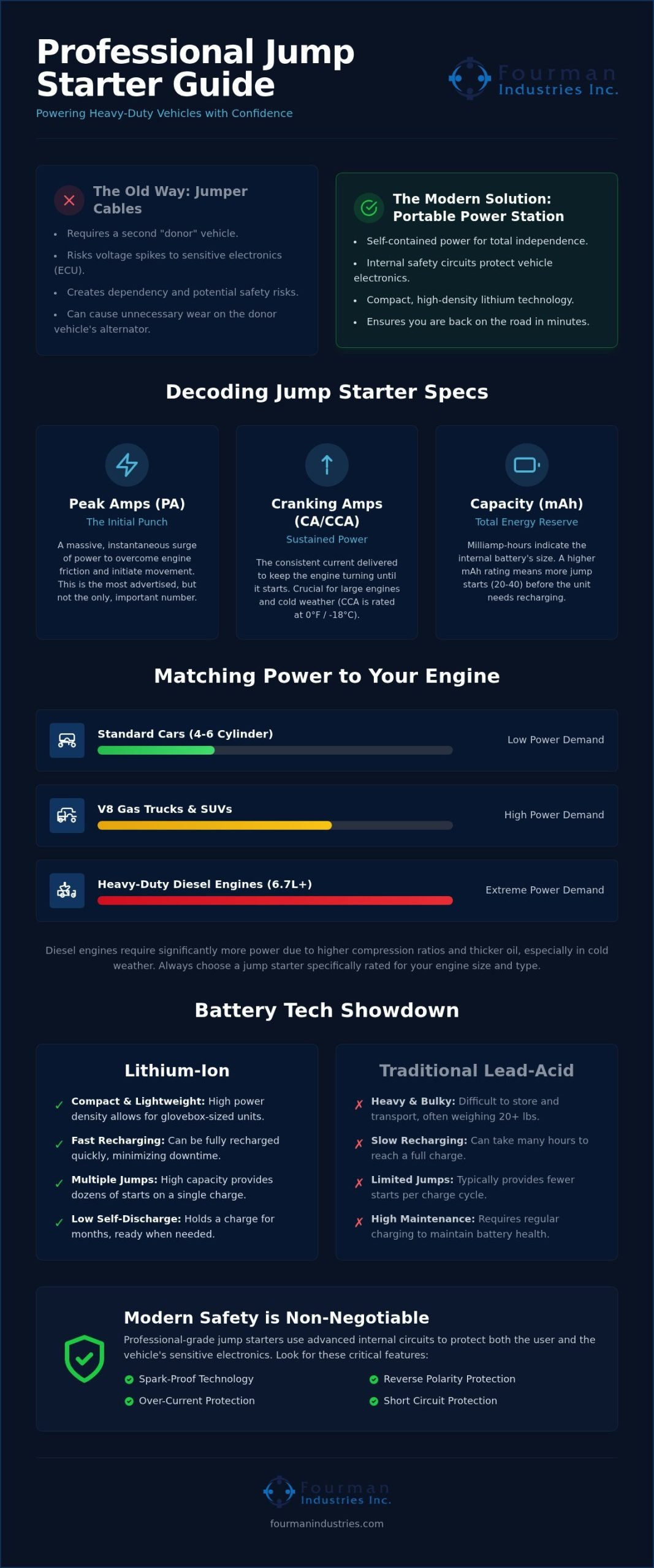
Modern roadside recovery has moved far beyond the days of heavy, leaking lead-acid boxes. Today, a professional truck & car battery jump starter functions as a self-contained power station. These units utilize high-density lithium-ion technology to pack thousands of amps into a chassis small enough for a glovebox. This shift isn’t just about saving space; it’s about professional independence. When you’re operating on a national scale or working remote job sites, you cannot afford to wait for a donor vehicle that might never arrive.
Relying on another driver for a jump-start is a major liability. It puts your schedule in someone else’s hands and creates a safety risk in isolated areas. For a professional, time is the most valuable currency. A dead battery shouldn’t result in hours of lost labor or missed deadlines. Carrying your own power source ensures you’re back on the road in minutes, maintaining total control over your workday and your safety.
Jumper Cables vs. Portable Jump Starters
Traditional jumper cables are becoming a relic of the past. Modern 2026 vehicles are packed with sensitive Engine Control Units (ECUs) and complex sensors. Using cables to bridge two vehicles creates a risk of voltage spikes that can fry these expensive electronics. Portable units eliminate this risk by using internal safety circuits to regulate power flow. You also avoid the “waiting game.” Instead of flagging down a stranger and hoping they have a compatible battery, you handle the situation yourself. This keeps your crew moving and prevents the unnecessary wear on a second vehicle’s alternator.
The Critical Difference in Truck Requirements
You can’t expect a basic consumer-grade pack to handle a heavy-duty rig. Truck engines, especially diesel variants, have high compression ratios and much thicker oil. They require a massive, sustained burst of energy to overcome internal friction. This is where high-amperage discharge becomes vital. A professional truck & car battery jump starter is engineered to provide that initial “punch” needed to turn over high-displacement engines without overheating. Understanding these power demands is the first step toward choosing a tool that won’t let you down. For a deeper look at the mechanics of the process, check out our guide on how to safely use a car jump starter.
Decoding the Specs: Peak Amps, Cranking Amps, and Engine Displacement
Peak Amps are the most advertised number on any truck & car battery jump starter. Think of this as the initial punch. It’s the massive surge of electricity required to break the engine’s internal friction and get the pistons moving. Once that movement starts, the unit transitions to Cranking Amps to keep the engine turning until it fires. While a gas engine might only need a quick jolt, diesel engines require a sustained, high-amperage flow due to their massive compression ratios.
Temperature also plays a huge role in performance. In freezing weather, engine oil thickens like molasses and battery chemistry slows down. You need a unit that accounts for this “cold soak” effect. If your gear isn’t rated for the environment, that Peak Amp rating won’t mean much when the mercury drops. Professionals working in northern climates should prioritize units with higher discharge ratings to compensate for these efficiency losses.
Matching the Tool to Your Engine Size
Small 4-cylinder cars are easy to wake up. Most basic consumer packs handle them without breaking a sweat. However, once you move into V8 territory, the power demands climb significantly. Then there’s the “Diesel Tax.” A 6.7L Cummins or Powerstroke engine needs a specialized heavy-duty pack because the energy required to compress air enough for ignition is far greater than sparking a gas mixture. For lithium jump packs, Cold Cranking Amps (CCA) represent the amount of current the unit can consistently deliver for 30 seconds at 0 degrees Fahrenheit while maintaining a usable voltage level.
The Importance of Capacity for Fleet Use
If you’re managing a fleet, the mAh (milliamp hours) rating is your best friend. This number tells you the total energy capacity of the internal battery. While Peak Amps get the engine started, mAh determines how many times you can do it before the pack needs a recharge. A high-capacity unit might give you 20 to 40 jumps on a single charge. This is essential if you’re jumping multiple vehicles across a job site throughout the week.
Many professionals also use these units as a mobile power bank. You can charge phones, tablets, or even power small diagnostic tools when you’re away from a wall outlet. For those who need reliable power back at the shop to keep these units topped off, understanding The Complete Guide to 12 Gauge Extension Cords ensures your charging station is just as rugged as your portable gear. If you’re tired of gear that quits when the work gets tough, it’s time to invest in a professional-grade truck & car battery jump starter from a partner you can trust.
Lithium-Ion vs. Lead-Acid: Which Architecture Fits Your Fleet?
Choosing the right truck & car battery jump starter architecture depends on your specific operational needs. For decades, heavy lead-acid “jump boxes” were the only game in town. These units are essentially a car battery with a handle; they are reliable but incredibly heavy and lose their charge quickly if left in a trunk. Modern lithium-ion units have flipped the script by offering a superior weight-to-power ratio. You can now get thousands of peak amps from a device that weighs less than five pounds, making it easy to carry into tight spots or store under a seat.
Lithium units also win on shelf life. They stay charged for months without maintenance, whereas a lead-acid unit needs a recharge every few months to prevent the internal plates from sulfating. When you analyze the cost-per-jump over the life of the tool, lithium often comes out ahead. High-quality lithium cells can handle up to 1,000 charge cycles. While the initial investment might be higher, the longevity and lack of maintenance make it a smarter long-term play for busy fleets and independent contractors alike.
You might have heard stories about lithium batteries swelling or failing. In professional-grade equipment, this is largely a myth. High-quality packs include sophisticated Battery Management Systems (BMS). These controllers prevent overcharging and manage heat during high-discharge events. Cheap, unbranded packs lack these protections, which is where the reputation for swelling comes from. Stick to professional gear to ensure your tool remains stable, safe, and ready to work.
Lithium-Ion: The Choice for Portability
For most mobile professionals, lithium is the clear winner. It’s the ultimate 12v automotive accessory because it doesn’t take up half your tool chest. Modern units even feature USB-C ports, allowing you to charge the pack from your vehicle’s dashboard while driving between jobs. The built-in safety controllers also provide peace of mind by preventing sparks if you accidentally touch the clamps together, making the recovery process faster and less stressful.
Lead-Acid: The Shop Standard
Don’t count out the old guard just yet. If you run a fixed workshop where the unit stays on a rolling cart, a lead-acid station is a powerhouse. These units are built for high-impact industrial environments where they might get knocked around. They also perform exceptionally well in extreme, sustained cold. While lithium chemistry can sometimes struggle to output full power at sub-zero temperatures without a “warm-up” jump, lead-acid remains a steady shop standard for heavy-duty recovery.
Safety Protocols and Proper Jump-Starting Technique for Modern Electronics
Using a truck & car battery jump starter incorrectly can lead to more than just a failed start; it can cause permanent damage. Start by turning off all lights, heaters, and accessories in the dead vehicle. Connect the red positive clamp to the positive terminal of the battery first. Then, attach the black negative clamp to a solid, unpainted metal part of the vehicle’s frame or engine block. Once the connections are secure, power on the jump starter and attempt to fire the engine. After the vehicle starts, power off the unit and remove the clamps in the exact reverse order.
Spark-proof technology is a non-negotiable feature for 2026. Older jumper cables often created massive sparks upon contact, which could ignite hydrogen gas near the battery. Modern professional units use internal sensors to ensure electricity only flows when a complete, correct circuit is detected. This works alongside reverse polarity protection. If you accidentally cross the cables, the unit will alert you with a light or sound and refuse to send power, preventing a catastrophic short circuit that could melt your battery terminals.
Sometimes, a battery is too far gone to save. If your jump starter indicates a “fault” or won’t initiate even with a full charge, the battery might be “bricked.” This usually happens when the internal plates are physically damaged or the voltage has dropped to near zero for too long. In these cases, attempting to force a jump can be dangerous. It’s better to pull the battery and have it professionally tested rather than risking your jump starter or the vehicle’s electrical system.
Protecting Your Vehicle’s Computer
Modern vehicles rely on sensitive Engine Control Units (ECUs) that don’t handle voltage spikes well. A sudden “load dump” or surge during a jump can fry these boards, leading to thousands of dollars in repairs. Professional units prevent this by regulating the output voltage to a steady 12v. Most high-end units also feature a “Boost” button. Use this only when the battery is so dead it can’t even be detected, as it bypasses safety checks to deliver maximum current. For maximum safety, always connect the negative clamp to a clean, unpainted metal surface on the vehicle’s frame or engine block to ensure a solid ground away from the battery.
Maintenance and Storage for Long-Term Reliability
A truck & car battery jump starter is only useful if it’s charged when you need it. Check the battery level every three to six months and top it off if it drops below 80%. Avoid storing the unit in extreme heat, like a sun-drenched dashboard, as high temperatures degrade lithium cells quickly. During winter, keep the unit in a climate-controlled area if possible, as extreme cold can temporarily reduce the power output. When you’re back at the shop, using The Best Heavy Duty Outdoor Extension Cords for 2026 ensures your charging station stays powered up and ready for the next emergency. Equip your fleet with a professional truck & car battery jump starter from Fourman Industries to ensure your crew stays safe and productive.
Building Your Professional Roadside Kit at Fourman Industries
A high-quality truck & car battery jump starter is more than just a tool; it’s a vital piece of job site insurance. When you’re managing a fleet or working as an independent contractor, you can’t view your equipment in isolation. Professional readiness means building a cohesive ecosystem of hardware that addresses multiple failure points simultaneously. A dead battery is often just the first symptom of a vehicle that’s been sitting too long or pushed too hard in extreme conditions.
By treating your recovery gear as a complete kit, you eliminate the frantic search for individual tools when an emergency strikes. High-visibility cases and professional branding aren’t just for show. They ensure your gear is easily identifiable in a crowded truck bed and less likely to be left behind on a busy site. Investing in a professional-grade truck & car battery jump starter is the first step toward a proactive maintenance strategy that keeps your crew moving and your overhead low.
Integrating Your Automotive and Industrial Tools
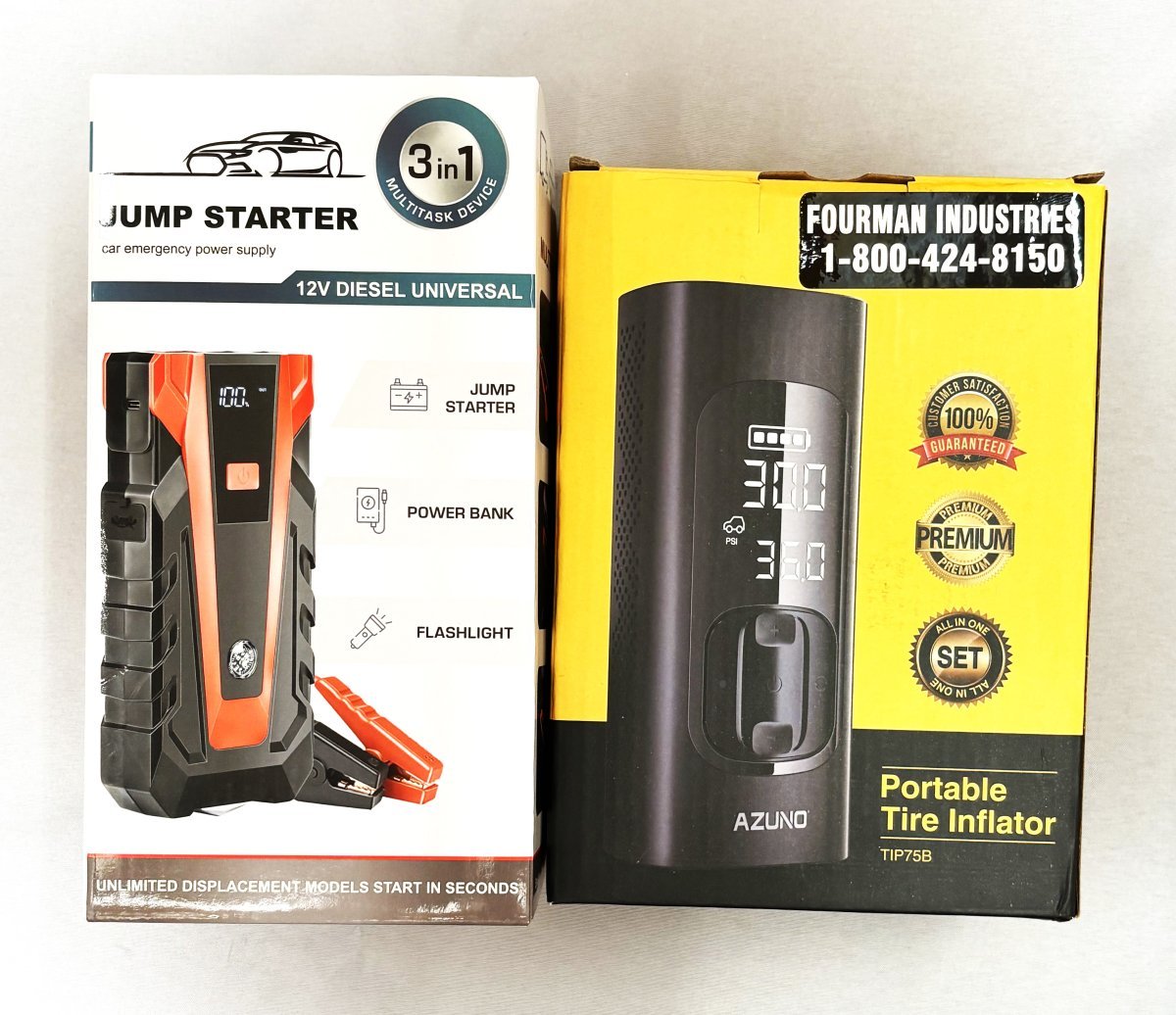
True roadside independence requires more than just a spark. We recommend pairing your jump starter with a Portable 12v Tire Inflator Kit. These two tools solve the most common “vehicle-down” scenarios without requiring a tow truck. While the jump starter handles the engine, the inflator ensures your tires are at the correct pressure for heavy loads. This combination is especially effective for trailers that have been parked for weeks between jobs. For a comprehensive look at building a complete vehicle emergency setup, our guide on emergency car kit essentials covers the modern, high-performance tools every professional should carry.
Organization is the enemy of downtime. We offer custom printed extension cords that allow you to color-code your charging stations and identify your property instantly. This level of organization prevents the common problem of tools “walking away” from the job site. If you’ve struggled with missing equipment in the past, take a moment to read our guide on how to Prevent Extension Cord Theft to protect your investment.
Why Fourman Industries for Your Roadside Needs?
Since 1997, Fourman Industries has focused on providing the rugged hardware that professionals actually need. We understand that a tool failing on a remote site isn’t just an inconvenience; it’s a loss of revenue. Our national reach allows us to support fleet managers and tradespeople across the country with heavy-duty gear that stands up to industrial use. We don’t just sell products; we provide the reliability you need to finish the job on time.
Don’t wait for the next cold snap or dead battery to discover the gaps in your recovery kit. Equip your vehicles with the power and performance they deserve. Visit the Fourman Industries automotive collection today to find your next truck & car battery jump starter and build a kit that’s as hardworking as you are.
Secure Your Fleet’s Future with Professional Grade Power
Choosing the right equipment means looking past the marketing hype and focusing on the specs that actually turn over a heavy-duty engine. You’ve learned that matching peak discharge rates to your engine’s compression is the difference between a successful recovery and a wasted morning. Whether you’re managing a national fleet or a single rig, having a reliable truck & car battery jump starter ensures you aren’t at the mercy of a second vehicle or a tow truck. Protecting your modern electronics with spark-proof technology is a non-negotiable standard for the job sites of 2026.
Since 1997, Fourman Industries has focused on providing rugged hardware specifically designed for industrial job sites. We provide national shipping across the United States to keep your crew powered up no matter where the work takes them. Don’t let a dead battery stall your progress or damage sensitive electronics. Equip your fleet with the professional Truck & Car Battery Jump Starter from Fourman Industries today. You’ve got the knowledge to make the right choice; now get the gear that works as hard as you do.
Frequently Asked Questions
Can a car jump starter really start a heavy-duty diesel truck?
Yes, provided the unit has a high enough peak amp rating and discharge capacity. Diesel engines have much higher compression ratios than gasoline engines, which means they require significantly more energy to turn over. A professional-grade truck & car battery jump starter designed for high-displacement vehicles can handle these loads easily. Standard consumer models will likely fail because they can’t provide the sustained current needed for a large diesel block.
How many peak amps do I need for a V8 truck engine?
You should look for a minimum of 1,000 to 2,000 peak amps for a standard gasoline V8 engine. If you are starting a large diesel V8, like a 6.7L, aim for units offering 3,000 peak amps or more. Higher amperage ensures the tool can overcome the internal friction of larger pistons and thicker oil. This is especially important during cold weather starts when battery efficiency naturally drops.
Is it safe to leave a lithium jump starter in a hot car during summer?
Avoid leaving lithium units in direct sunlight or on a dashboard where temperatures can exceed 150 degrees Fahrenheit. While high-quality packs include thermal protection, extreme heat degrades battery cells and reduces their overall lifespan. Store your unit in a tool chest, under a seat, or in the trunk. This keeps it away from intense heat and ensures the hardware remains reliable when you actually need it.
How long does a portable jump starter hold its charge when not in use?
Most modern lithium-ion units hold a functional charge for six to twelve months. However, we recommend checking the battery level every three months to ensure it stays above 80%. This practice prevents deep discharge, which can permanently damage the internal cells. Keeping it topped off ensures you aren’t stranded when an emergency happens on a remote site. Regular maintenance is the key to professional-grade readiness.
What is the difference between peak amps and cranking amps?
Peak amps represent the initial, split-second burst of energy used to break the engine’s internal friction. Cranking amps are the sustained power delivered over several seconds to keep the engine turning until it starts. Think of peak amps as the “punch” that starts movement and cranking amps as the “muscle” that finishes the job. Both ratings are critical when you’re dealing with high-displacement truck engines in tough conditions.
Do I still need jumper cables if I have a portable jump starter?
You don’t strictly need them, but some professionals keep them as a last-resort backup. A portable truck & car battery jump starter is superior because it works independently without a second vehicle. It also protects sensitive vehicle computers from the voltage spikes that often occur with traditional cables. Relying on a self-contained unit is safer and much faster when you’re working alone on a remote job site or in tight spaces.
Can I use my jump starter to power other 12v tools or devices?
Yes, many professional units feature 12v DC outlets or USB ports to power various accessories. You can run a portable tire inflator, charge a laptop, or power diagnostic equipment directly from the pack. This versatility makes the unit a valuable mobile power station for your entire kit. It extends the tool’s utility beyond just starting dead batteries, making it a true multi-purpose asset for any service vehicle.
What should I do if my jump starter won’t turn over the engine on the first try?
Wait at least 30 to 60 seconds between attempts to allow the jump starter’s internal components to cool down. If the vehicle battery is completely flat, you might need to engage the “Boost” mode to bypass safety checks. Never attempt more than five consecutive jumps in a short period. If the engine doesn’t fire after several tries, the battery may be physically damaged or the starter motor might have failed.




