
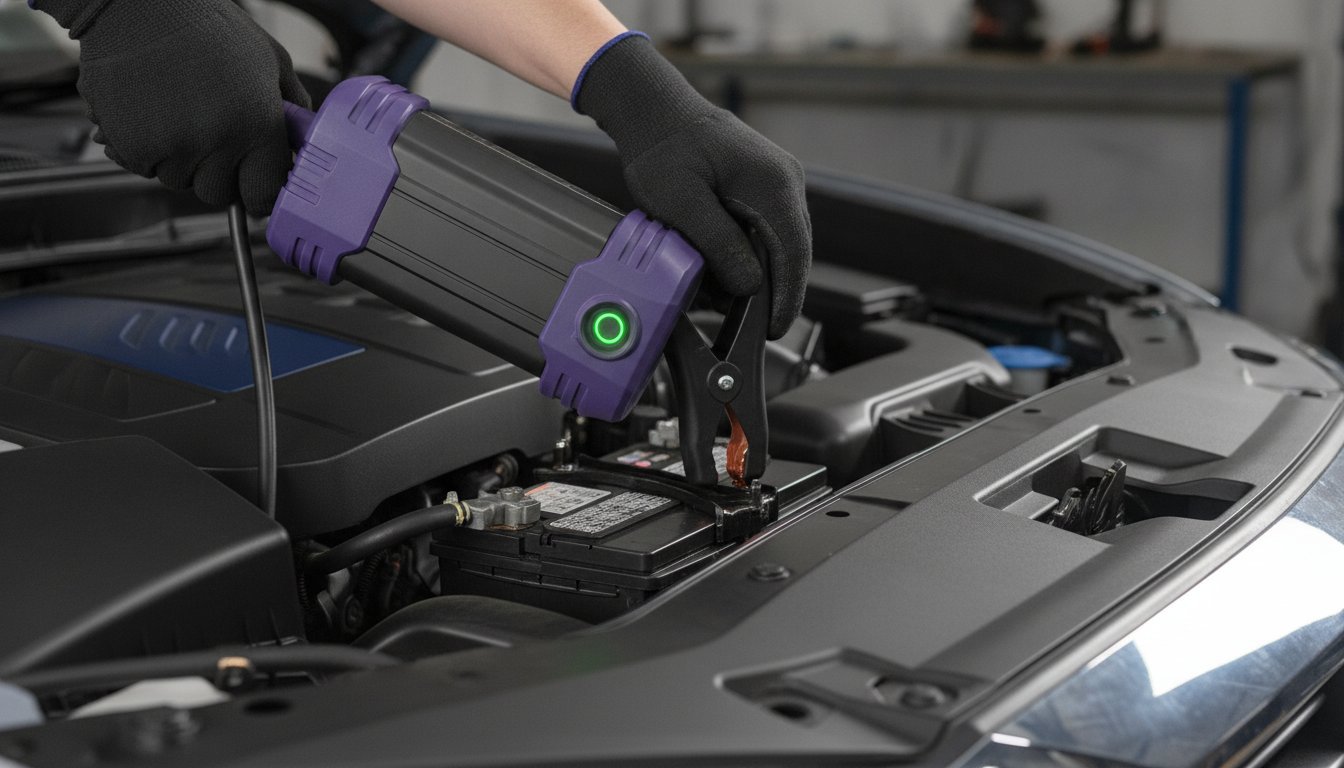
What if the simple act of trying to save your dead battery ends up frying your car’s expensive engine control module? It’s a real risk if you don’t follow the proper sequence. When you’re stranded alone, the pressure to get moving can lead to costly mistakes. Learning how to safely use a car jump starter isn’t just about getting a spark; it’s about protecting the sophisticated computers that run your modern vehicle.
We understand that staring at those heavy duty clamps can be intimidating. The fear of electrical sparks or a dead device is enough to make anyone feel anxious. You want a solution that works the first time, every time. This guide delivers the exact professional protocols needed to jump-start your vehicle independently and with total confidence. We’ll cover the specific connection order, the essential safety checks you can’t skip, and how to maintain your Truck & Car Battery Jump Starter so it’s always ready when you need it most.
Key Takeaways
- Master the exact connection sequence to protect your vehicle’s sensitive electronics and avoid dangerous hydrogen gas build-up.
- Learn how to safely use a car jump starter by correctly identifying battery terminals and following a strict power-down protocol.
- Ensure your equipment is always road-ready by understanding charging cycles and the “ready when you need it” maintenance rule.
- Select the right gear for your ride by comparing peak versus cranking amps to ensure your power source matches your engine size.
- Gain total roadside independence by switching from traditional cables to a self-contained Truck & Car Battery Jump Starter.
Understanding Portable Jump Starters and Roadside Safety
A portable jump starter is a self-contained battery system designed to give your engine the high-amperage kick it needs to turn over. Think of it as a specialized, industrial-grade power bank for your vehicle. Gone are the days of standing on a dark shoulder with jumper cables in hand, hoping a stranger pulls over to help. In 2026, roadside safety is about independence. Relying on another vehicle’s charging system is an outdated practice that can actually put modern alternators at risk.
The shift toward portable units has changed the game for DIY reliability. These devices allow you to manage a dead battery without a second car, which is vital when you’re off the grid or in a deserted parking lot. However, having the tool is only half the battle. You must respect the power it holds. Safety in this context is all about controlling the flow of high-current electricity. When you learn how to safely use a car jump starter, you aren’t just starting a motor; you’re protecting your vehicle’s sensitive computer systems from a catastrophic surge.
How Portable Units Differ from Jumper Cables
The primary advantage of a portable unit is total autonomy. You don’t need to flag down help or position two cars nose-to-nose in a dangerous traffic lane. Beyond convenience, modern units like a professional-grade Truck & Car Battery Jump Starter include internal safety features that traditional cables lack. These include:
- Reverse Polarity Protection: The unit detects if you’ve crossed the positive and negative clamps. It will alert you or refuse to fire, preventing a short circuit.
- Spark-Proof Technology: Most units won’t send power to the clamps until they sense a solid, correct connection. This eliminates those intimidating initial sparks that can ignite battery gases.
- Compact Portability: These tools are small enough to store under a seat or in a tool chest, yet they deliver enough cranking amps to start a heavy-duty truck engine.
Pre-Jump Safety Assessment
Before you reach for the power button, perform a quick visual inspection. Your battery is a chemical factory, and things can go wrong. Look for these specific red flags to ensure you are learning how to safely use a car jump starter without causing an accident:
- Casing Damage: If the battery case looks bloated, cracked, or is leaking fluid, do not attempt to jump it. This suggests internal failure or a frozen core.
- Environmental Hazards: Ensure there are no puddles of gasoline or flammable vapors nearby. Lead-acid batteries vent hydrogen gas during discharge, which is highly explosive.
- Personal Safety: Remove metal jewelry like rings or watches. These act as conductors if you accidentally touch a live terminal. If you have safety glasses in your emergency kit, put them on now.
The Safe Jump-Starting Sequence: A Step-by-Step Guide
First, kill the power. Before you even touch your gear, ensure the vehicle is completely dormant. Switch off the headlights, the radio, and the air conditioning. Modern car computers are incredibly sensitive to voltage spikes. Reducing the electrical load before you begin ensures the jump starter’s energy goes exactly where it’s needed: the starter motor. It also prevents accidental fuses from blowing when the current hits the system.
Next, pop the hood and locate your battery. Look for the symbols stamped into the plastic or metal. The ‘+’ sign usually has a red cap or a red wire attached to it. The ‘-‘ sign is usually black. If the terminals are covered in white, crusty corrosion, give them a quick scrub with a wire brush or a dry cloth. A clean connection is a safe connection. Learning how to safely use a car jump starter begins with this simple visual confirmation.
Connecting the Clamps Correctly
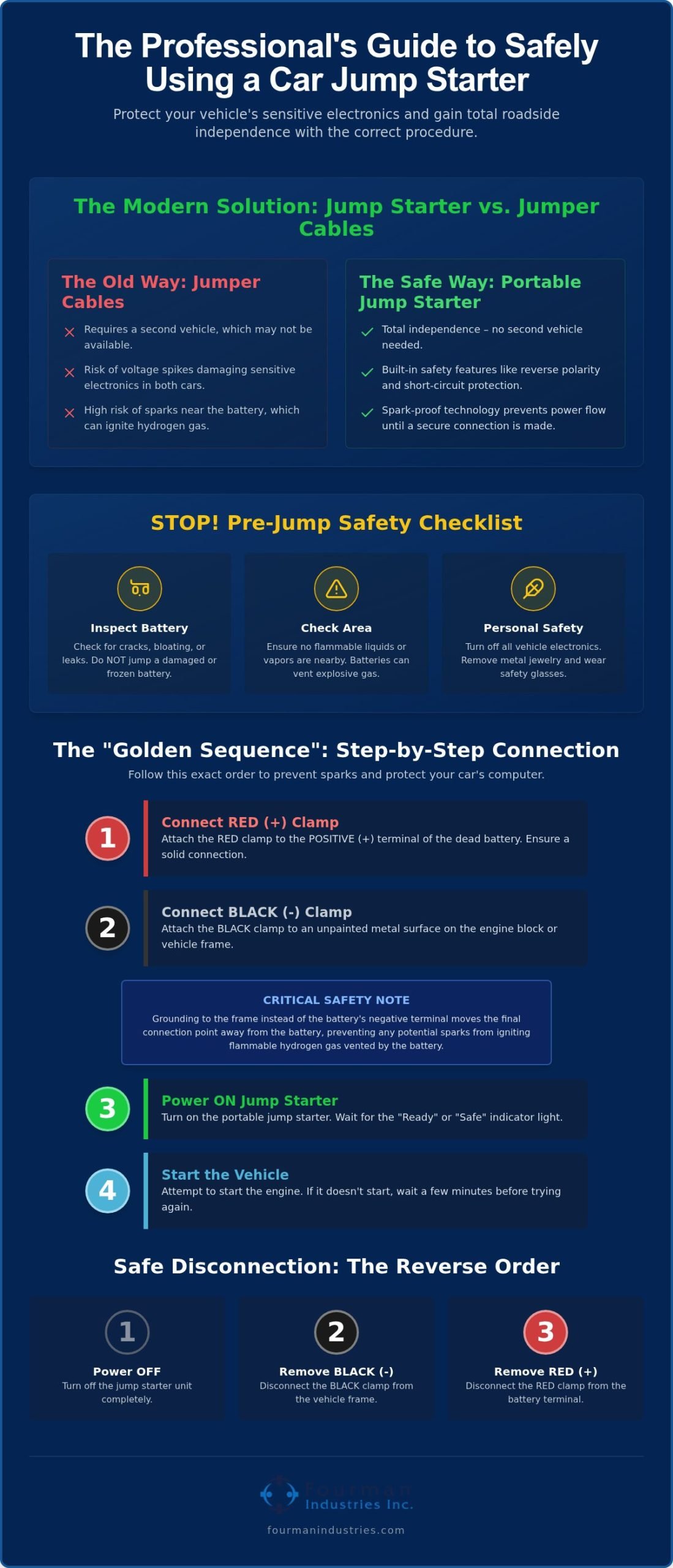
- Step 1: Connect the RED (positive) clamp to the positive terminal of the dead battery.
- Step 2: Connect the BLACK (negative) clamp to a clean, unpainted metal part of the engine block or the vehicle frame.
Why the engine block instead of the negative terminal? Connecting the black clamp directly to the negative post of a dead battery can create a spark. Since lead-acid batteries can vent flammable hydrogen gas, that tiny spark is a major hazard. Grounding to the frame or engine block keeps the connection point far away from potential fumes. Before moving to the next step, double-check that your cables aren’t dangling near moving parts like the cooling fan or the serpentine belt.
Starting the Engine and Disconnecting
Once your connections are secure, power on your Truck & Car Battery Jump Starter. Most professional units feature a “Ready” indicator or a solid green light. Once you see that signal, get behind the wheel and turn the key or press the start button.
Crank the engine for no more than 3 to 5 seconds. If it doesn’t fire immediately, wait a full minute before trying again. This pause prevents the jump starter from overheating and protects your vehicle’s starter motor from burnout. If you’re looking for a rugged, reliable tool that handles these high-amperage demands without breaking a sweat, consider the Truck & Car Battery Jump Starter from Fourman Industries.
When the engine hums to life, don’t just rip the cables off. Disconnect them in the exact opposite order of how you put them on. Remove the black clamp from the engine block first, then remove the red clamp from the battery. Finally, power down the jump starter and secure it in its case. Mastering how to safely use a car jump starter means respecting the sequence from the first connection to the final stowage.
Critical Safety Hazards and How to Avoid Them
Don’t treat a dead battery like a harmless plastic brick. It is a chemical vessel. Lead-acid batteries vent hydrogen gas during the charging and discharging process. This gas is highly flammable. If you create a spark near the battery vents, you risk an explosion. This is why grounding the negative clamp to the frame, rather than the battery itself, is a non-negotiable step when learning how to safely use a car jump starter.
Crossing your cables is another major threat to your vehicle’s health. Reverse polarity can instantly destroy your alternator or melt the entire wiring harness. While professional-grade units usually have built-in protection, never assume the tool will do all the thinking for you. Always double-check your “+” and “-” markings. Similarly, avoid the temptation of over-cranking. If the engine doesn’t start after a few short bursts, stop immediately. Continuous cranking builds up extreme heat inside the jump starter and the vehicle’s starter motor. You could end up melting internal solder or seizing the motor entirely.
Weather conditions require extra caution but shouldn’t stop your progress. If it’s raining or snowing, keep the jump starter unit as dry as possible. Water on the terminals can increase electrical resistance or cause a minor short. Wipe down the battery area with a dry cloth before attaching clamps to ensure a solid, metal-to-metal bite. Understanding these environmental risks is the difference between a successful recovery and an expensive repair bill when figuring out how to safely use a car jump starter.
Protecting Sensitive Vehicle Electronics
Modern cars are essentially rolling computers. The Electronic Control Unit (ECU) manages everything from fuel injection to cabin climate. A sudden voltage spike during a jump start can “fry” these delicate circuits. Professional-grade gear includes surge protection to buffer these spikes. Never attempt to “test” if the battery is charging by unhooking the cables while the engine is running. This creates a massive load dump that can send a destructive surge through a 12-volt system, destroying the ECU in seconds.
Preventing Sparks and Short Circuits
Keep your clamps separated at all times. Even if the unit is powered off, get into the habit of never letting the red and black clamps touch. This prevents accidental shorts that degrade the internal battery cells. Clean terminals are also vital for safety. Corrosion acts like an insulator, forcing the electricity to fight its way through. This resistance generates intense heat, which can damage the battery posts. Arcing is an electrical spark that jumps between two conductors, creating enough heat to ignite fuel vapors or damage sensitive electronic sensors within the fuel system.
Maintaining Your Jump Starter for Long-Term Reliability
A dead jump starter is just an expensive paperweight. It doesn’t matter if you have the most powerful unit on the market if the internal cells are drained when you’re stuck in a dark parking lot. Part of mastering how to safely use a car jump starter is making maintenance a regular part of your vehicle’s upkeep. If you treat this tool like a “set it and forget it” item, it will likely fail you when the temperature drops and the crisis hits.
Battery chemistry is a “use it or lose it” game. Even if you haven’t jumped a single car, the internal battery will naturally discharge over time. Professional-grade units are built to hold a charge for months, but they still require periodic attention to prevent deep discharge. A deep discharge can chemically damage the cells, making it impossible for the unit to provide the high amperage needed to turn over a heavy engine.
Charging and Storage Best Practices
Adopt the 3-month rule. Mark your calendar to plug in your unit every quarter, even if you haven’t used it. This ensures the battery stays at a high state of charge, which prolongs its overall lifespan. When you do plug it in, pay close attention to the LED indicators. A solid green light usually means the battery is full, while a pulsing light might indicate a maintenance or “trickle” charge mode. Never leave a unit on a cheap charger indefinitely; once it’s full, unplug it to prevent heat buildup.
Storage location is equally vital. While it’s tempting to keep your gear in the glovebox for easy access, that’s often the hottest part of the car’s interior. In southern summers, dashboard temperatures can cook a battery’s capacity in a single season. The trunk is generally the better option. It stays cooler and provides a more stable environment for the sensitive electronics inside. Keeping your device out of direct sunlight is a simple way to ensure it’s ready for action.
Clamp and Cable Care
Inspect your cables at least twice a year. Look closely at the stress points where the heavy-gauge wire enters the clamp handles. If you see frayed copper or cracked insulation, the unit is no longer safe to use. High-current electricity will follow the path of least resistance, and a frayed wire can lead to dangerous arcing or an electrical fire. For more tips on managing high-performance wiring, you can check out our guide on The Best Heavy Duty Outdoor Extension Cords for 2026.
Don’t forget to clean the clamp teeth. Over time, these copper or brass jaws can collect lead deposits, dirt, or corrosion from battery terminals. This buildup increases electrical resistance, which generates heat instead of delivering power to the starter. A quick scrub with a wire brush keeps the “bite” clean and ensures a solid connection every time. Keep your vehicle ready for any emergency with a rugged Truck & Car Battery Jump Starter that’s built for industrial reliability. If you store your jump starter and power equipment on a jobsite or in a shared workspace, it’s also worth reading our guide on how to prevent extension cord theft to protect your valuable electrical gear from loss.
Choosing the Right Gear: Trucks vs. Small Cars
Not all engines are created equal. A jump starter that fits in your pocket might be fine for a commuter sedan, but it will likely fail when tasked with a heavy-duty V8. Using a tool that is underpowered for your engine doesn’t just waste time; it can actually damage the jump starter’s internal cells as they struggle to meet the massive demand. Understanding these power requirements is the final step in learning how to safely use a car jump starter without being left stranded in a crisis.
When you’re shopping for gear, you’ll see two main numbers: Peak Amps and Cranking Amps. Peak Amps represent the maximum current a unit can deliver in a split-second burst. Cranking Amps are the more realistic measure of what the tool can sustain to actually turn the engine over. For professional reliability, always look at the Cranking Amps first. Additionally, don’t overlook cable length. Large SUVs and trucks often have batteries tucked deep into the engine bay. Short cables force the jump starter into precarious positions, increasing the risk of it falling into moving parts or slipping off the terminals.
Power Ratings for Different Engines
Matching the tool to the task is essential for a successful start. Most 4-cylinder and 6-cylinder engines are easily handled by units providing 400 to 600 Amps. These engines are lighter and require less force to reach starting speed. However, if you drive a large V8 or a heavy-duty pickup, you need a tool delivering at least 1000 Peak Amps to ensure a reliable connection. Diesel engines require significantly more current than gas engines because they rely on high compression and glow plugs to ignite fuel. If you’re learning how to safely use a car jump starter on a diesel rig, you cannot cut corners on amperage.
The Fourman Industries Standard
At Fourman Industries, we don’t believe in “good enough” gear. Our Truck & Car Battery Jump Starter is engineered with the high-amperage capacity needed for professional-grade reliability. We build our tools with rugged housing and heavy-duty copper clamps that can withstand the heat of a difficult jump start. Beyond just power, we include essential safety features like built-in high-lumen flashlights to help you see your terminals in the dark and USB ports to keep your phone charged during an emergency.
Pairing your starter with a Portable 12v Tire Inflator Kit creates a complete roadside recovery system. These tools ensure you aren’t just getting the engine started, but you’re also making sure your vehicle is safe to drive once you’re back on the road. Don’t leave your safety to chance with consumer-grade backups that might fail when the temperature drops. Equip your vehicle with a Fourman Industries Truck & Car Jump Starter today and take control of your roadside independence.
Take Control of Your Roadside Independence
You now have the professional blueprint for handling a dead battery with total autonomy. By mastering the exact connection sequence and respecting the delicate electronics in your vehicle, you’ve learned how to safely use a car jump starter without the need for a second car. A successful recovery starts long before you pop the hood. Stick to the three-month charging rule and always ensure your tool’s cranking amps match your engine’s specific requirements.
Since 1997, Fourman Industries has provided the rugged, professional-grade power solutions that DIY enthusiasts and pros trust. Our compact Lithium-Ion technology delivers the high-amperage punch needed for both light-duty cars and heavy-duty trucks. Don’t leave your safety to chance with underpowered consumer gear that might fail when the temperature drops. Shop Heavy-Duty Jump Starters and Roadside Essentials at Fourman Industries to equip your vehicle for the long haul. With the right tools and the right sequence, you’ll never have to worry about being stranded again.
Frequently Asked Questions
Can I jump-start a car in the rain safely?
Yes, you can jump-start a car in the rain as long as you keep the jump starter unit and the battery terminals as dry as possible. Water increases electrical resistance and the risk of a short circuit. Use an umbrella or have a passenger hold a cover over the engine bay. Always wipe down the battery posts with a dry rag before attaching the clamps to ensure a solid, metal-to-metal connection that won’t slip.
What happens if I connect the jump starter cables in the wrong order?
Connecting cables in the wrong order increases the risk of creating a spark near the battery, which could ignite hydrogen gas. If you cross the positive and negative clamps, you could cause a short circuit that damages your vehicle’s alternator or the jump starter itself. Following the professional sequence for how to safely use a car jump starter ensures that the final ground connection happens far away from any potential fumes or battery vents.
How many times can a portable jump starter start a car on one charge?
Most high-performance units can provide 10 to 20 starts on a single full charge, depending on the engine size and ambient temperature. However, you should never rely on these maximum numbers. Large V8 engines or diesel trucks draw significantly more power than a small sedan. It’s best practice to top off your device after every successful use to ensure it has enough amperage for the next emergency without failing during a critical moment on the road.
Do portable jump starters work on completely dead batteries?
Yes, professional-grade portable jump starters can start a vehicle with a completely dead battery, but you might need to engage a “boost” or “manual override” button. Most modern units have safety sensors that won’t fire unless they detect at least some voltage. If your battery is at zero volts, the unit might think it isn’t connected. Activating the override sends power directly to the clamps to bypass this safety check and start the motor immediately.
How long should I leave the jump starter connected after the car starts?
You should disconnect the jump starter immediately after the engine is running smoothly. Leaving the unit connected while the alternator is charging can cause a back-feed of current into the jump starter, which may damage its internal Lithium-Ion cells. Follow the reverse sequence: remove the black negative clamp first, then the red positive clamp. Once disconnected, let your car run for at least 20 minutes to allow the alternator to recharge the vehicle battery properly for future use.
Why is my jump starter clicking but the car won’t start?
A clicking sound usually indicates a poor electrical connection or a jump starter that doesn’t have enough cranking amps for your engine. Check the clamps to ensure they have a firm “bite” on clean metal. If there is corrosion on the terminals, the electricity can’t flow efficiently. If the connections are solid and it still clicks, your jump starter might be underpowered or its own internal charge could be too low to turn the motor over successfully.
Can a portable jump starter damage my car’s computer?
A high-quality jump starter with built-in surge protection is unlikely to damage your car’s computer. However, risks arise if you reverse the polarity or if you unhook the battery while the engine is running. These actions create voltage spikes that can fry the Electronic Control Unit. Using a professional-grade Truck & Car Battery Jump Starter significantly reduces this risk because these units are specifically designed to stabilize the current during the starting process and protect sensitive electronics.
How often should I charge my portable jump starter if I don’t use it?
You should charge your portable unit at least once every three months to maintain its battery health. Even when sitting idle, Lithium-Ion batteries slowly lose their charge. If the voltage drops too low for too long, the internal cells can become permanently damaged. Regular maintenance ensures that when you need to know how to safely use a car jump starter, the tool actually has the power to perform the job in a crisis without any hesitation.




