
Voltage drop is the silent killer of your most expensive power tools. You’ve probably felt a circular saw lose its bite or noticed a cord getting hot during a long afternoon on the job. It’s a common problem that leads to permanent motor damage and wasted time. Choosing a 12 gauge extension cord isn’t just about grabbing the first reel you see. It’s about matching the right wire thickness to your tool’s amperage needs to ensure peak performance and long-term reliability.
We know you want equipment that works as hard as you do without the technical headache. This guide covers the essentials of power delivery to help you protect your gear and maximize jobsite efficiency. We will explain the relationship between gauge and amperage, decode industry terms like SJTW, and show you how to prevent equipment damage before it starts. From understanding OSHA safety standards to picking the right length for your table saw, you’ll gain the confidence to power your project the right way.
Key Takeaways
- Master the AWG system to see why a 12 gauge extension cord is the professional standard for high-draw tools like table saws and compressors.
- Learn how to match your tool’s amperage to the 15-amp safety limit to prevent overheating and circuit trips.
- Decode the SJTW jacket rating to ensure your power supply is truly weather-resistant and jobsite-ready.
- Discover how to manage voltage drop over long distances so your equipment maintains peak performance at every foot.
- Find out how custom printing and high-visibility colors can stop tool theft and keep your workshop organized.
What is a 12 Gauge Extension Cord and Why Does Gauge Matter?
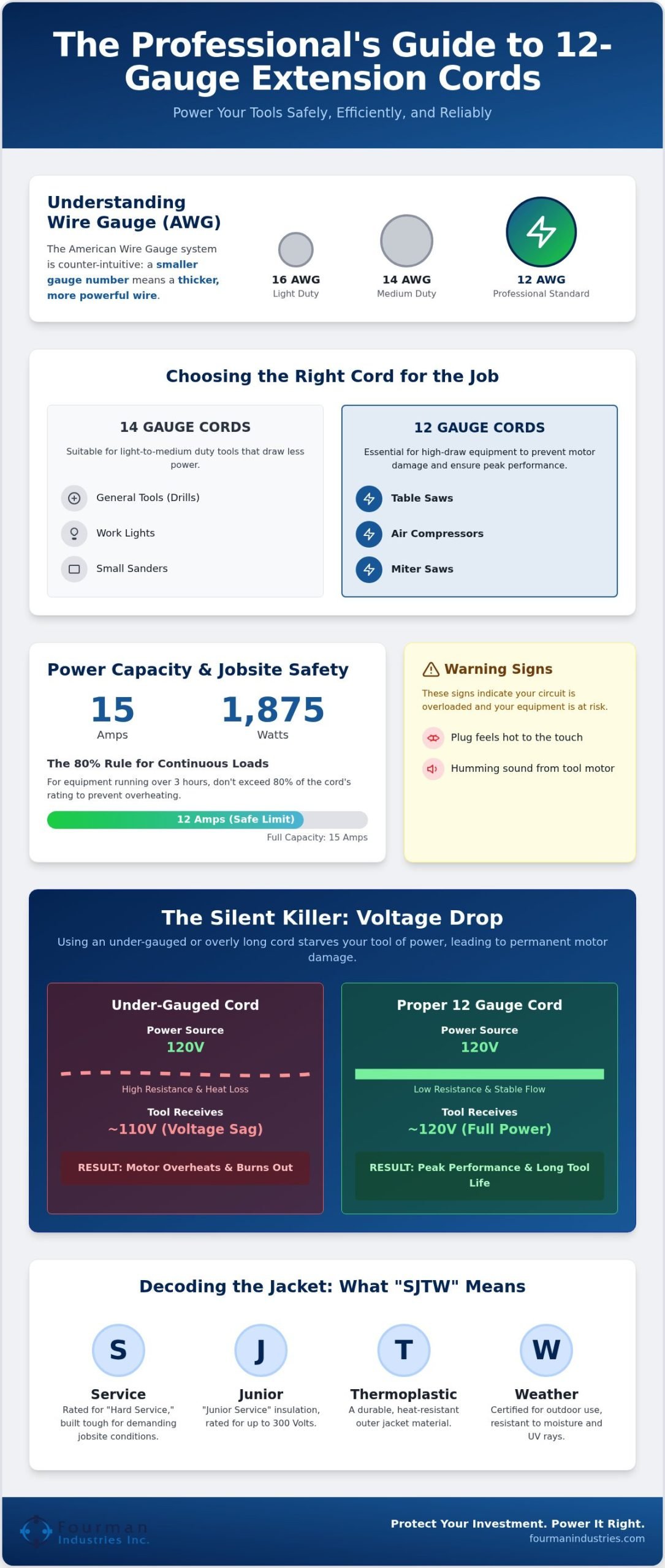
Understanding wire gauge is the first step to keeping your jobsite safe and your tools running at peak performance. The American Wire Gauge (AWG) system is the standard used across North America to measure wire diameter. It can feel a bit backwards when you first look at it. A smaller gauge number actually indicates a thicker wire with a higher capacity for carrying electricity. A 12 gauge extension cord has significantly more copper than a 14 or 16-gauge cord, making it the professional choice for demanding tasks. You’ll often see these labeled as “12/3” on the packaging. This notation simply tells you there are three individual 12-gauge wires tucked inside the protective outer jacket: a hot wire, a neutral wire, and a ground wire.
The Science of Wire Thickness
Thicker copper is essential for consistent power delivery. Think of electricity moving through a wire like water moving through a pipe. A wider pipe allows more water to flow with less pressure loss. In electrical terms, thicker copper creates less resistance. This ensures that more power reaches your tool instead of turning into wasted heat inside the cord itself. Heat is the primary enemy of any electrical system. Thicker wires dissipate heat more efficiently, which keeps the cord cool even during long, high-draw work sessions. While a 12 gauge extension cord is physically heavier than a thin household cord, that extra weight is the sign of a professional-grade tool. It’s built to handle the physical abuse of a busy workshop while delivering the steady current your motors crave.
12 Gauge vs. 14 Gauge: The Professional’s Choice
A 14-gauge cord works fine for a handheld drill, a work light, or a small sander. However, it often fails when you plug in high-draw equipment. Large table saws, air compressors, and miter saws demand a massive burst of current the moment they kick on. If the wire is too thin, the voltage drops and the tool’s motor has to work twice as hard to maintain speed. This is how expensive motors eventually burn out. Using a 12 gauge extension cord provides a critical safety margin that pros rely on every day. Even if your tool only requires 12 or 13 amps of continuous power, using a cord rated for a full 15 amps ensures you aren’t pushing your electrical system to the breaking point. Over-specifying your cord is always a smarter move than risking a multi-hundred dollar piece of machinery on a cheap, thin wire. It’s about protecting your investment and staying productive without unnecessary interruptions.
Amperage and Wattage: Understanding Your Power Capacity
Every 12 gauge extension cord is built to a specific electrical standard. For most professional applications, this means a rating of 15 Amps and 1,875 Watts. You can find these numbers stamped directly onto your tool’s nameplate or listed in the owner’s manual. Following extension cord safety guidelines is about more than just avoiding blown fuses; it’s about keeping your gear in top condition. If you only see a Wattage rating, don’t worry. To find your tool’s amperage, simply divide the total wattage by 120.
Pros follow the 80% rule for continuous loads to keep the jobsite running smoothly. If you’re running a piece of equipment for more than three hours, you shouldn’t exceed 12 Amps on a 15-Amp rated cord. Pushing a cord to its absolute limit for long periods creates excess heat. Watch for warning signs like a plug that feels hot to the touch or a strange humming sound from your tool’s motor. These are red flags that your circuit is overloaded and your equipment is at risk.
Calculating Your Total Tool Load
If you use 12 Gauge SJTW Triple Tap Extension Cords, you might have multiple tools plugged into a single line. You must add up the Amps of every tool that will be running at the same time. Motorized equipment like miter saws or compressors often have a “startup surge” that pulls significantly more power for a split second when the motor kicks on. Always calculate your load based on these peak numbers to prevent tripping your breaker in the middle of a critical cut. Managing your power draw effectively ensures that every tool on the tap gets the juice it needs without hesitation.
Why Under-Gauged Cords Damage Your Equipment
When a cord is too thin for the job, it causes a phenomenon known as “Voltage Sag.” This means your tool isn’t receiving the full 120 volts required to operate correctly. To compensate for this drop in pressure, the motor pulls more current, which generates intense internal heat. Over time, this heat melts the wire insulation inside your tool and leads to total motor failure. A high-quality 12 gauge extension cord keeps the voltage steady and protects your high-value saws and compressors from this slow, expensive damage. Investing in the right gauge today prevents the headache of replacing a burnt-out tool tomorrow. If you’re running the most demanding equipment on your site, understanding the 10 gauge vs 12 gauge extension cord differences can help you determine whether you need to step up to even thicker copper for maximum motor protection.
SJTW Ratings: Deciphering the Extension Cord Jacket Code
Examine the small, raised lettering printed along the side of your 12 gauge extension cord. Those characters aren’t just for show. They form a specific code that defines the cord’s limits and safety ratings. The “S” stands for Service, meaning it’s rated for hard usage. The “J” stands for Junior, which indicates a 300-volt rating. This is the standard for most power tools and appliances. In contrast, full “S” cords without the “J” are rated for 600 volts and are significantly bulkier and heavier. The “T” tells you the jacket is made of Thermoplastic, and the “W” is the most critical letter for pros: it stands for Weather-resistant.
SJTW is the industry benchmark for jobsite reliability. It balances heavy-duty protection with enough flexibility to move around a workshop easily. These jackets are designed to resist moisture, oil, and grease, making them ideal for messy environments or damp construction sites. For a deeper dive into how these materials are tested and why they matter for your safety, check out Understanding SJTW Extension Cords: The Professional’s Reference Guide (2026). Knowing these ratings helps you pick a cord that won’t fail when the conditions get tough.
Indoor vs. Outdoor 12 Gauge Cords
Outdoor-rated cords feature specialized UV stabilizers in their thermoplastic jackets. Without these stabilizers, the sun’s rays would eventually turn the plastic brittle and cause the insulation to crack. This creates a massive shock hazard that can lead to fires or injury. Don’t use an indoor-only cord outside, even for a quick project. Indoor cords lack the moisture resistance needed to handle dew, humidity, or light rain. If you work in sub-zero temperatures, look for jackets specifically designed to stay flexible in the cold. A stiff cord is a nightmare to coil and can quickly become a permanent trip hazard if it won’t lay flat on the ground.
Specialty Jacket Colors for High Visibility
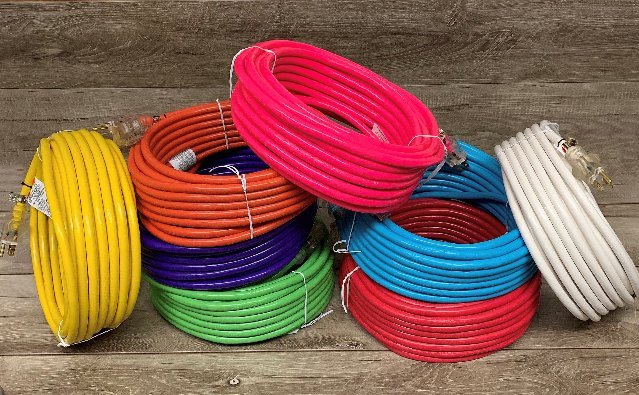
Color choice is a key part of your jobsite safety strategy. High-visibility colors like bright orange and yellow are industry standards for a reason. They stand out against concrete and dirt, reducing the chance of someone tripping over your power line. Many professionals are now switching to pink extension cords to improve visibility even further. These high-contrast colors are easy to spot in low-light areas like crawlspaces or during early morning setups. Using a unique color doesn’t just prevent accidents; it also makes it much harder for your gear to disappear into someone else’s truck at the end of the shift.
The Impact of Length on 12 Gauge Performance
Length is the biggest variable in how much power actually reaches your tool. As electricity travels down a wire, it encounters resistance that causes “Voltage Drop.” Think of it as losing electrical pressure. The longer the distance, the more pressure you lose. While a 14-gauge cord might work for a light at 100 feet, it will cause a table saw to struggle or even stall. A 12 gauge extension cord uses thicker copper to fight this resistance, maintaining a much steadier flow of power over long distances. This is why pros reach for 12-gauge when the outlet is across the room or out in the driveway.
For most 15-amp applications, 100 feet is the maximum recommended length for a 12-gauge wire. Pushing past this limit risks dropping the voltage below the safe operating level for your equipment. If you need more reach than that, you’ll likely need to switch to a beefier 10-gauge cord to avoid damaging your motors. Understanding these limits is key to jobsite safety. For a deep dive into managing long-distance power, read our How to Use a 12 Gauge Extension Cord 100 Ft: The Ultimate Safety & Performance Guide. It covers the specific technical thresholds you need to know for the biggest jobs.
Choosing Between 25ft, 50ft, and 100ft
Your choice of length should match the specific needs of your workspace. A 25ft cord is perfect for stationary workshop tools like table saws or planers where the outlet is close by. It offers the least resistance and maximum power delivery. For workshop setups where the outlet is nearby, a 12 gauge extension cord 25 ft is the optimal zero-compromise choice that delivers a full 15-amp load without the bulk or power loss of longer cables. The 50ft cord is the versatile standard. It provides enough reach for most indoor and outdoor tasks without excessive bulk. When you need to reach the far corner of a jobsite, the 100ft cord is the go-to option. Just remember that at 100 feet, you’re at the edge of the performance envelope for high-draw tools. Always check that your tool isn’t struggling if you’re using the full length of the cord.
Triple Tap vs. Single Outlet Cords
Managing multiple tools often leads to a tangled mess of thin, cheap cords. Using a single 12 gauge extension cord with a triple tap head creates a heavy-duty backbone for your entire workspace. You can run your saw, a work light, and a battery charger from one reliable source. This keeps your floor clear and your power delivery consistent. However, having three outlets doesn’t mean you have triple the power. You are still limited by the 15-amp capacity of the wire and the circuit breaker. Don’t run three high-draw tools simultaneously. Use the triple tap for efficiency and organization, but always keep your total amperage in mind to prevent overloads.
Ready to upgrade your power setup? Explore our range of professional 12 Gauge SJTW Triple Tap Extension Cords to get the performance your tools deserve.
Personalization and Custom Printing for Jobsite Management
Theft and gear confusion on a crowded jobsite are more than just minor annoyances. They represent a significant hidden cost in both replacement expenses and lost productivity. When multiple crews are working in the same space, generic black or yellow cords often end up in the wrong truck by “accident.” Custom printing your company name or phone number directly onto your 12 gauge extension cord makes ownership undeniable. It’s much harder for a cord to walk away when your branding is visible every 12 inches along the entire length of the jacket. For a full breakdown of how to protect your assets, check out The Ultimate Guide to Custom Printed Extension Cords (2026).
Beyond printing, using high-visibility, unique colors like purple or pink provides an extra layer of security. Most contractors stick to the standard industry colors, which makes your specialized gear stand out from across the lot. This visual distinction simplifies your end-of-day inventory and ensures your team isn’t wasting valuable billable hours hunting for their power supply in a sea of identical cables. It’s a simple logistical fix that pays for itself the first time a cord stays on your site instead of disappearing. Of course, protecting your investment goes beyond the cord itself — a reliable truck & car battery jump starter is equally essential gear to keep on hand so a dead battery never shuts down your entire operation on a remote jobsite.
Branding Your Electrical Equipment
Branded gear sends a clear message of professionalism to your clients and competitors alike. It shows you’re an established business that takes pride in its tools and maintains a high level of organization. This professional image builds trust with homeowners and general contractors who want to see a tidy, well-managed site. On the management side, it allows you to quickly identify which crew is missing their gear or which specific jobsite a cord belongs to if it’s left behind. Custom imprinting is a one-time investment that provides long-term security and peace of mind for your most essential power assets.
Durability and Professional Grade Quality
A 12 gauge extension cord is only as effective as the components holding it together. At Fourman Industries, we prioritize industrial-strength construction that survives the daily grind of a professional workshop. We use heavy-duty molded plugs and reinforced strain relief to prevent the copper wires from pulling away from the brass blades. These connections are usually the first point of failure on cheap, store-bought cords. By choosing reinforced, professional-grade equipment, you’re investing in a tool that will last for years rather than months. It keeps your projects moving and ensures that your power delivery is as rugged as the tools you’re plugging into it.
Power Your Projects with Confidence
Choosing the right gear is the difference between a job well done and an expensive equipment failure. You now understand that a 12 gauge extension cord is the professional baseline for protecting high-draw motors from damaging voltage drop. By decoding SJTW ratings, you can ensure your power supply stands up to the toughest weather conditions on any site. Remember that customization isn’t just about looks; it’s a practical strategy to stop theft and keep your inventory organized during busy multi-crew projects.
Fourman Industries has specialized in custom printed cords since 1997. We build our products with industrial-grade 12/3 SJTW construction to handle the physical demands of your daily work. Whether you need high-visibility pink or purple options to stand out or a classic triple tap setup for maximum efficiency, we have the solution. Shop Heavy Duty 12 Gauge SJTW Triple Tap Cords at Fourman Industries to get the reliable power your business deserves. Equip your team with the best tools and stay focused on the work that matters.
Frequently Asked Questions
Can I run a space heater on a 12 gauge extension cord?
Yes, you can safely run most standard space heaters on this type of cord. Most portable heaters draw 1,500 watts, which is about 12.5 amps. Since a 12 gauge extension cord is rated for 15 amps, it handles this load without overheating. Always use the shortest length possible and never plug other high-draw appliances into the same cord.
What is the difference between 12/3 and 14/3 extension cords?
The main difference is the thickness of the copper wire and the amount of power it can carry. A 12/3 cord has thicker wire than a 14/3 cord, which allows it to handle 15 amps safely. The “3” in both cases indicates three internal conductors: hot, neutral, and ground. Choosing the 12-gauge option provides a better safety margin for heavy power tools.
How many amps can a 100-foot 12 gauge extension cord handle?
A 100-foot 12 gauge extension cord is rated for 15 amps. However, at this extreme length, you will experience some voltage drop. For tools that pull a continuous 14 to 15 amps, you might notice a slight dip in performance. It’s the maximum recommended length for 12-gauge wire before you should consider stepping up to a 10-gauge cord.
Is a 12 gauge cord considered heavy-duty?
Yes, 12-gauge is the industry standard for heavy-duty professional work. It’s built to handle high-draw equipment like miter saws, air compressors, and large circular saws. While 14-gauge is medium-duty and 16-gauge is light-duty, the 12-gauge wire is the baseline for construction sites and demanding workshop environments. For the most power-hungry applications, reviewing a detailed 10 gauge vs 12 gauge extension cord comparison will help you determine if you need to step up to even heavier copper.
What does the W mean in an SJTW extension cord rating?
The “W” stands for weather-resistant. This indicates that the cord’s outer jacket is specially formulated with UV stabilizers to resist damage from sunlight. It also means the insulation is moisture-resistant. This rating is essential if you plan to use your cord outdoors where it might be exposed to damp grass or direct sun for long periods.
Can I plug two 12 gauge cords together to reach 200 feet?
You shouldn’t connect two extension cords together to increase your reach. This practice, known as daisy-chaining, creates extra resistance at the plug connection and doubles the voltage drop. Your tools will likely underperform and the connection point can become a fire hazard. Use a single 100-foot cord or move your project closer to a permanent outlet.
Is 12 gauge wire thick enough for a portable generator?
It’s the correct choice for the standard 15-amp or 20-amp outlets found on most portable generators. If you’re running lights, power tools, or small appliances, a 12-gauge cord works perfectly. If your generator has a large 30-amp twist-lock outlet intended for a transfer switch or an RV, you’ll need a thicker 10-gauge cord to handle that higher capacity. When working with generators on remote jobsites, pairing your setup with a heavy-duty truck & car battery jump starter ensures you’re never stranded if your vehicle battery dies far from help.
Why is my extension cord plug getting hot during use?
A hot plug is usually a sign of a loose connection or an overloaded cord. If the brass blades on the plug are dirty, corroded, or don’t fit tightly into the outlet, they create electrical resistance that turns into heat. It can also happen if you’re drawing more than 15 amps. Stop using the cord immediately and inspect the plug for damage or signs of melting.




