
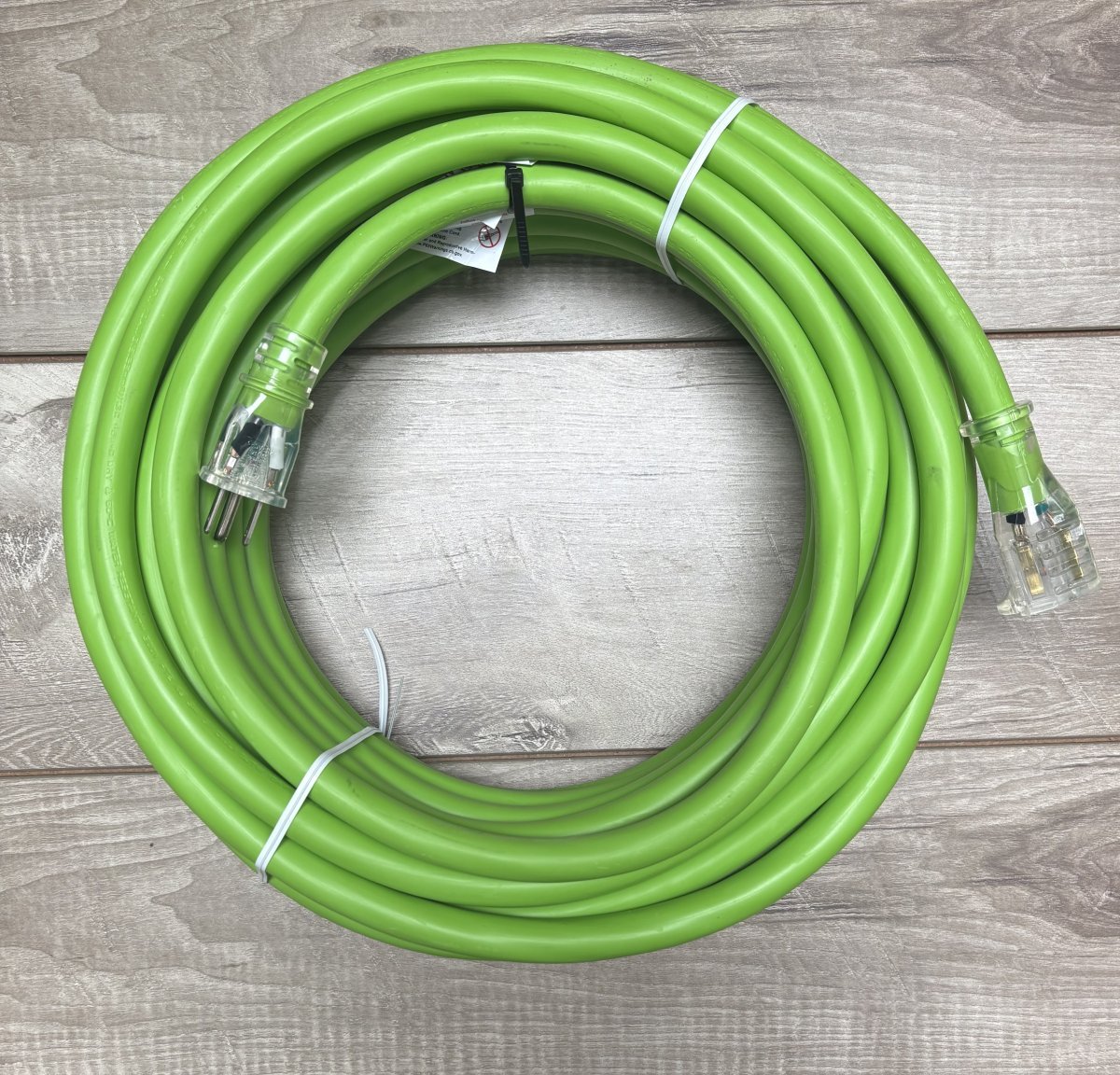
A cheap extension cord is the most expensive mistake you can make on a jobsite. You have likely experienced the frustration of a circular saw losing torque mid-cut or a compressor failing to kick over because it is starving for power. When your equipment underperforms, it is usually because your heavy duty outdoor extension cord isn’t actually heavy duty enough for the task. It is a common headache, but using the wrong gear leads to melted jackets, fried motors, and wasted hours.
You deserve power solutions that work as hard as you do. This guide will help you navigate the technical side of power delivery, from choosing the right American Wire Gauge (AWG) to understanding the durability of SJTW jackets. You’ll learn how to prevent voltage drop over long distances and why high-visibility colors like pink or purple are becoming the industry standard for safety and theft prevention. We also cover the latest 2026 OSHA requirements for ground monitoring and GFCI protection to ensure your site stays compliant and your crew stays safe. Let’s get your gear powered up the right way.
Key Takeaways
- Master the technical specs that define a true heavy duty outdoor extension cord, including why UL-certified SJTW jackets are essential for weather resistance.
- Learn how to match your wire gauge to tool amperage to eliminate voltage drop and prevent expensive equipment motor burnout.
- Stop jobsite theft by using custom-printed cords and high-visibility colors like pink or purple that make your gear impossible to “accidentally” borrow.
- Stay safe and OSHA-compliant with professional best practices for inspecting jackets and protecting power connections in wet conditions.
- Identify the best 10 and 12-gauge power solutions for your specific needs, from high-draw compressors to multi-tool setups.
What Defines a True Heavy Duty Outdoor Extension Cord?
Walk into any big-box hardware store and you will see walls covered in orange and yellow cords labeled as "heavy duty." Most of them don’t actually earn that title. In a professional setting, a label is just marketing unless the technical specifications back it up. A true heavy duty outdoor extension cord is defined as one with 12 AWG or lower and an SJTW or better jacket. These two factors determine whether your cord will power your tools efficiently or become a fire hazard on the jobsite.
Before diving into the specific specs, it helps to understand extension cord basics regarding how these tools are engineered for safety. For professionals, "heavy duty" isn’t about how thick the cord looks. It is about the copper wire’s capacity to carry high amperage over distance without overheating. If the internal wire is too thin, the resistance creates heat. This heat melts insulation and ruins expensive equipment.
Understanding AWG: Why Lower Numbers Mean More Power
AWG stands for American Wire Gauge, and it is the industry standard for measuring wire thickness. The scale works inversely, which can be confusing at first. A lower gauge number means a thicker wire with more copper. Thicker copper allows more electricity to flow with less resistance. This is critical for maintaining the "pressure" of the electricity as it moves from the outlet to your tool.
- 16 Gauge: Light duty. These are for lamps or small fans. Never use these on a jobsite.
- 12 Gauge: Heavy duty. This is the standard for circular saws, drills, and most professional power tools.
- 10 Gauge: Extra heavy duty. These are essential for high-draw equipment like large air compressors or table saws.
Standard 16-gauge cords are a common cause of motor failure. When a tool is starved of power due to a thin wire, the motor works harder to compensate. This causes the internal components to overheat, leading to a permanent loss of torque or a total burnout. Investing in a lower gauge cord is an insurance policy for your most expensive tools.
The SJTW Jacket: Your Shield Against the Elements
The jacket is the only thing standing between your crew and a dangerous short circuit. For outdoor work, you need more than just standard rubber. Professional cords use a specific coding system to describe their durability. SJTW is the gold standard for outdoor reliability. S stands for Service, J stands for Junior (rated for 300 volts), T stands for Thermoplastic, and W stands for Weather/Outdoor resistance.
The "W" rating is non-negotiable for any cord used on grass, dirt, or concrete. It means the jacket is treated to resist UV rays from the sun and won’t break down when sitting in a puddle or on damp soil. High-quality thermoplastic jackets also remain flexible in freezing temperatures. This prevents the outer layer from cracking when you’re coiling it up at the end of a cold winter shift. A cord that stays flexible is a cord that lasts through multiple seasons of hard use.
The Critical Link: Gauge vs. Length and Voltage Drop
Distance is the enemy of consistent power. Think of your electrical setup like a plumbing system. If you try to push a high volume of water through a long, narrow hose, the pressure at the nozzle drops significantly. Electricity behaves the same way. As current travels down a heavy duty outdoor extension cord, it encounters resistance. This resistance causes a "voltage drop," which means your tools receive less than the 120 volts they need to operate correctly.
Voltage drop isn’t just a technicality; it’s a tool killer. When a motor is starved of voltage, it pulls more current to compensate. This extra current generates intense heat inside the tool. You might notice your saw slowing down mid-cut or your drill feeling hot to the touch. To prevent this, you must account for length. A good rule of thumb is to move up one gauge size for every 50 feet of cord you add to the run.
When to Choose a 10 Gauge Extension Cord
High-draw equipment requires a serious backbone. If you are running a table saw, a large air compressor, or an industrial space heater, a standard cord will fail you. These tools often pull close to 15 amps or more. A 12 gauge cord works fine for short distances, but once you hit the 100-foot mark, the resistance becomes too high for comfort.
This is where the 10 Gauge ECONO Extension Cord becomes the industry standard. It provides the thickest copper core available for standard 120v outlets. It offers the best balance of weight and power delivery for long-distance runs. When you need to reach the far corner of a jobsite without sacrificing torque, the 10 gauge option ensures your equipment stays cool and efficient. For heavy-duty projects, investing in 10 Gauge ECONO cords prevents the costly downtime of fried motors.
Voltage Drop Guide for 2026 Equipment
To keep your jobsite running smoothly, use this guide for 15 Amp loads. It helps you decide which cord to grab from the truck based on how far you need to reach:
- 25 Feet: A 12 gauge cord is perfect. Voltage drop is negligible.
- 50 Feet: A 12 gauge cord is still acceptable, but you are at the limit for high-draw tools.
- 100 Feet: Switch to a 10 gauge cord. A 12 gauge cord at this length can lose over 5% of its voltage, which is risky for electronics and motors.
Safety is the priority here. Never daisy-chain multiple extension cords together to reach a target. Every connection point creates additional resistance and heat. If you need 150 feet of reach, buy a single 150-foot heavy duty outdoor extension cord in 10 gauge rather than plugging three 50-foot cords together. One solid run is always safer and more efficient than a series of weak links.
Security and Visibility: Beyond the Standard Orange Cord
Every jobsite is a sea of orange and yellow. These standard colors are so common that they practically invite people to "borrow" them. When every crew has the same gear, it’s easy for your heavy duty outdoor extension cord to end up in someone else’s truck at the end of the day. Stepping away from the standard palette isn’t just about style. It’s a strategic move to protect your investment and keep your workflow moving.
Visual organization is the secret to a smooth site. Color-coding your power cords makes it immediately obvious which cord belongs to your crew, preventing other trades from accidentally unplugging your equipment to power their own tools. It eliminates the "which cord is mine?" guessing game that happens when lines are tangled near a temporary power pole or a shared generator.
The Anti-Theft Power of Custom Printed Extension Cords
Theft is a hidden cost of doing business. A single high-quality cord is an investment, and losing three or four a year adds up quickly. This is where custom imprinting pays for itself. When your company name is permanently printed along the entire length of the jacket, the cord becomes impossible to resell. It also makes it very awkward for a subcontractor to claim your equipment as their own. Beyond security, custom printing acts as a professional marketing tool for your business. It shows clients that you are a serious professional who pays attention to the details. The upfront cost of a custom cord is minor compared to the recurring cost of replacing stolen generic ones. For a comprehensive breakdown of physical and visual strategies to prevent extension cord theft on the jobsite, including how to lock down your setup and use permanent identification, our dedicated guide covers every angle professionals need to know.
While custom cords protect your tools, other professional solutions can protect the entire jobsite; for example, you can learn more about Iron Guys and their custom iron gates and railings designed for both security and professional appeal.
Pink and Purple Cords: Safety Through Contrast
Safety and security go hand-in-hand. Standard orange cords often blend into the background on busy sites, creating tripping hazards. Pink and purple cords offer the highest level of contrast against dirt, concrete, and grass. These colors don’t appear naturally in industrial environments, making them impossible to miss for anyone walking through a high-traffic area. High visibility keeps your crew upright and your gear protected.
There is also a psychological benefit to unique colors. Most people are hesitant to walk off with a heavy duty outdoor extension cord that is highly recognizable. It is a bold deterrent that says this gear is accounted for. You can also use these colors to manage your power circuits. For example, you might designate that purple is for the generator and pink is for the main site power. This simple system saves time when troubleshooting a tripped breaker or setting up a new station. You don’t have to trace lines through a pile of debris; you just follow the color.

Best Practices for Safe Outdoor Power Management
Safety starts before you flip the switch. A heavy duty outdoor extension cord is a professional tool, not a disposable accessory. Treating it with respect ensures your equipment runs at peak performance and your crew stays out of harm’s way. Before every shift, run your hand along the length of the cord to inspect the jacket. If you feel any nicks, cuts, or soft spots that suggest internal damage, remove the cord from service immediately. Exposed copper is an invitation for a short circuit or a fire.
Keep your connections dry and secure. Even with a weather-resistant rating, you should never leave a plug sitting in a puddle or directly on damp soil. Use a cord lock or an elevated protective cover to keep the connection point off the ground. This prevents moisture from seeping into the terminals and tripping your breakers. Additionally, verify that your power source is GFCI-protected. Per 2026 OSHA requirements, GFCI protection is mandatory for all 120-volt, single-phase, 15- and 20-ampere receptacle outlets on construction sites that are not part of the permanent wiring.
Avoid the "induction heater" effect. Many users leave their cord partially coiled while in use to keep the jobsite tidy. This is a dangerous mistake. When electricity flows through a coiled wire, it creates an electromagnetic field that generates intense heat. This heat can melt the insulation from the inside out, even if the tool isn’t drawing maximum amperage. Always uncoil the entire length of your cord to allow for proper heat dissipation.
Maintenance Tips for SJTW Jackets
Your SJTW jacket is tough, but it isn’t indestructible. Keep it clean to prevent chemical degradation. If your cord gets covered in oil, grease, or mud, wipe it down with a damp cloth and mild soap. Harsh chemicals can eat through the thermoplastic over time. When it comes to storage, use the "over-under" wrap technique. This prevents the internal copper strands from twisting and developing a "memory" that leads to kinks and tangles. While thermoplastic is rated for cold weather, bring your cords inside during extreme temperature drops to maintain maximum flexibility and prevent the outer shell from becoming brittle.
Recognizing Warning Signs of Overload
Your equipment will tell you when something is wrong. If the plug feels hot to the touch or you notice a faint smell of burning plastic, you have an overload or a poor connection. Dimming lights or motors that "surge" and struggle to maintain speed are classic indicators of significant voltage drop. Don’t ignore these signs. If a cord shows signs of terminal wear, such as burnt prongs or a loose fit in the outlet, it is time to retire it. To keep your site running safely and efficiently, upgrade to a high-quality heavy duty outdoor extension cord that meets your specific power demands. The same attention to proper electrical safety protocols applies when working with vehicle power systems — understanding how to safely use a car jump starter ensures you protect sensitive onboard electronics just as you protect your tools from voltage damage on the jobsite.
Fourman Industries Top Heavy-Duty Picks for 2026
Choosing the right heavy duty outdoor extension cord is about more than just checking a box. It is about matching the right tool to the right job. At Fourman Industries, we have spent decades refining our lineup to solve the specific problems pros face on the site every day. Whether you are running a single high-draw table saw or a multi-tool finish crew, our 2026 picks prioritize power delivery and asset protection. This commitment to specialized, high-performance gear is a standard shared by professionals in various industries, much like how elite athletes rely on FiberSport USA for precision-engineered track and field equipment.
Asset protection is a major part of our philosophy. Our Custom Printed Series allows you to put your business name directly on the jacket. This transforms a standard utility into a branded asset that is far less likely to walk off the jobsite. When you combine custom printing with our high-visibility Pink Extension cords or Purple extension cords, you create a deterrent that big-box stores simply don’t offer. These unique colors stand out in the mud and debris, reducing tripping hazards while making your gear instantly recognizable from across the street.
Efficiency with the 12 Gauge Triple Tap
The 12 Gauge SJTW Triple Tap Extension Cords are the ultimate productivity boosters for modern crews. Why waste time hunting for power strips that aren’t rated for outdoor use? These cords feature three outlets at the female end, allowing you to run a saw, a charger, and a work light from a single line. We have engineered these with reinforced relief necks to prevent pull-out damage when the cord is inevitably yanked. The lighted ends provide instant confirmation that power is active and the circuit is grounded. This helps you meet 2026 OSHA safety standards without reaching for extra testing equipment.
For the most demanding equipment, the 10 Gauge Extension Cords are the industrial-strength choice. As we covered in the voltage drop section, distance kills motors. This extra-thick 10-gauge wire ensures that your air compressors and heaters get every bit of the amperage they need, even on 100-foot runs. It is the most robust heavy duty outdoor extension cord in our lineup. It is designed for those who cannot afford downtime from a tripped breaker or a burned-out motor.
Why Fourman Industries Cords Win on the Jobsite
We aren’t just another retailer. Founded in 1997, Fourman Industries has been a reliable partner for professionals for nearly thirty years. Every cord we sell carries a UL certification. This means it has been tested to meet rigorous national safety standards for hard usage. We offer direct-to-customer customization that allows you to get exactly what you need without the middleman markup. Stop settling for generic gear that fails after one season. Build your custom heavy-duty extension cord at Fourman Industries today!
Power Your Success with Professional-Grade Gear
Your tools are only as strong as the power source behind them. You now know that a true heavy duty outdoor extension cord requires the right balance of copper gauge and jacket durability to survive a season on the job. By matching your cord length to the amperage of your high-draw saws and compressors, you protect your equipment from permanent motor damage. It is a simple step that saves you thousands in potential replacement costs over the life of your gear.
Security is just as vital as performance. Custom printing and high-visibility colors don’t just help with site organization; they actively prevent theft and keep your crew safe from tripping hazards. Fourman Industries has provided these professional solutions since 1997, offering industry-leading 10 and 12 gauge options with UL-certified SJTW jackets designed for extreme durability. Our direct-to-customer model ensures you get the exact specifications you need for any environment without the retail markup.
Secure your jobsite with custom-printed heavy-duty cords from Fourman Industries
Don’t let a weak connection or a stolen cord hold your project back. Invest in gear that works as hard as you do and keep your site running at full power.
Frequently Asked Questions
Can I use a 12 gauge extension cord for a generator?
Yes, a 12-gauge cord is sufficient for most portable generators providing up to 20 amps of power. It’s the go-to choice for running standard power tools or small appliances during an outage. If your generator features a 30-amp outlet, you’ll need to step up to a 10-gauge cord to handle the higher load safely. Always match the cord’s amp rating to the breaker on your generator’s control panel.
What happens if I use a light-duty cord for a heavy-duty tool?
Using a light-duty cord for high-draw tools causes a significant voltage drop that starves the motor of power. This forces the tool to run hotter and less efficiently, which eventually leads to permanent motor burnout. On the other side, the cord itself will begin to heat up as it struggles to carry the current. This can melt the protective jacket and create a serious fire hazard on your site.
Are pink and purple extension cords as durable as the orange ones?
Absolutely, the color has no impact on the cord’s structural integrity or weather resistance. Our pink and purple options feature the same UL-certified SJTW jackets found on our industrial orange cords. They provide the same rugged protection against UV rays, moisture, and oil. The only difference is that these unique colors make your gear much harder to lose or steal in a crowded workspace.
Is a 10 gauge cord overkill for home use?
A 10-gauge cord isn’t overkill if you value your equipment’s longevity. While a 14 or 12-gauge cord handles basic lawn equipment, a 10-gauge line is necessary for home workshops running air compressors or large table saws. It ensures your tools get full power without surging. If you’re running any high-amp tool over 50 feet from your garage outlet, the 10-gauge option is the smartest choice for safety.
How do I know if my extension cord is UL/ETL certified?
You can verify certification by looking for the UL/ETLsymbol stamped directly onto the plug or the outer jacket of the cord. Genuine UL/ETL-certified cords also have the manufacturer’s file number printed alongside the gauge and jacket type. This mark confirms that the heavy duty outdoor extension cord has passed strict independent testing for fire, shock, and durability. Don’t trust any cord on a professional site that lacks this mark.
What is the maximum length I can run an extension cord safely?
You should limit your total run to 100 feet whenever possible to maintain consistent voltage. If you need to reach further, you must use a 10-gauge cord to prevent your tools from losing torque. Never plug two cords together to extend your reach. Daisy-chaining creates extra resistance at the connection point, which generates heat and increases the risk of a short circuit or fire.
Does custom printing on the cord affect its safety or UL/ETL rating?
Custom printing doesn’t affect the safety or the UL rating of the cord in any way. The text is applied to the surface of the thermoplastic jacket and doesn’t penetrate the insulation or touch the copper wires. It’s a surface-level modification that meets all safety standards while providing a massive boost to your site security. It remains a fully compliant, professional-grade tool even with your company name on it.
How can I prevent my outdoor extension cord from being stolen?
The best way to prevent theft is to make your gear unique and recognizable. Using a heavy duty outdoor extension cord in high-visibility pink or purple makes it stand out from the sea of standard orange cords. Adding custom printing with your company name makes the cord impossible to resell or claim as "found" equipment. These visual markers act as a powerful deterrent for potential thieves on busy jobsites. For a deeper look at how to prevent extension cord theft using proven physical and identification strategies, our professional guide walks through every method worth implementing on your site.




