
What if your “life-saving” emergency kit is actually just a trunk full of outdated junk that won’t start your car when the cell towers go dark? It’s a terrifying thought, but for many drivers, it’s a reality. Most of us carry a false sense of security with a tangled pair of cheap jumper cables and a dead flashlight. You’ve likely felt that frustration of gear failing exactly when you need it most. Understanding modern emergency car kit essentials is about more than just checking a box. It’s about ensuring you never have to depend on a stranger’s battery or a spotty signal to get home safely.
Discover the critical difference between basic survival and professional-grade roadside preparedness with our 2026 guide to car kit essentials. We’re moving past the era of liquid-burning flares and bulky equipment. Instead, we’ll focus on compact, high-performance tools like lithium-ion jump starters and digital tire inflators that offer total self-reliance. This article previews the must-have gear for 2026, including medical supplies and professional-grade bit sets for quick repairs. You’ll walk away with a plan for a kit that handles both medical and mechanical emergencies without breaking a sweat.
Key Takeaways
- Move beyond the “wait for help” mindset by building a kit focused on active self-sufficiency and immediate movement.
- Understand why relying on a second vehicle for a jump start is a risk you don’t need to take in 2026.
- Master your emergency car kit essentials by swapping out messy tire sealants for precise 12v inflator kits that protect your sensors.
- Streamline your trunk with high-performance bits and tools that handle the vast majority of mechanical roadside issues.
- Organize your gear into weather-resistant layers so the most critical power and safety tools are always within reach.
Modern Emergency Car Kit Essentials: Why Traditional Kits Fail
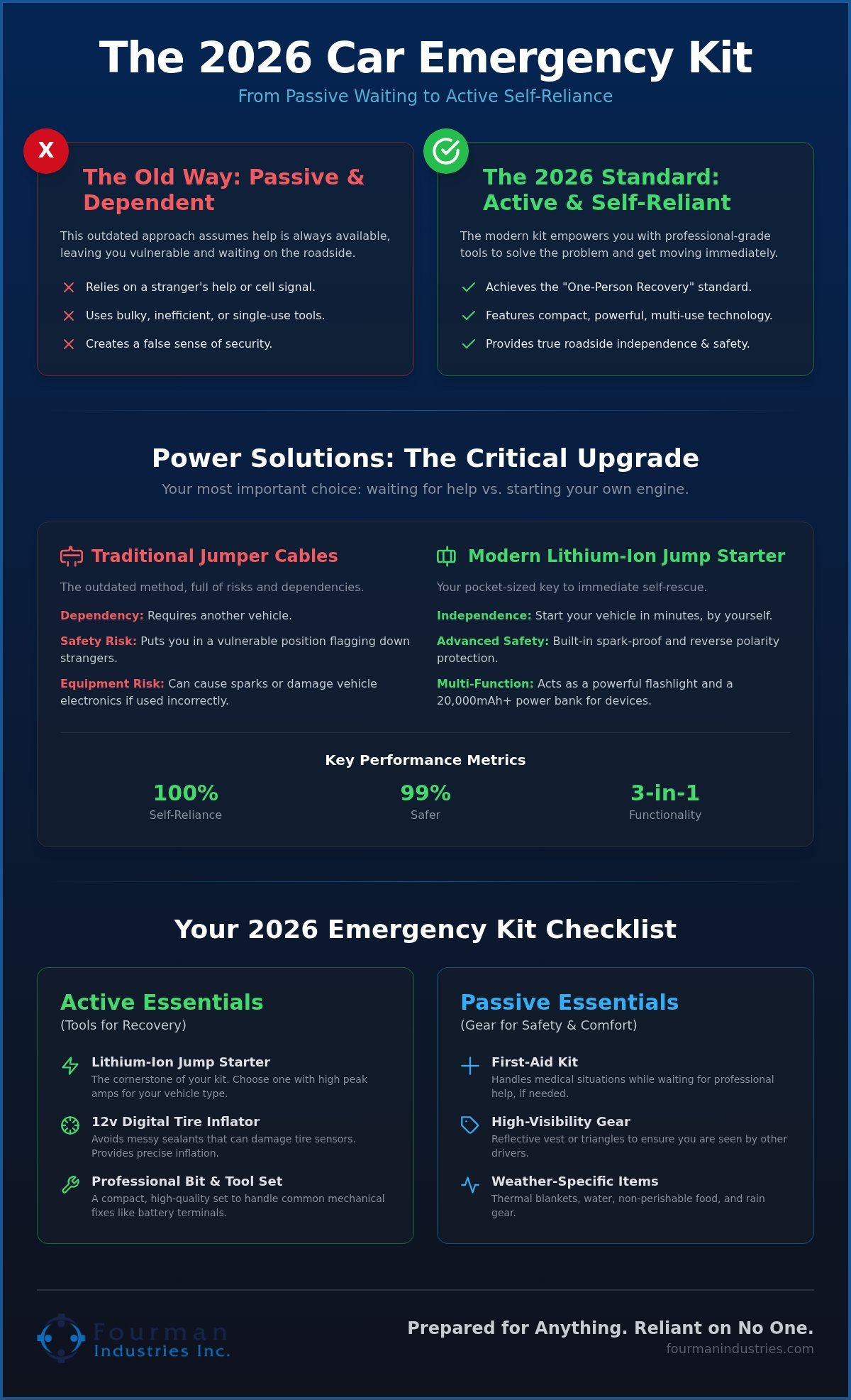
Most drivers pack for a picnic rather than a breakdown. They toss in a few blankets, a bottle of water, and a set of tangled jumper cables, then call it a day. This “passive” approach assumes that help is always a phone call away. However, the reality of 2026 is different. While vehicle technology has advanced, our reliance on digital infrastructure has created a new vulnerability. If you’re stranded in a dead zone without cell service, your roadside assistance app is useless. This is why emergency car kit essentials have shifted from survival supplies to active recovery tools.
The “Active Preparedness” philosophy focuses on gear that allows you to fix the problem and move. Traditional jumper cables are now considered a secondary backup item because they require a second vehicle and a willing stranger. In high-stakes situations, waiting for a Good Samaritan isn’t a strategy. Modern kits have transitioned from bulky, heavy lead-acid boosters to compact lithium-ion technology. These newer units hold a charge for months and provide enough cold-cranking amps to turn over heavy-duty engines without any outside help.
The Self-Sufficiency Standard of 2026
True preparedness in 2026 is measured by the “One-Person Recovery” standard. Can you get your vehicle back on the road without a bystander or a tow truck? Professional-grade equipment like a Truck & Car Battery Jump Starter is the cornerstone of this approach. These tools aren’t just for batteries; they often serve as multi-functional hubs with high-output LED lights and USB power banks. Using professional gear reduces the stress of a breakdown because you know the tool will work the first time. You aren’t just sitting and waiting; you’re actively solving the mechanical failure.
Passive vs. Active Essentials
A balanced kit requires a 50/50 split between two distinct categories. Passive essentials are designed for safety and comfort while you are stationary. These include first aid kits, thermal blankets, and water. They keep you alive but they don’t get you home. Active essentials are the tools of recovery. This category includes jump starters, a portable 12v tire inflator kit, and impact-ready hardware. Without active tools, your emergency car kit essentials are incomplete. You need the means to address a flat tire or a dead battery immediately to avoid being a sitting duck on a dark shoulder.
Power Solutions Review: Portable Jump Starters vs. Jumper Cables
Choosing between traditional jumper cables and a modern portable unit is the most critical decision for your emergency car kit essentials. While cables are inexpensive, they rely on the cooperation of another driver. In 2026, relying on the kindness of strangers isn’t just slow; it’s a security risk. A high-quality truck & car battery jump starter provides instant independence. These professional-grade units deliver enough power to crank heavy engines without needing a donor vehicle, getting you back on the road in minutes rather than hours.
Safety has also taken a massive leap forward. Older cables could spark or damage sensitive vehicle electronics if connected incorrectly. Modern portable starters feature integrated spark-proof technology and reverse polarity protection. These systems prevent the unit from discharging if the clamps are placed on the wrong terminals. Even in the biting cold of a 2026 winter, lithium-ion technology has matured to maintain its discharge capacity, ensuring your dead battery isn’t a permanent problem in freezing temperatures.
Why Independence is the Ultimate Safety Feature
Maintenance of Your Power Gear
Your gear is only useful if it actually works when the lights go out. Follow the “Check Every Quarter” rule for battery health. Every three months, verify the charge level and top it off if it has dropped below 80%. Store your lithium-ion gear in a climate-controlled part of the cabin rather than the trunk to avoid extreme temperature fluctuations that can degrade the cells. Integrating high-visibility charging cables into your emergency car kit essentials ensures you can find your power source in low-light conditions. If you want to ensure your setup is truly professional, explore our heavy-duty power solutions to simplify your roadside readiness.
Tire Maintenance: Comparing 12v Inflator Kits to Manual Solutions
A flat tire is the most common reason drivers find themselves stranded. For decades, the “quick fix” was a pressurized can of chemical sealant. In 2026, we know better. These cans are messy, temporary, and frequently destroy expensive Tire Pressure Monitoring System (TPMS) sensors. They provide a false sense of security without actually solving the problem. If you want your emergency car kit essentials to be professional-grade, you need a way to manage air pressure precisely and repeatedly.
A portable 12v tire inflator kit is the modern solution for slow leaks and temperature-related pressure drops. Unlike manual pumps that leave you exhausted on the side of a busy highway, these kits do the heavy lifting for you. They allow you to top off a tire and drive to a repair shop safely, keeping you away from the dangerous “white line” of the shoulder for as long as possible.
Digital vs. Analog: Precision Under Pressure
Precision matters when you’re dealing with tire heat and load. Old analog gauges are notoriously difficult to read, especially when the compressor is vibrating. The 2026 pro standard is the digital auto-shutoff feature. You simply set your desired PSI, and the unit stops automatically once it hits the mark. This prevents over-inflation, which can lead to uneven tire wear or a blowout. Most modern inflators also include high-output LED work lights. These are vital for finding a valve stem in pitch-black conditions. For contractors or those hauling heavy loads, look for a high-duty cycle motor. These motors can run longer without overheating, which is necessary for the high-volume tires found on trucks and trailers.
The Reach Factor: Powering Your Inflator
The biggest flaw in most retail inflators is the cord length. Most 12v cigarette lighter cords are barely ten feet long. That won’t reach the back tires of a crew cab truck, let alone a boat trailer or a camper. You shouldn’t have to reposition your vehicle just to get air to a tire. This is where a heavy-duty 12 gauge extension cord becomes a “hidden” essential. By using a high-visibility cord, like our pink or purple options, you ensure the cable is seen by other drivers while extending your reach from a portable power station. Ensure your inflator kit also includes nozzle attachments for more than just tires. Having the ability to inflate air mattresses or sports gear makes your emergency car kit essentials useful for more than just the worst-case scenarios.
Essential Hardware: Selecting Professional Tools for Roadside Fixes
You don’t need a rolling tool chest in your trunk. That is a mistake many drivers make, following generic advice to carry a 200-piece socket set that just adds weight and eats up cargo space. Instead, adopt the “Minimalist Mechanic” approach for your emergency car kit essentials. This philosophy focuses on high-quality, versatile tools that handle the most common 90% of roadside issues, such as loose battery terminals, dragging splash guards, or stripped license plate screws.
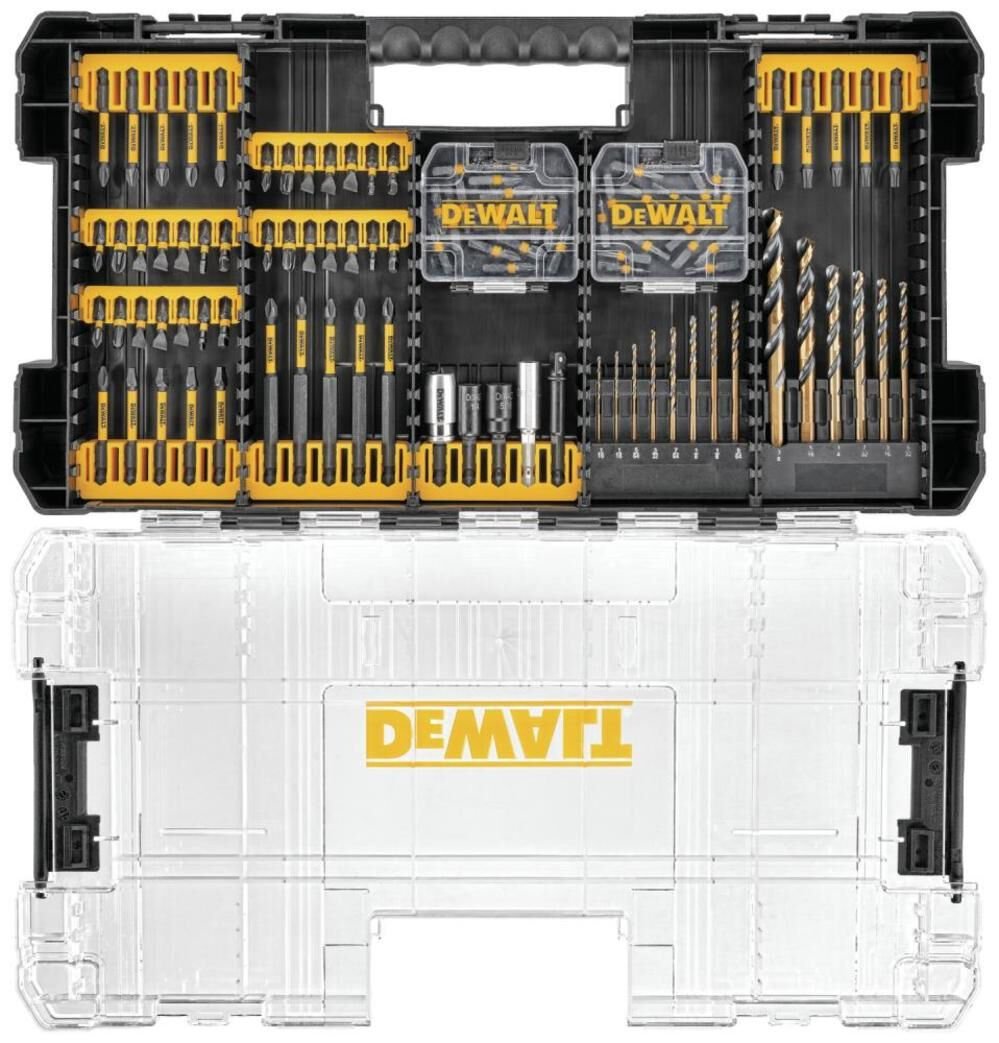
The foundation of this minimalist kit is a professional driver system. Cheap multi-tools usually fold or snap under pressure, but a DeWALT FLEXTORQ bit set is engineered for high-torque applications. When you’re trying to loosen a rusted fastener in the rain, you need bits that won’t strip. Pair these with a few core hand tools: an 8-inch adjustable wrench, needle-nose pliers with a wire cutter, and a dedicated high-torque screwdriver handle. These few items solve more problems than a box full of cheap, specialized sockets ever will.
Impact-Ready Durability for Roadside Stress
FLEXTORQ technology features a specialized torsion zone that allows the bit to flex under load. This prevents the head from snapping when you’re applying maximum force to a stubborn bolt. It’s a lifesaver when you’re working in a hurry on a dark shoulder. A magnetic bit holder is another critical addition; it keeps your hardware from disappearing into the gravel when your hands are shaking from the cold. If you’re a professional who carries a cordless drill in your vehicle, ensure you’ve selected the best drill bits for impact driver use. These bits are designed to survive the hammering action of an impact tool without shattering, which is a common failure point for standard black-oxide bits.
Beyond the Basics: Cutting and Prying
Sometimes the obstacle isn’t mechanical. You might need to clear heavy brush after a slide or cut away a damaged plastic wheel well liner that’s rubbing against your tire. A single Bosch reciprocating saw blade can be used in a manual folding handle to provide incredible cutting power without the bulk of a full power saw. For temporary fixes, keep heavy-duty zip ties and a roll of high-quality duct tape nearby. Even your power gear can serve double duty. A high-visibility pink extension cord is easy to spot in the grass, and in a pinch, its rugged jacket allows it to function as an emergency signaling rope or a temporary tie-down for a loose trunk lid.
Don’t settle for tools that fail when the pressure is on. Check out our full range of professional-grade hardware and cords to build a kit you can actually trust.
The Comprehensive Checklist: Building Your 2026 Emergency Kit
Building a professional setup requires more than just buying the right parts. It’s about organization and maintenance. Start by choosing a durable, weather-resistant storage container. A hard-shell case is best for protecting sensitive electronics and preventing heavy tools from puncturing other gear. If you have limited trunk space, a high-denier soft bag offers more flexibility. Once you have your container, layer your emergency car kit essentials by frequency of use. Place your power solutions at the very top. You should never have to dig through survival blankets and water rations to reach your jump starter during a midnight breakdown.
Maintenance is the part most drivers skip. Audit and update your kit every six months to coincide with seasonal changes. Check the charge levels on your lithium-ion devices and swap out summer gear for winter supplies. Finally, practice using your gear. Connect your jump starter to your battery and run your tire inflator for a few minutes while you’re safely in your driveway. Learning how these tools operate in a controlled environment reduces panic when a real emergency happens.
The “Must-Have” List for 2026
- Lithium Jump Starter: A high-capacity unit with at least 2,000 peak amps for reliability.
- Portable 12v Inflator: Look for digital auto-shutoff for pressure precision.
- Professional Tool Set: Include DeWALT FLEXTORQ bits and a multi-bit driver.
- Hands-Free Lighting: An LED headlamp is superior to a handheld flashlight for repairs.
- Safety Signaling: Reflective triangles and high-visibility markers to alert other drivers.
- First Aid Kit: A stocked medical bag for minor injuries and roadside scrapes.
Customizing for Your Vehicle Type
Your vehicle’s specific needs dictate the final composition of your kit. For heavy-duty trucks and SUVs, prioritize higher peak amp jump starters and longer extension cords to reach trailer tires. If you drive an EV, focus heavily on tire repair kits and 12v battery health. EVs can’t be jumped in the traditional sense, so maintaining that small 12v system is vital for keeping the computer systems online. For compact cars, space is at a premium. Look for integrated power banks and collapsible tools to maximize your emergency car kit essentials without losing your entire trunk. Every vehicle is different, but the goal of total self-reliance remains the same.
Take Control of Your Roadside Readiness
Preparing for 2026 means moving past the “hope for the best” strategy. You’ve seen why traditional gear fails and how independent power solutions like lithium jump starters change the game. By focusing on active recovery tools and professional-grade hardware, you ensure that a dead battery or a flat tire is a minor delay rather than a dangerous ordeal. High-quality emergency car kit essentials are an investment in your safety and peace of mind on the open road.
Since 1997, we’ve helped drivers stay powered up with heavy-duty 10 and 12-gauge solutions. As an authorized retailer of DeWALT and Bosch hardware, we understand that reliability isn’t optional when you’re stranded. Don’t wait for the next breakdown to realize your kit is outdated. Upgrade your roadside preparedness with Fourman Industries professional gear today. You have the skills to handle the road; we have the tools to make sure you get where you’re going. Safe travels out there.
Frequently Asked Questions
Do I really need a portable jump starter if I have a new car?
Yes, because new cars are packed with complex electronics that can drain a battery quickly if a light is left on or a door isn’t closed properly. Even a brand-new battery can fail in extreme temperatures or after sitting for long periods. Having a portable unit ensures you aren’t stranded in a parking lot waiting for a tow truck just because of a simple parasitic drain.
How long does a lithium-ion car jump starter hold its charge?
Most high-quality lithium-ion jump starters will hold a functional charge for six to twelve months. However, it’s best practice to check the charge level every three months to ensure it’s above 80%. Extreme heat or cold can accelerate discharge. Keeping it at a healthy level ensures it has the peak amps needed to turn over a cold engine during an actual emergency.
Can a 12v tire inflator drain my car battery?
Yes, it can drain your battery if you use it for an extended period while the engine is off. To prevent this, always keep your engine running while using a 12v inflator. This provides a steady flow of power from the alternator. If you’re inflating multiple tires or a large truck tire, the draw is significant; running the vehicle is the only way to protect your battery’s health.
What is the most important item in a winter car emergency kit?
A reliable power source is the most critical of all emergency car kit essentials during winter. Cold weather can reduce a battery’s cranking power by up to 50%, making a jump starter vital. Beyond power, a high-quality thermal blanket is a life-saver if you’re stuck waiting for help in freezing temperatures. These two items address the immediate threats of a dead vehicle and hypothermia.
Are jumper cables safer than portable jump starters?
No, portable jump starters are generally safer because they include integrated spark-proof technology and reverse polarity protection. Traditional cables carry the risk of short-circuiting or damaging sensitive ECUs if you cross the leads. A portable unit also removes the safety risk of flagging down a stranger on a dark road. It’s a cleaner, more controlled way to get your engine running again without external help.
How often should I check the air pressure in my spare tire?
You should check your spare tire’s pressure every time you change your oil or at least every six months. Spare tires naturally lose air over time through permeation. There is nothing worse than pulling out a spare only to find it’s as flat as the tire you’re replacing. Keeping it topped off ensures your emergency car kit essentials are actually ready for the road.
Should I keep a fire extinguisher in my car kit?
Yes, carrying a compact UL-rated fire extinguisher designed for Class B and C fires is a smart move. Vehicle fires often start from electrical shorts or fuel leaks, and having an extinguisher can prevent a small flame from consuming the entire car. Mount it in an accessible location, like the side of the trunk or under the passenger seat, so you don’t have to dig for it.
Can I use my car kit tools for home DIY projects?
You can, but it’s better to keep your car tools dedicated to your vehicle. High-performance gear like DeWALT FLEXTORQ bits are great for home projects, but if you forget to put them back in the trunk, your kit is useless during a breakdown. Keep a separate set of tools for the garage. This ensures your roadside kit remains complete and ready for any mechanical issue you face away from home.




