
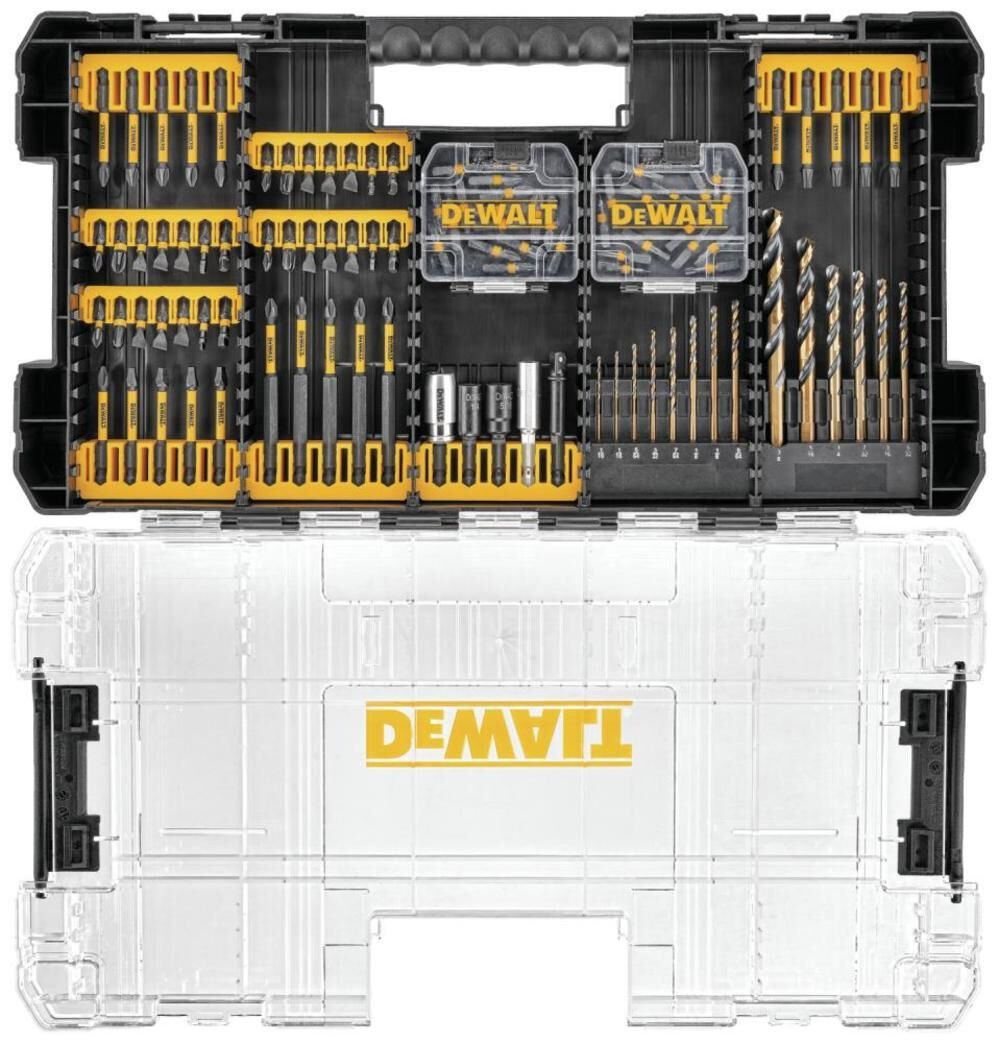
Did you know that a single bit from a DeWALT FlexTorq set can outlast a standard driver bit by up to 200 times? It is a staggering statistic, but it highlights the reality of modern high-torque impact drivers. You’ve likely felt the frustration of a bit snapping right as you’re finishing a critical fasten, or worse, watching a stripped screw ruin a piece of expensive material. Most pros agree that cheap bits are actually the most expensive tools on the job site because of the constant downtime and material damage they cause.
This dewalt flextorq bit set guide is here to help you master the technical specifications and practical applications of these impact-ready accessories. By understanding how the specialized torsion zone absorbs energy, you can finally eliminate fastener cam-out and significantly extend your tool’s life. We will provide a clear breakdown of the CNC-machined tolerances, compare the FlexTorq line against the MaxFit series, and identify exactly which sizes you need to maintain peak efficiency in any professional application.
Key Takeaways
- Get the facts on the “Impact Ready” standard and see how these bits manage 2,000 in/lbs of torque on the toughest jobs.
- Follow this DeWALT FlexTorq bit set guide to understand how the extended torsion zone flexes to prevent the breakage that stalls your progress.
- Pinpoint the exact Torx sizes you need for everything from decking to framing to ensure a tight, slip-free fit.
- See how modular storage like the ToughCase+ keeps your bits organized so you stop losing money on missing equipment.
- Master the art of matching bits to fasteners to stop cam-out and keep your high-end materials looking professional.
What is DeWALT FlexTorq? Understanding the Impact-Ready Standard
DeWALT FlexTorq isn’t just another product line. It is a structural engineering response to the massive power of modern cordless tools. This dewalt flextorq bit set guide starts with a simple reality: impact drivers are significantly stronger than they were a decade ago. Standard bits often snap or “cam-out” because they cannot handle the sudden, violent peaks of rotational force. FlexTorq bits are designed specifically to flex under pressure rather than shearing off. This line evolved from the older Tough Grip series, moving toward the modern “Impact Ready” standard. This rating ensures that every bit in the set can withstand up to 2,000 in/lbs of torque without failing.
Organization is just as important as durability on a busy job site. Most FlexTorq sets come housed in the ToughCase+ system. This modular storage solution allows you to click cases together and customize your bit layout. It eliminates the “lost tool tax” that happens when loose bits end up at the bottom of a five-gallon bucket. When you buy a FlexTorq set, you aren’t just buying steel; you’re buying a system designed to keep you working instead of searching for a replacement T25.
Impact Driver vs. Drill/Driver Requirements
Standard drills provide constant rotational force, which is fine for drilling holes or driving small screws into soft wood. An Impact driver works differently. It uses an internal hammer and anvil mechanism to deliver thousands of tiny, concussive blows every minute. This force is what allows you to drive a six-inch lag bolt, but it shatters standard bits because they are too rigid. FlexTorq accessories undergo a specialized heat-treatment process. This creates a bit that is hard at the tip for a precise fit but slightly more “springy” in the middle. This allows the bit to absorb the impact rather than snapping under the strain of an 18V or 20V motor.
FlexTorq vs. MaxFit: Clearing the Confusion
Confusion often happens when you’re staring at the yellow and black tool aisle. While both lines are high-quality, they serve different masters. MaxFit bits are precision-engineered for the tightest possible fit in manual drills and standard drivers. They are the go-to choice for precision cabinetry or furniture assembly where you want zero wobble. However, for heavy framing, deck building, or any task involving an impact driver, you need the ruggedness of FlexTorq. You can find a detailed breakdown in our DeWALT MaxFit vs. FLEXTORQ comparison. Choose FlexTorq when the tool is doing the heavy lifting, and stick to MaxFit when you’re doing the fine-tuning.
The Engineering of the FlexTorq Torsion Zone
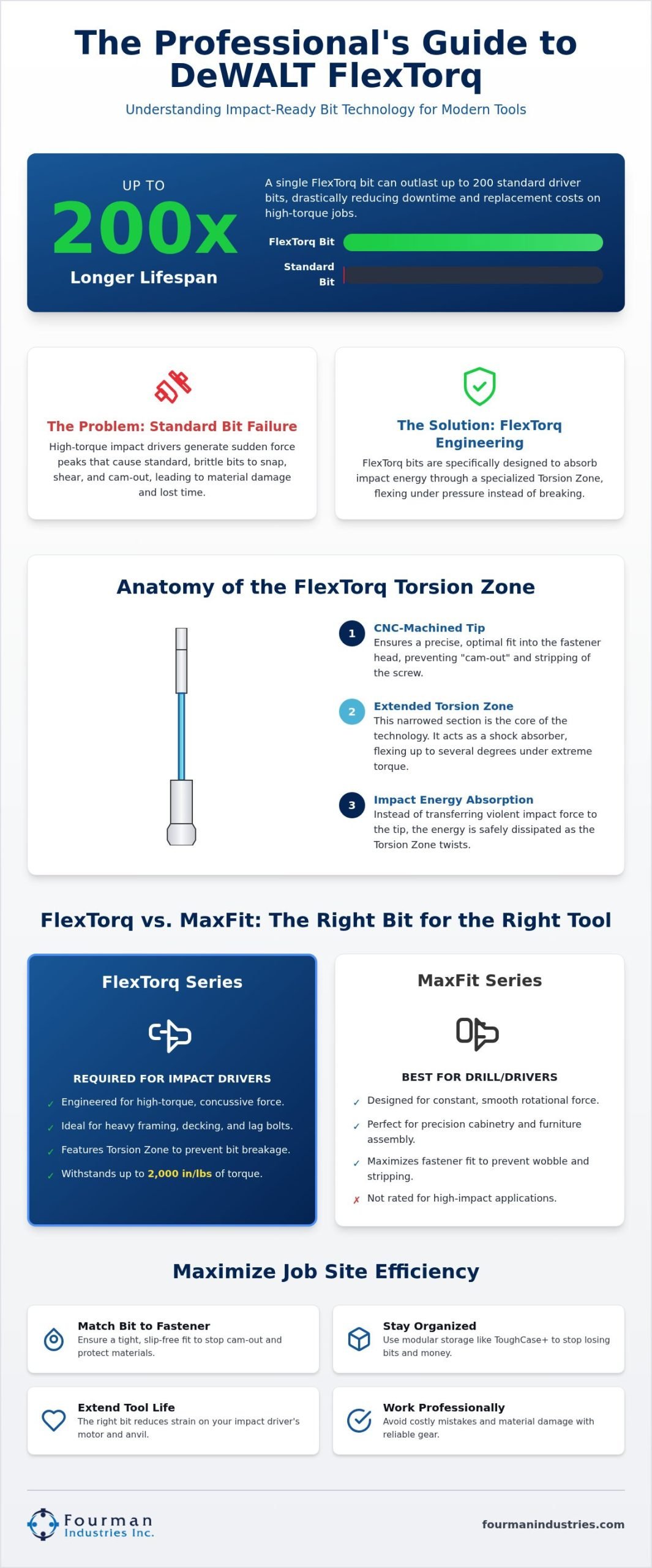
The “FlexTorq Zone” isn’t just a marketing label stamped on the side of a plastic case. It is a structural solution to the physics of high-torque impact driving. Standard driver bits are often too brittle; they snap like glass when they hit the peak resistance of a 20V impact driver. This dewalt flextorq bit set guide identifies the core of this technology as the “extended torsion zone.” By using a specialized metallurgy centered on S2 tool steel, DeWALT created a bit that is hard enough to grip a screw but flexible enough to survive the hammer-and-anvil action of your tools. On average, this allows the bits to deliver up to 200 times longer life compared to standard screwdriving bits.
The reflex design works by allowing the bit to twist slightly under load. Instead of the energy transferring directly to the tip and shattering the steel, the force is distributed through the bit’s body. This “spring action” is what keeps the head of the bit intact during heavy-duty framing or deck building. Using the right bit isn’t just about speed; it’s about following OSHA power tool safety guidelines to prevent slips and material damage that can lead to job site injuries. If you want to keep your workflow moving, having a reliable DeWALT FlexTorq bit set in your pouch is the best way to avoid the constant “bit-swapping” dance.
Anatomy of a Torsion Zone
Visualize the “waist” of the bit. This narrowed section acts as a mechanical shock absorber. When your impact driver hits a high-torque peak, this zone twists up to several degrees. This tiny movement is enough to bleed off the excess energy that would otherwise cause the bit to shear. The effectiveness of this zone is directly related to the length of the bit. A 2-inch bit has more room for a torsion zone than a 1-inch insert bit, which is why pros often prefer longer bits for high-stress fasteners. The longer the waist, the more “twist” the bit can handle before it reaches its breaking point.
CNC Precision and Fastener Grip
The second half of the engineering puzzle is the tip itself. DeWALT uses CNC (Computer Numerical Control) machining to mill the heads of these bits. This process ensures that the tolerances are incredibly tight. For T20 to T40 size fasteners, these optimized geometries offer up to 2x better fitment than major competitors. A precise fit is the only way to stop “cam-out,” which is when the bit jumps out of the screw head. When a bit wobbles or slips, it doesn’t just ruin the bit; it strips the fastener and slows down your entire crew. CNC-milled tips lock into the screw, ensuring every ounce of torque goes into the wood rather than into grinding down the metal.
DeWALT Max Fit Torx Screwdriver Bit Set: Sizing and Compatibility
The job site has changed. If you look at modern decking or framing screws, you’ll see the star-shaped Torx drive everywhere. This shift happened because Torx fasteners allow for higher torque transmission without the bit slipping out. This dewalt flextorq bit set guide focuses on how to match these sizes to your specific project. While Phillips heads are still around for drywall and light assembly, Torx is the professional standard for anything structural.
A standard DeWALT FlexTorq set covers the full spectrum from T10 to T40. The T25 bit is the undisputed workhorse of modern construction. It is the standard size for 3-inch deck screws and most general-purpose wood fasteners. These bits use a standard 1/4-inch hex shank, meaning they are fully compatible with any major brand of impact driver, whether you’re running yellow, red, or teal tools. You don’t need a specific brand of driver to benefit from the torsion zone engineering.
Torx Bit Sizing Reference Chart
Choosing the wrong bit is the fastest way to ruin a fastener. If you use a T20 bit in a T25 screw, you’ll feel it “bite” initially, but it will strip the head the moment you apply real pressure. Use this general guide for matching bits to your hardware:
- T10 and T15: Perfect for small trim screws, cabinet hardware, and light-duty interior work.
- T20: Often found in specialized interior fasteners and some smaller-gauge deck screws.
- T25: The go-to for #8 and #10 wood screws and most exterior decking fasteners.
- T30 and T40: Required for heavy-duty structural lags and ledger board screws.
The optimized tip geometry in FlexTorq bits ensures a 2x better fit on T20 to T40 sizes compared to major competitors. This tight fit is critical when you’re driving hundreds of screws a day; it saves your forearms from the fatigue caused by pushing too hard just to keep the bit engaged.
Specialty Bits in the FlexTorq Catalog
The FlexTorq ecosystem goes beyond just star drives. Square drive bits, also known as Robertson bits, are essential for electrical boxes and many cabinetry lines. These offer excellent grip and are virtually impossible to strip when sized correctly. For those working with hex-head fasteners, nut drivers and socket adapters allow your impact driver to replace a traditional wrench set for many tasks.
One of the best upgrades highlighted in this dewalt flextorq bit set guide is the magnetic screw lock sleeve. This sleeve slides over the bit and holds the fastener securely in place. It allows for true one-handed driving, which is a lifesaver when you’re balanced on a ladder or reaching into a tight corner. It turns a standard bit into a precision tool that won’t drop expensive stainless steel screws into the mud.
How to Choose and Maintain Your Impact Bit Set
Buying the right tools is only the first step. To get the most out of your gear, you need a maintenance routine that prevents failure before it happens. This dewalt flextorq bit set guide breaks down the five steps to keeping your driver bits in peak condition. If you ignore these, you’re just throwing money into the scrap bin.
- Audit your fasteners: Look at your inventory. If you’re mostly driving deck screws, your set should be heavy on T25 bits. Don’t carry weight you don’t use.
- Use modular storage: Systems like the ToughCase+ aren’t just for show. They prevent bits from rubbing against each other, which can dull the precision-milled edges.
- Inspect tips daily: Take ten seconds every morning to check for rounding or hairline cracks. A compromised bit will fail under the first high-torque load.
- Clear debris: Magnetic holders attract metal shavings. This buildup prevents the bit from seating fully in the fastener, leading to instant cam-out.
- Replace early: The moment a bit slips, it’s done. Trying to “get one more” screw out of a worn bit is how you ruin expensive materials.
Keeping a fresh DeWALT FlexTorq bit set on hand ensures you never have to choose between a job well done and a deadline.
Selecting the Right Bit for Impact Drivers
Not every bit is built for every job. You should consult our Pro Selection Guide for Impact Bits to match bit hardness to your specific application. For example, 1-inch insert bits are cost-effective for high-volume work when paired with a magnetic holder. However, 2-inch power bits offer better reach and allow the torsion zone to work more effectively. While bulk bit bags are cheaper upfront, organized sets save time by keeping the right size within reach at all times. It’s about finding the balance between cost and job site efficiency.
Extending Bit Life Through Proper Technique
Even the best S2 tool steel will fail if your technique is sloppy. Axial pressure is your best friend. You must keep the driver perfectly aligned with the fastener and apply enough forward force to keep the bit seated. If the driver is at an angle, the torque isn’t distributed evenly, and the bit will snap. You also need to manage your trigger speed. Don’t just pin the trigger and hope for the best. “Feathering” the trigger allows you to control the impact force and prevents the bit from overheating. Finally, listen to your tool. A failing bit often makes a distinct grinding sound or a sharp metallic “ping” before it actually breaks. If you hear it, swap it out immediately.
Maximizing Job Site Efficiency with Professional Gear
Efficiency on a job site isn’t just about how fast you can drive a screw. It’s about how well your entire system stays together under pressure. This dewalt flextorq bit set guide has already shown you how the torsion zone prevents breakage, but a bit is only as good as the organization behind it. The ToughCase+ system reduces downtime by keeping your bits indexed and visible at all times. You don’t waste ten minutes digging through a messy bag for a specific T20. You find it instantly, drive the fastener, and move to the next task without breaking your rhythm.
Professional-grade accessories justify their higher initial cost through sheer longevity. While cheap bits might seem like a bargain, the “broken bit tax” adds up quickly in lost time and ruined materials. High-quality bits represent a commitment to your productivity. Pro sets often range up to 100 pieces in the flagship 2026 configurations, ensuring you have the exact tool for every specialized fastener you encounter. When your gear works reliably, you stay on schedule and keep your overhead low.
Powering Your Tools: Beyond the Bit
Even the most advanced FlexTorq bit will fail if your impact driver isn’t getting consistent power. Voltage drop is a silent killer of torque on many job sites. If you run your tools through a thin, generic cord over a long distance, your driver’s motor will struggle to hit its peak impact ratings. This strain doesn’t just slow you down; it can cause the bit to slip because the driver isn’t hitting with the necessary crispness. You should pair your impact driver with a heavy-duty 12 gauge extension cord for maximum voltage delivery. Stable power ensures your tool performs exactly how the engineers intended.
Asset Management and Theft Prevention
Tools disappear on busy sites every day. It’s a frustrating reality that can stall a project and eat into your profits. Managing your assets is just as important as maintaining your bits. You can protect your equipment by using personalized and custom-printed extension cords to mark your crew’s territory clearly. Choosing high-visibility options like pink or purple cords makes it easy to identify your kit from across the site. This level of organization prevents gear confusion and builds a cohesive, professional image for your business. It shows clients that you’re a “practical expert” who takes pride in every part of your setup, from the bit tip to the power source.
Build a Faster, More Reliable Job Site
Mastering your tool setup starts with choosing gear that’s built for the extreme torque of modern construction. As we’ve detailed in this dewalt flextorq bit set guide, the right bit does more than just drive a screw; it protects your materials and prevents the downtime caused by snapped steel. By combining the flex-zone technology of DeWALT bits with organized storage and consistent power delivery, you can eliminate the frustrations of cam-out and broken tips forever.
Efficiency doesn’t happen by accident. It’s the result of pairing industry-leading FlexTorq technology with heavy-duty accessories that stand up to daily abuse. Since 1997, we’ve focused on providing the customized job site solutions that professionals need to stay productive and organized. Don’t let a cheap bit or a failing power cord slow down your crew’s progress. It’s time to invest in equipment that works as hard as you do.
Upgrade your kit with DeWALT FlexTorq and Professional Gear at Fourman Industries and see the difference that pro-grade durability makes on your next project. Keep your tools sharp, your site organized, and your work moving forward. A well-prepared professional also thinks beyond the job site; having the right emergency car kit essentials in your vehicle ensures you’re just as ready for roadside breakdowns as you are for demanding construction tasks.
Frequently Asked Questions
Are DeWALT FlexTorq bits better than MaxFit for impact drivers?
Yes, FlexTorq bits are the superior choice for impact drivers because they feature the specialized extended torsion zone. MaxFit bits lack this flexible “waist” and are more likely to shatter under the high-torque peaks of an 18V or 20V impact tool. While MaxFit offers a tighter fit for precision cabinetry using a standard drill, this dewalt flextorq bit set guide recommends sticking with FlexTorq for any heavy framing or decking task.
Can I use FlexTorq bits in a regular drill/driver?
You can absolutely use FlexTorq bits in a regular drill or driver. They feature the standard 1/4-inch hex shank that fits into any quick-release chuck or traditional three-jaw chuck. While you won’t utilize the full potential of the torsion zone in a low-torque drill, you’ll still benefit from the CNC-machined tip and the durability of the S2 tool steel construction during your general assembly or hobbyist tasks.
What is the most common Torx bit size for construction screws?
T25 is the most common Torx size you’ll encounter on a modern job site. It is the industry standard for 3-inch deck screws and structural wood fasteners. Most sets featured in a dewalt flextorq bit set guide will include multiple T25 bits because they see the most wear and tear. For smaller interior trim or cabinet screws, you will typically reach for a T10 or T15 bit instead.
How do I know when a FlexTorq bit needs to be replaced?
Replace your bit the moment you notice rounding at the tip or visible hairline cracks along the torsion zone. A healthy bit should seat firmly in the fastener with zero wobble. If the bit starts to slip out of the screw head (cam-out), the precision-milled edges have likely worn down. Continuing to use a worn bit will eventually strip the fastener and could damage your expensive work surface.
Why do my impact bits keep snapping even if they are ‘impact ready’?
Even impact-ready bits can snap if you don’t maintain proper axial pressure. If your driver isn’t perfectly aligned with the screw, the torque hits the bit at an angle, causing it to shear. Excessive heat is another factor; driving long fasteners into dense lumber without feathering the trigger can make the steel brittle. Always ensure you’re pushing straight and letting the tool’s impact mechanism do the heavy work.
Does the DeWALT ToughCase+ fit other brands of bits?
The ToughCase+ system is highly versatile and fits any standard 1/4-inch hex shank bits, regardless of the brand. The internal bit bars are modular, so you can reorganize them or swap them out to fit your specific needs. This makes it a great central hub for your entire collection. It allows you to keep your specialty bits and standard drivers in one rugged, connectable case for better job site organization.
Is there a difference between Torx and Star drive bits?
There is no functional difference between the two; Torx is simply the trademarked brand name for the six-point star drive system. You’ll often see them labeled as star bits in generic hardware stores or on bulk fastener boxes. Whether a bit is labeled as Torx or star, the sizing (like T25 or T30) remains the same across the industry, ensuring compatibility with your existing driver sets and fasteners.
What should I do if a bit snaps off inside a screw head?
If a bit snaps flush inside a screw head, your best bet is to use a small center punch and hammer to tap the fragment loose. If you can’t get a grip with needle-nose pliers, you might need a dedicated screw extractor kit. In many framing situations, it’s often more efficient to simply leave the broken screw in place and drive a new fastener an inch away to keep the project moving.




