
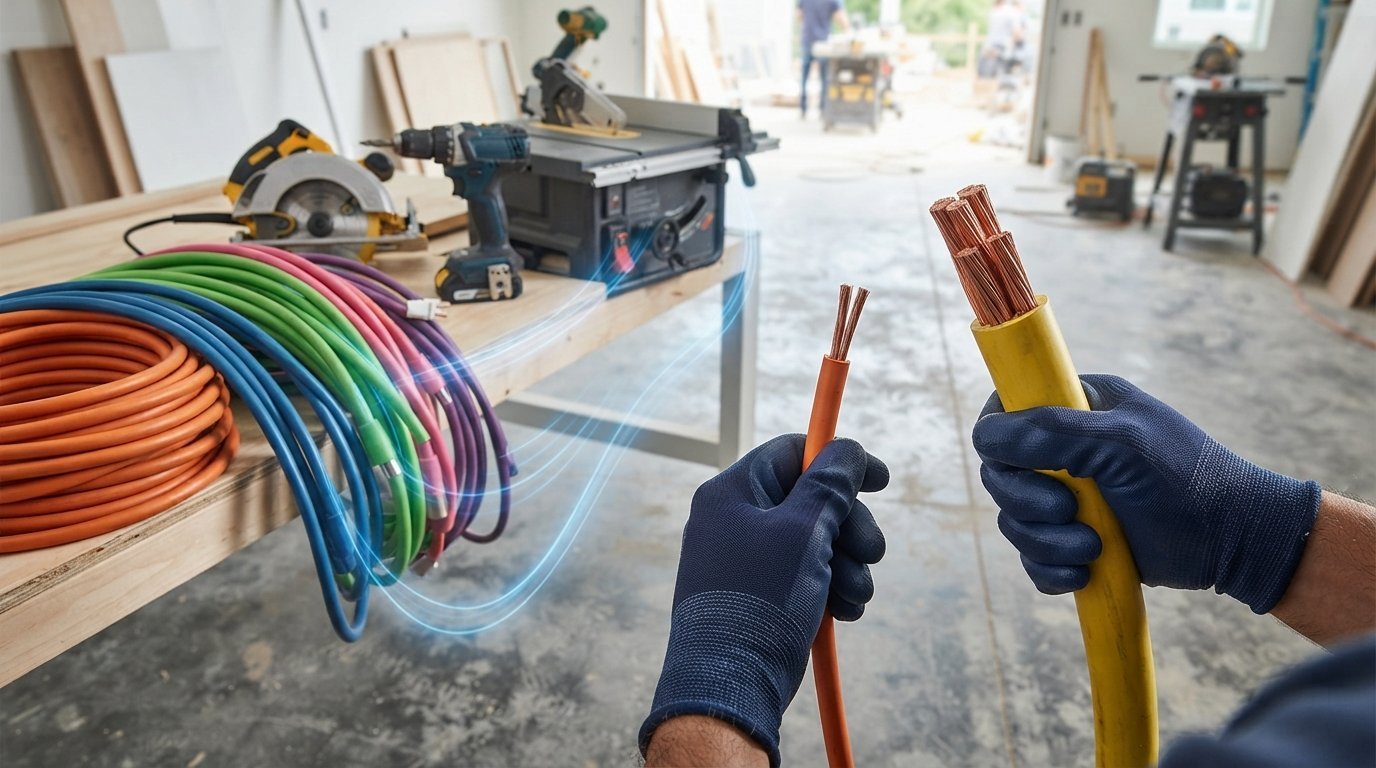
Why is your high-end table saw bogged down or running hot when it’s plugged into a brand-new cord? The answer usually isn’t the tool. It’s the wire. You’ve likely felt that frustration when a motor struggles to start or your equipment feels underpowered during a critical cut. It’s tempting to grab whatever cord is closest, but choosing the right gauge extension cord is the difference between a job well done and a permanent equipment failure.
We know you care about your gear and your safety. You want maximum power without the constant fear of starting an electrical fire or tripping a breaker every five minutes. This professional guide simplifies the confusing American Wire Gauge system, where smaller numbers actually mean bigger, beefier wires. We’ll help you stop the power loss that’s killing your productivity in 2026.
By the end of this article, you’ll have total confidence in your next purchase. We provide a definitive chart for gauge versus distance and explain why a 12 Gauge SJTW Triple Tap is the professional standard for most sites. You’ll also learn when your high-draw gear requires the industrial strength of a 10 Gauge ECONO cord to stay cool under pressure.
Key Takeaways
- Learn the “smaller is bigger” rule of the American Wire Gauge system to ensure your tools get the copper they need to run efficiently.
- Master the art of choosing the right gauge extension cord by matching your tool’s amperage draw to the cord’s thickness and total distance.
- Understand how voltage drop over distance can damage expensive motors and why you should step up to a heavier gauge every 50 feet.
- Identify why a 12 Gauge SJTW Triple Tap cord is the professional jobsite standard and when to switch to a 10 Gauge ECONO cord for high-draw equipment.
- Discover how custom-printed cords and high-visibility colors like pink or purple can stop jobsite theft and keep your crew organized in 2026.
Understanding AWG: The Science of Extension Cord Gauge
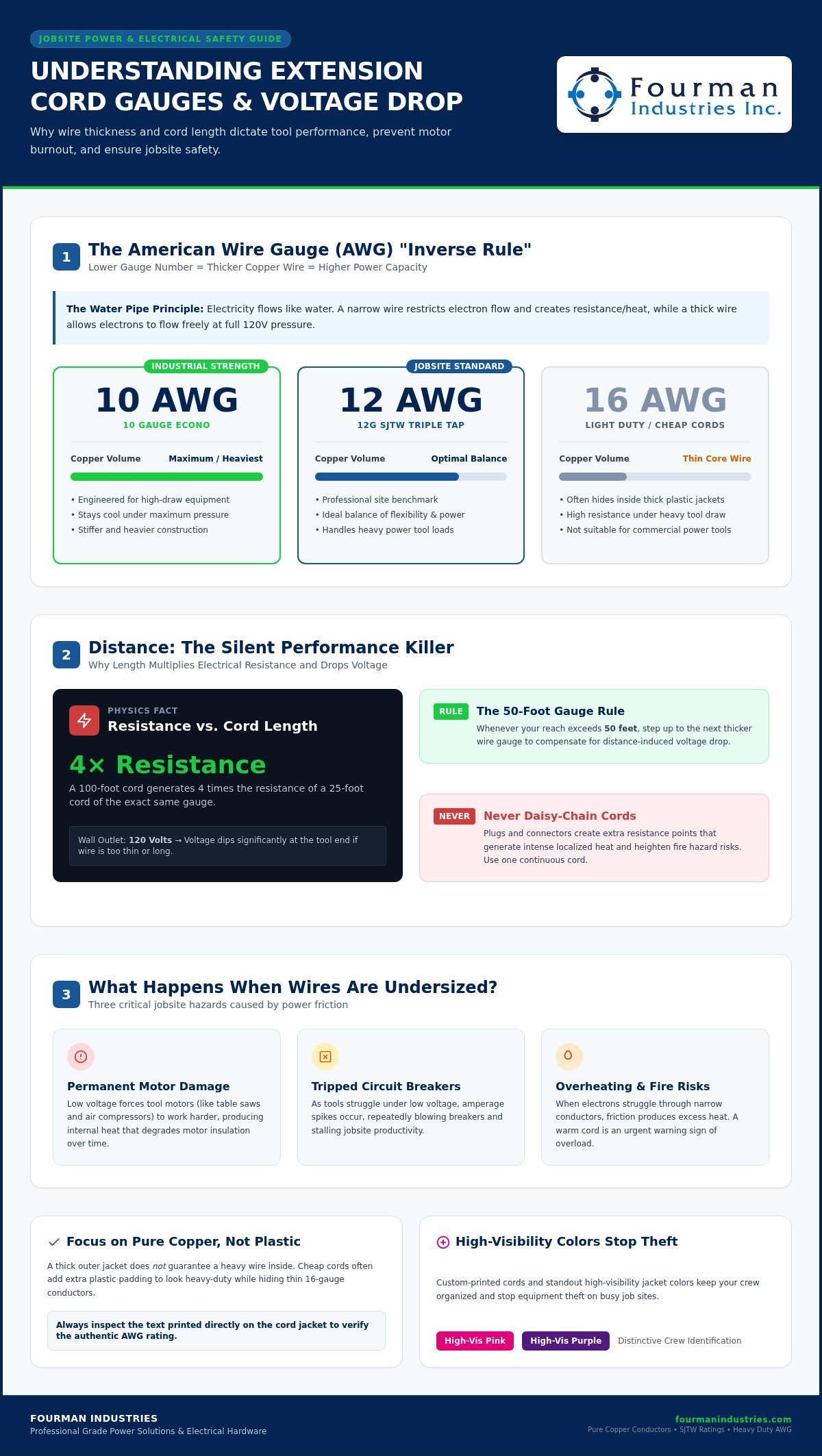
The American Wire Gauge (AWG) standard is a bit like golf. A lower score means you are actually doing better. When choosing the right gauge extension cord, you are looking at the physical thickness of the copper wire inside the insulation. This measurement dictates how many electrons can flow through the cord at once. If the wire is too thin for the tool, the electricity encounters resistance. This resistance creates heat, wastes energy, and can eventually melt your cord or fry your motor.
Think of it like a water pipe. A narrow pipe restricts flow and increases pressure. A wide pipe lets the water move freely. In the electrical world, 12-gauge and 10-gauge wires are the heavy-duty pipes of the jobsite. They provide the “Professional Grade” benchmark because they can handle the high amperage that modern power tools demand without dropping voltage or overheating. Using anything less for a circular saw or a compressor is asking for trouble.
The Inverse Rule: Why Lower Numbers Mean More Power
The AWG system can be confusing at first. It’s helpful to visualize the difference between a 10-gauge and a 16-gauge wire. A 10-gauge cord is significantly heavier and stiffer because it contains much more copper. Many people assume a thick outer jacket means a thick wire inside. That’s a common misconception. Some cheap cords use extra plastic padding to look “heavy-duty” while hiding a thin, 16-gauge wire inside.
For professional work in 2026, we focus on the copper, not the plastic. A 12 Gauge SJTW Triple Tap cord is our standard for a reason. It offers the right balance of flexibility and power capacity. If you move up to a 10 Gauge ECONO cord, you’re getting an industrial-strength solution designed for the highest-draw gear on the market. Always check the printed text on the cord jacket to find the real AWG number.
Why Copper Quality Matters for Conductivity
Pure copper is the gold standard for conductivity. When you use an undersized wire for a heavy load, the electrons literally struggle to push through the narrow conductor. This friction creates heat. A high-quality cord manages this heat effectively. If you’ve ever felt an extension cord get warm to the touch, it’s a warning sign that the gauge is too small for the tool.
Safety is the biggest priority here. Undersized wires lead to:
- Permanent motor damage in your expensive tools.
- Tripped circuit breakers that stall your progress.
- Potential fire hazards from overheating jackets.
Using a professional-grade 10 or 12-gauge cord ensures your gear stays cool and your workspace stays safe.
The Impact of Length: Calculating Voltage Drop
Distance is the silent killer of power tool performance. While you might understand that a thicker wire carries more current, many people overlook how much power is lost just traveling from the outlet to the tool. This loss is called voltage drop. It is essentially a decrease in electrical pressure. When choosing the right gauge extension cord, you have to account for the total length of the run, not just the tool’s amperage.
Electricity faces resistance every inch it travels through copper. The longer the wire, the higher the resistance. If your cord is too long or too thin, the voltage arriving at your saw might be significantly lower than the 120 volts leaving the wall. This is why a 100-foot run demands specialized 12 gauge extension cords to maintain steady performance. For industrial gear, you might even need to step up to a 10 Gauge ECONO cord for those long reaches.
How Distance Increases Resistance
The physics are simple. A 100-foot cord has four times the resistance of a 25-foot cord of the same gauge. If you measure the voltage at the outlet, it might look perfect. But if you measure it at the end of a flimsy, long cord while the tool is running, you’ll see a massive dip. We recommend the 50-foot rule for most jobsites. If your reach exceeds 50 feet, always step up to the next thicker gauge to compensate for the distance. Never daisy-chain two cords together. Plugs and connectors create extra resistance points that generate heat and increase the risk of a fire. It’s always safer to use one continuous, high-quality cord.
Protecting Tool Motors from Low Voltage
Low voltage doesn’t just make your tools run slower. It forces the motor to work harder to do the same job. This extra effort generates internal heat that degrades the motor’s insulation over time. High-value equipment like table saws or air compressors are especially sensitive to these drops. They require a 12 gauge extension cord at minimum for any significant distance.
Using an undersized cord is a mistake that costs you more in the long run. You might save a few dollars on a cheaper cord today, but you’ll spend hundreds replacing a burnt-out motor later. Investing in a professional-grade 12 Gauge SJTW Triple Tap ensures your gear stays healthy through 2026 and beyond. It’s the most cost-effective way to protect your workshop investments while maintaining peak jobsite efficiency.
Gauge Selection by Application: Light vs. Heavy Duty
You’ve mastered the science of AWG and the math of voltage drop. Now it’s time for the practical application. Choosing the right gauge extension cord for the specific gear in your shop is the most effective way to prevent equipment failure. Matching the cord to the tool’s amperage draw ensures your motors stay cool and your projects stay on schedule in 2026.
Every tool has an amperage rating found on its nameplate. To make the right choice, categorize your gear into these three power levels:
- Light-Duty (16-Gauge): These cords handle 0-10 amps. They are perfect for shop fans, work lights, or holiday displays. Don’t use them for anything with a motor.
- Medium-Duty (14-Gauge): Rated for 10-15 amps. These work well for power drills, hedge trimmers, and small orbital sanders.
- Heavy-Duty (12-Gauge): The professional floor. These handle 15-20 amps and are required for circular saws, reciprocating saws, and portable air compressors.
Using a light-duty cord for a heavy-duty tool is a recipe for a burnt-out motor. The tool will try to pull the current it needs through a wire that’s too narrow, creating heat that bakes the internal windings of your expensive gear.
When to Use a 10 Gauge Heavy Duty Extension Cord
Some equipment doesn’t just pull power; it demands it. Industrial machinery, large space heaters, and professional-grade welders can easily push a 12-gauge cord to its thermal limit. This is where 10 Gauge ECONO Extension Cords become essential. They provide the maximum power delivery needed for high-draw equipment that runs for extended periods. If you are operating a portable generator, a 10-gauge cord is a non-negotiable safety requirement. It manages the high-wattage surges common during generator startup without risking a fire or a voltage dip that could stall the engine.
The 12 Gauge SJTW Triple Tap: The Contractor Standard
Most professional contractors consider 12-gauge the ultimate jobsite standard. It’s the “sweet spot” because it handles almost any handheld tool while remaining flexible enough to coil at the end of the day. Our 12 Gauge SJTW Triple Tap Extension Cords are built specifically for this rugged environment. The “Triple Tap” design is a massive efficiency booster. It allows you to run a saw, a work light, and a battery charger simultaneously from a single 20-amp circuit. This reduces jobsite clutter and ensures every tool gets the stable power it needs to perform at peak capacity. By choosing the right gauge extension cord, you are investing in the longevity of your tools and the safety of your crew.
Decoding Jacket Ratings: SJTW, UL, and Safety
Selecting the correct copper thickness is only half the battle. The outer jacket is what protects that investment from the chaos of a jobsite. When choosing the right gauge extension cord, you must look beyond the color and feel of the plastic. You need to read the code printed directly on the cord. This alphanumeric string tells you exactly how much abuse the cord can handle before it becomes a safety hazard.
The most common rating for professional work in 2026 is SJTW. Understanding this acronym is vital for your safety. “S” stands for Service, meaning it is designed for hard usage. “J” stands for Junior, which indicates a 300-volt rating. This is the standard for most portable power tools. “T” refers to the Thermoplastic jacket material. Finally, “W” stands for Weather-resistant. If a cord lacks that “W,” it is strictly for indoor use and will degrade quickly if exposed to moisture or sunlight.
Safety certifications are just as important as the jacket material. Always look for the UL (Underwriters Laboratories) mark. This certification means the cord has passed rigorous testing for heat resistance and electrical integrity. We also recommend using high-visibility gear to prevent accidents. Our Pink extension cords and Purple extension cords aren’t just for style. They stand out in a crowded workspace, significantly reducing trip hazards and making it clear which gear belongs to your crew.
Weather Resistance and Temperature Flexibility
Thermoplastic jackets are durable, but they have specific physical limits. In extreme heat, cheap jackets can become oily or overly soft. In the biting cold, they often become stiff and difficult to coil. A high-quality “W” rated cord uses stabilizers to maintain flexibility across a wider temperature range. Industrial-grade jackets also provide a critical layer of defense against jobsite chemicals, oils, and the constant abrasion of being dragged across concrete floors.
Safety Features: Grounded Plugs and Lighted Ends
Never bypass the third prong on your power cords. This ground wire is your primary defense against electrical shock if a tool malfunctions. For high-gauge power, a solid grounded connection is non-negotiable. Many professionals now prefer cords with lighted ends. This simple feature allows for instant troubleshooting. If the end is glowing, you know the outlet is live without walking back to the wall. Before every shift, inspect your cords for jacket nicks or exposed copper. If the jacket is compromised, the cord is a fire risk and should be replaced immediately.
Ready to upgrade your gear with professional-grade protection? Explore our full selection of 12 Gauge SJTW Triple Tap Extension Cords today.
The Professional Edge: Customization and Gear Management
You’ve done the math on voltage drop and identified the right amperage for your tools. But choosing the right gauge extension cord is about more than just electrical specs. It’s about protecting a business asset. On a busy jobsite in 2026, your gear is under constant threat from heavy foot traffic, harsh weather, and simple theft. Managing your cords effectively ensures they stay in your inventory and continue to perform for years.
Professional contractors don’t treat their power solutions as disposable commodities. They look for ways to streamline their workflow and secure their equipment. By moving beyond generic, big-box store options, you can turn your power delivery system into a marketing and security tool that works as hard as you do.
Preventing Confusion and Theft on Shared Sites
Generic orange cords are a liability on a shared jobsite. They are easily “borrowed” by other crews and rarely find their way back to your truck. This is where custom extension cords provide a massive professional advantage. Having your company name or phone number printed directly on the jacket serves as a permanent psychological deterrent to theft. It’s much harder for someone to claim a cord is theirs when your branding is visible every 12 inches.
Color-coding is another highly effective management strategy. High-visibility options like pink extension cords or purple cords stand out in low-light environments and mud. These colors are impossible to miss, which reduces the chance of someone accidentally tripping over your line or running it over with a lift. It also makes end-of-day pack-out much faster for your crew since they can spot their specific gear from across the room.
Investing in Longevity: Quality Over Commodity
Cheap cords fail because of poor-quality jackets and thin internal conductors. They develop “memory kinks” that make them impossible to coil and lead to internal wire breaks. When choosing the right gauge extension cord, the ROI of a professional-grade 10 or 12-gauge cord is undeniable. A 12 Gauge SJTW Triple Tap cord built with high-quality thermoplastic will outlast three or four cheap alternatives.
To maximize the life of your gear, follow these management tips:
- Use the “Over-Under” Coiling Method: This prevents internal twisting and ensures the cord lays flat every time.
- Wipe Down Jackets: Remove oil and chemicals before storage to prevent the jacket from becoming brittle.
- Store in Cool, Dry Areas: While “W” rated cords handle the elements, constant UV exposure can eventually degrade any plastic.
A final checklist for your next purchase should include UL certification, a lighted end for troubleshooting, and a jacket rating that matches your specific work environment. Investing in industrial-strength solutions like our 10 Gauge ECONO series ensures you never have to worry about power failure when it matters most.
Take Command of Your Jobsite Power
Mastering the science of AWG and voltage drop puts you ahead of the competition. You now understand that choosing the right gauge extension cord is a strategic decision that protects your tools and your timeline. Whether you’re running a heavy-duty compressor on a 10 Gauge ECONO cord or powering a full crew with 12 Gauge SJTW Triple Taps, you have the knowledge to work safely and efficiently in 2026.
Don’t let power loss or jobsite theft slow you down. At Fourman Industries, we provide expert-selected 10 and 12 gauge options that meet strict UL Certified safety standards. Our custom printing services turn your cords into high-visibility security assets that stay in your truck where they belong. You’ve got the expertise; now get the gear that matches your professional standards and blue-collar reliability.
Shop Heavy-Duty Custom Extension Cords at Fourman Industries and keep your equipment running at peak performance. Your tools will thank you for the steady power and the long-term protection.
Frequently Asked Questions
What happens if I use a 16-gauge cord for a heavy-duty tool?
Using a 16-gauge cord for heavy tools like circular saws causes immediate voltage drop and dangerous heat buildup. The thin wire restricts electron flow; this forces the tool motor to run hot and eventually burn out. It’s a significant fire hazard that can lead to permanent equipment damage. Always check the tool’s amperage rating before choosing the right gauge extension cord to ensure your equipment stays safe and powerful in 2026.
How can I tell the gauge of an extension cord if the label is missing?
Check the outer jacket for embossed or printed text. Manufacturers usually stamp the gauge directly into the insulation for easy identification. Look for a number followed by a slash, such as “12/3” or “14/3.” The first number represents the American Wire Gauge. If the jacket is completely worn and the markings are gone, don’t risk your expensive tools. It’s safer to replace the cord with a known 12 Gauge SJTW Triple Tap.
Is a 12-gauge extension cord better than a 14-gauge?
A 12-gauge cord is superior for most professional applications because it contains more copper than a 14-gauge cord. This extra thickness allows it to carry more amperage over longer distances with less resistance. While 14-gauge is fine for small drills or hedge trimmers, 12-gauge is the standard for circular saws and compressors. It provides the steady power your gear needs to perform at peak capacity without overheating the motor and causing a failure.
Can I plug two extension cords together to reach a further distance?
Don’t plug two cords together. This practice, known as daisy-chaining, creates multiple points of electrical resistance at the plug connections. These connections generate heat and can melt the plastic housing over time. It also doubles the voltage drop over the total distance; this starves your tool of the power it requires. If your reach exceeds 50 feet, purchase a single continuous 100-foot cord in the correct gauge to maintain jobsite safety and performance.
What is the maximum length for a 12-gauge extension cord?
For a standard 15-amp tool, the maximum recommended length for a 12-gauge cord is 100 feet. Beyond this distance, the voltage drop becomes too high for most motors to handle safely. If you must run power further than 100 feet, you need to step up to a 10 Gauge ECONO extension cord. Using a thicker wire for long runs prevents the “bogging down” effect that kills tool motors and slows down your productivity on the job.
Why are some extension cords so much more expensive than others?
Price differences usually reflect the amount of copper and the quality of the insulation used. Professional cords use pure copper conductors and heavy-duty SJTW jackets that stay flexible in 2026’s extreme temperatures. Cheap commodity cords use thinner wire and plastic that cracks under stress. Investing in a high-quality cord from Fourman Industries means you won’t have to replace it every few months. It’s a one-time purchase that protects your much more expensive power tools.
Does the color of the extension cord jacket matter for safety?
Color plays a vital role in jobsite safety and gear management. High-visibility options like pink or purple extension cords stand out against mud and concrete; this significantly reduces trip hazards for your crew. These unique colors also act as a theft deterrent on shared sites because they are easy to identify. Choosing the right gauge extension cord in a bright color helps keep your workspace organized and your inventory secure during a busy project.
What does the “W” in SJTW stand for on an extension cord?
The “W” in the SJTW rating stands for weather-resistant. This indicates that the jacket material is specifically treated to resist moisture and long-term damage from sunlight exposure. Cords without this rating will become brittle and crack if left outdoors for extended periods. For any jobsite or outdoor project, the “W” is a non-negotiable safety feature. It ensures the insulation remains intact even when exposed to rain, snow, or the intense UV rays of 2026.




