
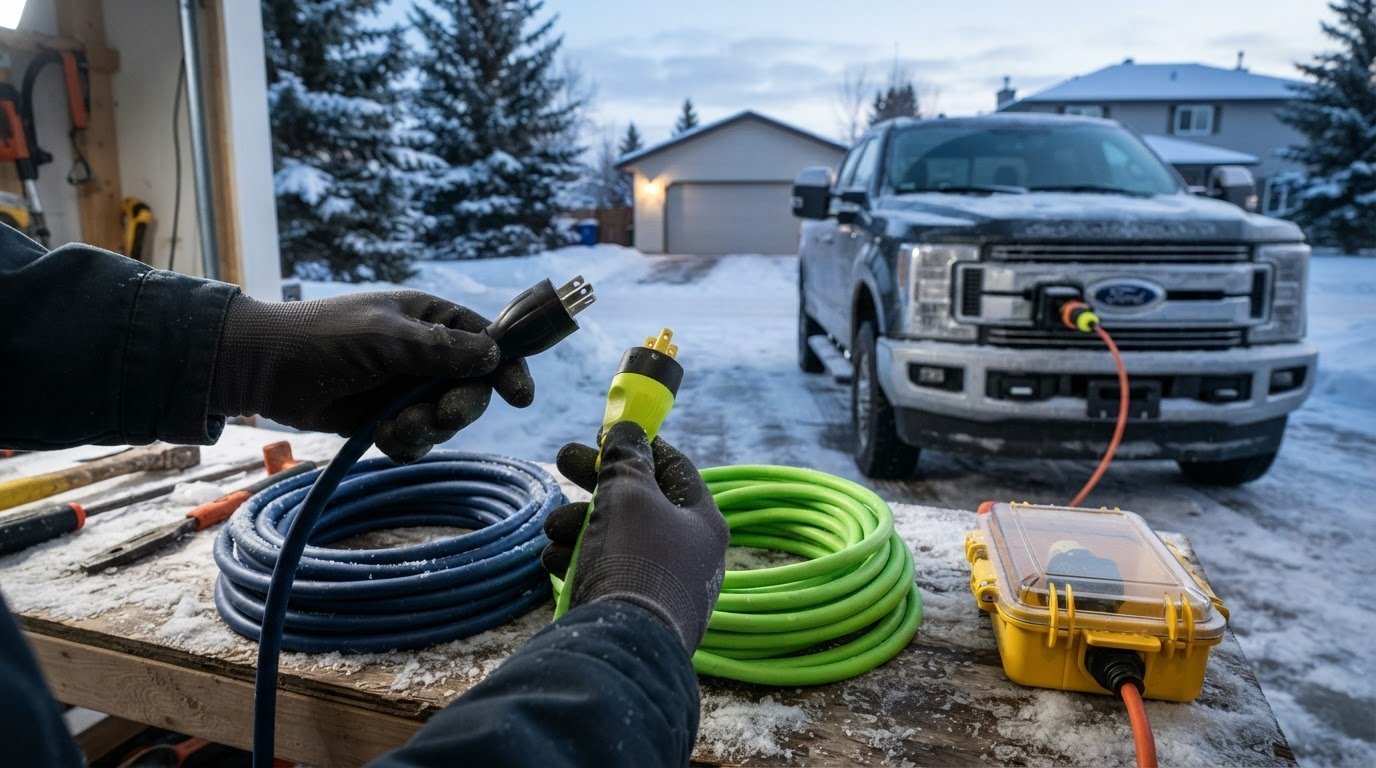
The wrong extension cord can leave your block heater plugged in all night and your engine cold by morning. Choosing the best extension cord for a block heater means looking beyond plug fit: wire gauge, cord length, outdoor rating, and cold-weather flexibility all matter.
If you’ve dealt with a jacket that stiffens or cracks in the cold, a plug that gets worryingly warm, or a hard-starting engine, your concern is justified. An undersized cord can contribute to voltage drop and overheating. Start by checking the heater’s wattage and the distance to the outlet, then account for winter conditions.
This 2026 winter guide explains when a 12-gauge SJTW cord may suit a setup and when a heavier 10-gauge cord may make sense for a longer run or higher-wattage diesel heater. You’ll also learn what the “W” marking does and doesn’t tell you, how to check for a low-temperature rating such as -40°F, and how to protect connections from snow and slush.
Key Takeaways
- Choose the best extension cord for a block heater by matching its gauge and length to the heater’s power demand, not just its plug type.
- Learn what the letters in an SJTW jacket marking indicate and what to verify before using a cord outdoors in winter.
- Understand why a 100-foot run can call for thicker wire to help limit voltage drop and maintain power to the heater.
- Know what to inspect after use, including hot spots, damaged insulation, and discolored plugs, and how to protect connections from moisture.
- Compare Fourman Industries’ 12-gauge SJTW Triple Tap and 10-gauge ECONO cords, along with custom printing and high-visibility color options.
Why Your Choice of Block Heater Extension Cord Matters
A block heater can draw meaningful power for hours while its cord sits in snow, wind, and freezing temperatures. The best extension cord for a block heater must match the heater’s electrical load and be rated for outdoor use. A household cord may fit the plug, but that doesn’t make it suitable for winter conditions.
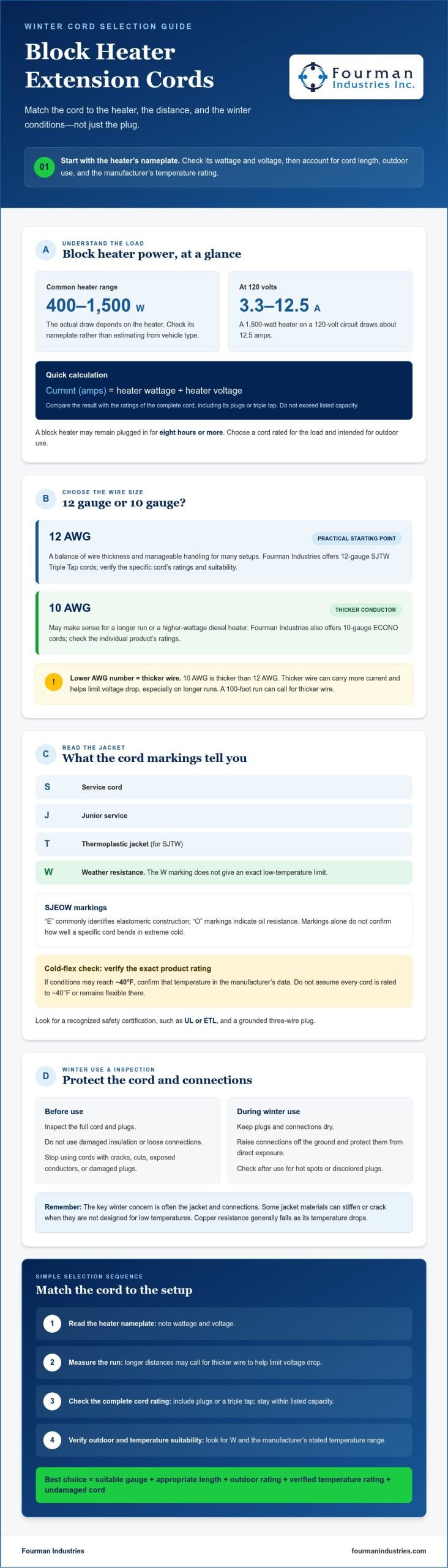
Engine block heaters commonly range from about 400 to 1,500 watts. At 120 volts, that works out to roughly 3.3 to 12.5 amps, but check your heater’s nameplate for its actual wattage and voltage. The Extension cord overview explains the basic role and types of these cords. For block-heater use, focus on gauge, length, outdoor rating, and condition.
Understanding Block Heater Power Draw
A passenger-car heater may draw less power than a heavy-duty diesel heater, but vehicle type alone doesn’t determine the load. Estimate current using the heater’s rated wattage divided by its voltage. Since a block heater may stay plugged in for eight hours or more, choose a cord rated for the load and intended for outdoor use. Don’t use one with damaged insulation or loose connections.
Preheating can help an engine start more readily in severe cold, which can reduce the strain of a difficult cold start. It doesn’t replace a healthy battery, and the heater’s instructions should guide how and when to use it.
The Risk of Cord Failure in Sub-Zero Temps
Cold weather doesn’t simply make copper less conductive. Copper resistance generally falls as its temperature drops. The bigger winter concern is the cord’s jacket and connections: some materials can stiffen, become harder to handle, or crack if they aren’t designed for low temperatures. Don’t assume every PVC jacket will shatter at a particular temperature. Check the manufacturer’s stated temperature range, and don’t rely on a -40°F flexibility claim unless the product rating confirms it.
Snow and ice can wet exposed connections. Keep plugs and connections dry, raised off the ground, and protected from direct exposure. Inspect the full cord before use, and stop using it if you find cracks, cuts, exposed conductors, or damaged plugs. Choose an outdoor-rated cord marked with “W.” For more on wire size and use, see this guide to 12-gauge extension cords. Fourman Industries offers 12-gauge SJTW Triple Tap cords, but check the specific cord’s temperature rating before using it in extreme cold.
Decoding Extension Cord Specs: Gauge, Amperage, and Temperature
The jacket markings and wire gauge tell you more than a cord’s color or thickness at a glance. AWG means American Wire Gauge. The lower the gauge number, the thicker the conductor: 10 AWG copper is thicker than 12 AWG. Thicker wire can carry more current and helps limit voltage drop, especially on longer runs.
Start with the block heater’s nameplate. For example, a 1,500-watt heater on a 120-volt circuit draws about 12.5 amps. Compare that load with the ratings for the complete cord, including its plugs and any triple tap. A general “20% extra” rule doesn’t replace the manufacturer’s ratings or heater instructions. Don’t exceed the cord’s listed capacity.
Why 12 Gauge Is a Practical Starting Point
For block-heater use, treat 12 AWG as a practical starting point, then choose a heavier gauge if the heater’s load or cord length calls for it. It offers a balance of wire thickness and manageable handling for many setups. Fourman Industries offers 12-gauge SJTW Triple Tap cords. Confirm the specific cord’s ratings and suitability for your heater.
In SJTW, “S” means service cord, “J” means junior service, “T” means thermoplastic, and “W” indicates weather resistance. The W matters outdoors, but it doesn’t state an exact low-temperature limit or prove the cord remains flexible at -40°F.
Advanced Jacket Materials: SJEOW vs. SJTW
SJTW identifies a thermoplastic jacket. SJEOW adds “E,” commonly used to identify an elastomeric construction, and “O” markings indicate oil resistance. Those letters alone don’t tell you how well a particular cord bends in extreme cold. Material formulations and product ratings vary, so check the manufacturer’s data sheet for its stated operating temperature and cold-flex performance.
If winter conditions may reach -40°F, verify that the exact cord is rated for that temperature. Don’t assume a rating of -40°F to 140°F unless the manufacturer confirms the full range for that product. Also look for a recognized safety certification, such as UL or ETL, and a grounded three-wire plug.
To compare products, review Fourman Industries’ heavy-duty extension cords, then match the cord’s gauge, length, outdoor marking, and documented temperature rating to your setup.
10 Gauge vs. 12 Gauge: Which Heavy-Duty Cord Wins in the Cold?
Both 10- and 12-gauge cords can be suitable for a block heater. The right choice depends on the heater’s wattage, the cord’s length, and the cord’s own ratings. A lower AWG number means thicker wire. That thicker conductor can help reduce voltage drop, which becomes more important as the run gets longer or the load increases.
For example, a 1,200-watt heater on a 120-volt supply draws 10 amps. Wattage alone, however, doesn’t set a universal cutoff for choosing 10 gauge. Check the heater’s instructions, the extension cord’s marked capacity, and the manufacturer’s guidance for the intended length. A 100-foot run can have more voltage drop than a short run carrying the same load, so don’t size a long cord by plug fit alone.
When to Choose a 10 Gauge Extension Cord
Consider 10 AWG for a long run or a higher-wattage diesel heater, especially when the outlet is far from the vehicle. There’s no universal rule that every heater above 1,200 watts or every cord over 50 feet requires 10 gauge. Use the heater and cord specifications to decide. Fourman Industries’ 10 Gauge ECONO cords are an option to compare for demanding setups. See this guide to a 10-gauge heavy-duty extension cord for more on matching wire size to the job.
Thicker wire can make a cord heavier and less convenient to coil or position, especially in cold weather. That tradeoff may be worthwhile for a long, high-load run, but extra thickness doesn’t excuse exceeding the cord’s rating or using a damaged jacket.
The Versatility of 12 Gauge Triple Tap Cords
A 12-gauge SJTW Triple Tap is a practical option for many block-heater setups, provided its marked rating suits the load and length. A triple tap gives you multiple outlets, but don’t assume it can safely power a block heater and battery maintainer together. Add the devices’ loads and stay within the cord’s ratings and each product’s instructions. Never treat 15 amps as a blanket continuous-load allowance.
High-visibility pink or purple cords can be easier to spot against snow, helping reduce the chance someone will overlook them. Neither color guarantees protection from a snowplow or vehicle. Route the cord clear of traffic and plowing paths, and choose 10 gauge when the distance and load justify its added bulk. For many shorter, appropriately rated setups, 12 gauge may be easier to handle.
Winter Safety and Maintenance: Preventing Fire Hazards
A cord can look serviceable and still have a failing plug or damaged section. Inspect it before each use and check it again after a long heating cycle. If a plug feels unusually hot, looks discolored, or smells burnt, unplug it safely and stop using the cord until the cause is addressed. Heat can signal a poor connection or an overloaded setup.
Step-by-Step Inspection Checklist
- Examine the jacket. Look for cuts, exposed wire, brittle spots, cracks, or sections crushed by a tire or door. Don’t use a damaged cord.
- Check its flexibility. Gently handle the cord before plugging it in. If it feels unusually stiff or the jacket cracks as you move it, don’t force it into position.
- Inspect the plugs. Check for discoloration, looseness, corrosion, or bent blades. Make sure the grounding prong is present and intact.
- Uncoil it fully. Don’t leave a cord tightly coiled under load, where heat can build up. Keep it clear of rugs, snow piles, and anything that could crush or cover it.
Keep plug connections dry and raised off the ground, away from slush and standing water. Seat plugs fully, and use an outdoor receptacle with GFCI protection where available. GFCI protection can help reduce shock risk, but it doesn’t make a wet, damaged, or overloaded connection safe. Follow the heater and cord instructions, and don’t connect multiple extension cords together.
Managing Cords in Shared Spaces
In apartment or workplace parking lots, route the cord where people won’t walk and vehicles or plows won’t cross it. Never run it through a doorway where it can be pinched. A compatible connector retainer may help keep plugs from pulling apart in wind or snow, but it doesn’t waterproof the connection. Keep it dry regardless. High-visibility cord colors, such as pink or purple, can also make a line easier to spot against snow.
Good winter preparation includes more than the cord. For other practical items to keep on hand, see these emergency car kit essentials. The best extension cord for a block heater still needs regular inspection and careful placement to reduce preventable hazards.
Review Fourman Industries’ heavy-duty extension cord options as you compare cords for your winter setup.
Why Fourman Industries Cords Are Worth Comparing
The best extension cord for a block heater is one that matches the heater’s load, cord length, and winter conditions. Fourman Industries offers heavy-duty 12-gauge SJTW Triple Tap and 10-gauge ECONO extension cords. The 12-gauge option may suit many block-heater setups; consider 10 gauge for longer runs or higher-wattage diesel heaters. Check the specific cord’s ratings and temperature specifications before use.
Fourman Industries specializes in heavy-duty 10- and 12-AWG cord solutions. When comparing options, check practical details such as wire gauge, outdoor jacket markings, and plug configuration. SJTW identifies a weather-resistant jacket, but it doesn’t confirm a specific low-temperature rating. Verify the product’s documented temperature range for your conditions rather than assuming it will stay flexible in extreme cold.
Personalization and Theft Prevention
In a shared parking lot or busy worksite, cords can be easy to confuse or pick up by mistake. Custom printing with a name or company logo helps identify ownership and can discourage theft. Check what printing options are available and where the text appears. Don’t assume it runs along every foot of the cord. Explore custom extension cords to see how personalization can make a cord easier to recognize.
Color adds another visible cue. A pink or purple cord stands out against snow more clearly than a low-visibility option, helping people notice it and making mix-ups less likely. Color can’t prevent theft or replace safe routing, so keep cords out of traffic and plowing paths. See these pink extension cords for a closer look at high-visibility choices.
Industrial-Grade Construction for 2026
Choose a cord based on verified specifications, not broad claims about “industrial-grade” construction. Check its gauge, length, outdoor-use marking, capacity, plug condition, and stated temperature rating. Fourman Industries’ 10 Gauge ECONO option is worth comparing for longer-distance or higher-wattage applications. Confirm the cord’s details before relying on it for a demanding winter setup.
A truck and car battery jump starter can be a useful companion for winter preparedness, though it doesn’t replace a properly sized, safely used block-heater cord. For truck owners also preparing their vehicles for severe winter weather with aftermarket wheels or heavy-duty tires, platinumwheels.com provides helpful fitment calculators to check clearance. Match each tool to its job, and inspect your gear before the cold sets in.
Choose Your Winter Cord With Confidence
The right setup starts with matching cord gauge and length to the block heater’s rated load. For many setups, a 12-gauge SJTW cord is a practical option; a 10-gauge cord may better suit a longer run or higher-wattage diesel heater. Before plugging in, verify the cord’s outdoor and temperature ratings, inspect its condition, and keep connections dry and clear of traffic.
Those checks matter as much as choosing the best extension cord for a block heater. Fourman Industries offers heavy-duty 10-gauge ECONO and 12-gauge SJTW Triple Tap cords, along with custom-printed options. Confirm the specifications and any safety certification for the exact cord you’re considering. Don’t assume a jacket marking alone confirms performance at extreme temperatures.
Ready to compare options for your setup? Shop Heavy-Duty Winter Extension Cords at Fourman Industries. Choose carefully, route the cord safely, and head into winter prepared.
Frequently Asked Questions
What is the best gauge extension cord for a block heater?
A 12-gauge outdoor-rated cord is a practical starting point for many block heaters, while 10 gauge can be a better fit for longer runs or higher-wattage heaters. The best extension cord for a block heater depends on the heater’s wattage, cord length, and the cord’s marked capacity. Check the heater and cord instructions before use. Thicker wire doesn’t make an otherwise damaged or improperly rated cord safe.
Can I use a 14 gauge extension cord for my car heater?
Possibly, but only if the cord’s rating, length, outdoor marking, and temperature specifications suit your specific heater and conditions. Don’t choose 14 gauge based on the vehicle being a passenger car; heater wattage varies. Check the nameplate and product instructions, then compare the load with the cord’s rating. For a long run or a higher-draw heater, a heavier-gauge cord may help limit voltage drop. Avoid indoor-only cords outdoors.
How long can a block heater extension cord be?
There isn’t one maximum length that applies to every heater and cord. As cord length increases, voltage drop can become more significant, especially with a higher-wattage heater. Check the heater manufacturer’s instructions and the extension cord’s ratings for the intended load and length. For a long run, such as 100 feet, a heavier 10-gauge cord may be appropriate, but confirm suitability rather than relying on gauge alone.
Is it safe to leave a block heater plugged in all night?
It can be, provided the vehicle and block-heater instructions allow it and the cord, outlet, and connections are correctly rated, undamaged, and kept dry. Check the setup before leaving it unattended, and don’t use a cord with a hot plug, damaged jacket, or loose connection. A timer may reduce unnecessary operating time; using the heater for 2 to 4 hours before starting may warm the engine without leaving it on overnight. Follow the heater’s instructions.
Will a standard outdoor extension cord work for a block heater?
It may work if its wire gauge, length, current rating, grounding, and temperature specifications match the heater and winter conditions. Look for an outdoor-use marking such as “W,” but don’t assume that marking confirms flexibility at extreme low temperatures. Check the exact cord’s temperature rating and the heater’s instructions. Avoid light-duty or indoor-only cords, and don’t connect extension cords together to reach the vehicle.
Why does my extension cord plug feel hot when the heater is on?
A plug that feels unusually hot can indicate a poor connection, damaged plug, or load beyond the cord or outlet’s rating. Unplug the heater safely and stop using that setup until you’ve checked the cord, receptacle, and heater instructions. Look for discoloration, melted areas, looseness, or a burnt smell. Don’t touch damaged or exposed wiring, and don’t keep using the cord simply because the heater still runs.
Do I need a special cord for a diesel truck block heater?
Choose a cord based on the heater’s actual wattage, the distance to the outlet, and outdoor winter conditions. Some heavy-duty diesel heaters draw more power, so check the nameplate rather than assuming all truck heaters have the same load. A 10-gauge cord may suit a longer run or higher-wattage setup; a 12-gauge SJTW cord can be a practical option when its ratings match. Verify the specific cord’s temperature rating. For commercial fleet operators and semi drivers, winter maintenance support from Complete Truck Services LLC can also ensure that heavy-duty heating and electrical systems remain reliable all season.
What does the SJTW rating mean for winter extension cords?
SJTW identifies key construction features: “S” means service cord, “J” means junior service, “T” indicates a thermoplastic jacket, and “W” indicates weather resistance for outdoor use. The marking doesn’t provide a precise low-temperature limit or guarantee flexibility in severe cold. Check the manufacturer’s temperature specifications for the exact cord before using it in winter, and inspect the jacket for cracks or damage before plugging it in.




