
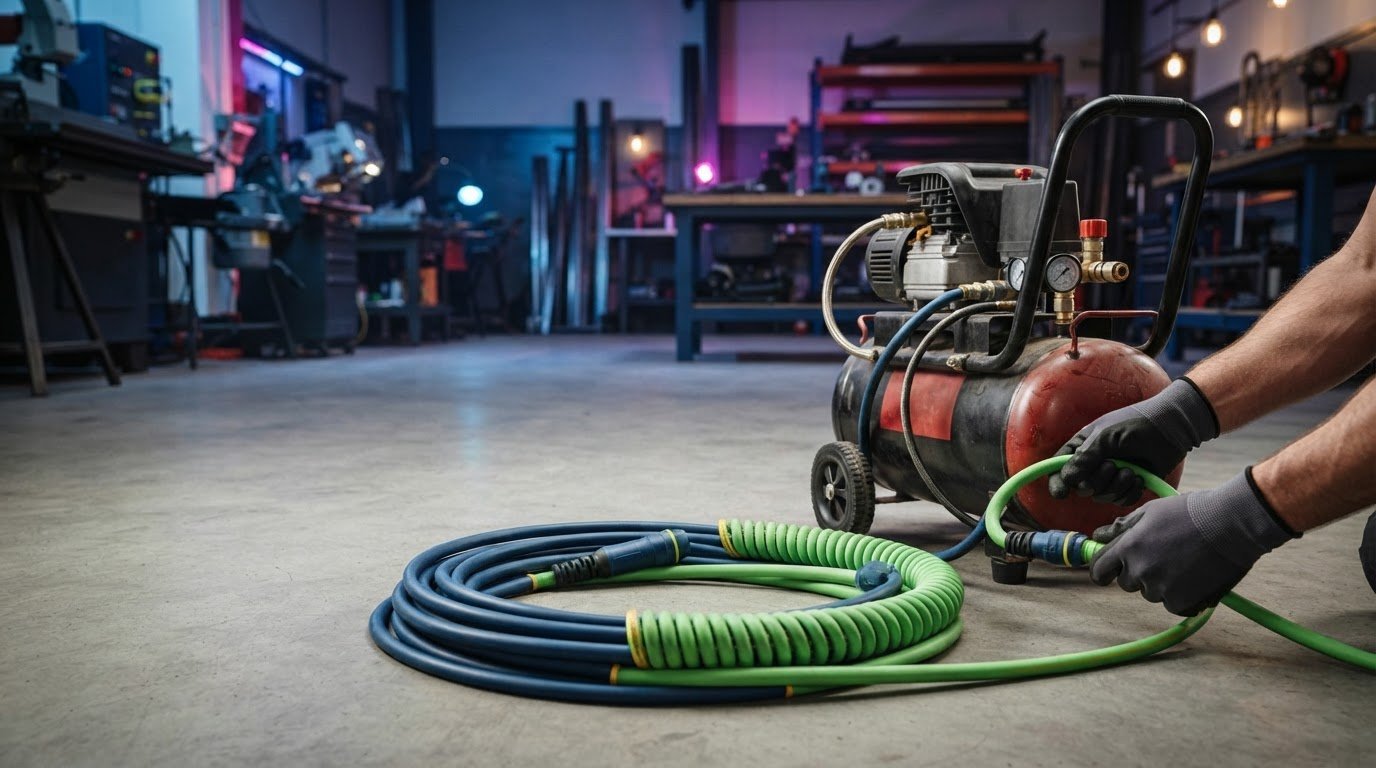
Your air compressor motor isn’t failing because it’s old. It’s failing because your extension cord for air compressor use is starving it of the power it needs to breathe. Most people grab the first cheap orange cord they see, but that thin wire is often a death sentence for a heavy-duty induction motor. We understand the frustration of a compressor that hums, stalls, or trips the breaker every time it tries to kick on. It’s a waste of your time and an expensive risk to your equipment that nobody needs on a busy workday.
Choosing the right cord is about more than just reaching the outlet. Voltage drop is the silent killer of induction motors, and only a calculated gauge-to-length ratio ensures your equipment lives a full life. In this 2026 buying guide, you’ll learn how to select the perfect gauge to ensure your motor starts every time, even under pressure. We’ll cover the critical 10 AWG versus 12 AWG decision, OSHA compliance for rugged jobsites, and why custom-printed jackets are the best way to stop your gear from walking off. Whether you’re in a busy workshop or a remote site, you’ll find the technical specs needed to keep your tools running for years.
Key Takeaways
- Understand why your compressor needs up to six times its running amperage just to start and how to handle that surge safely.
- Find the exact distance threshold where you must switch to a heavy-duty 10-gauge extension cord for air compressor protection.
- Decode industrial jacket ratings like SJTW to ensure your power supply survives moisture, chemicals, and rough workshop floors.
- Discover how custom-printed branding and high-visibility colors can slash jobsite theft and keep your equipment organized.
- Learn professional maintenance tips, including the “over-under” wrap, to prevent internal wire breakage and extend cord life.
Why Air Compressors Require Specialized Extension Cords
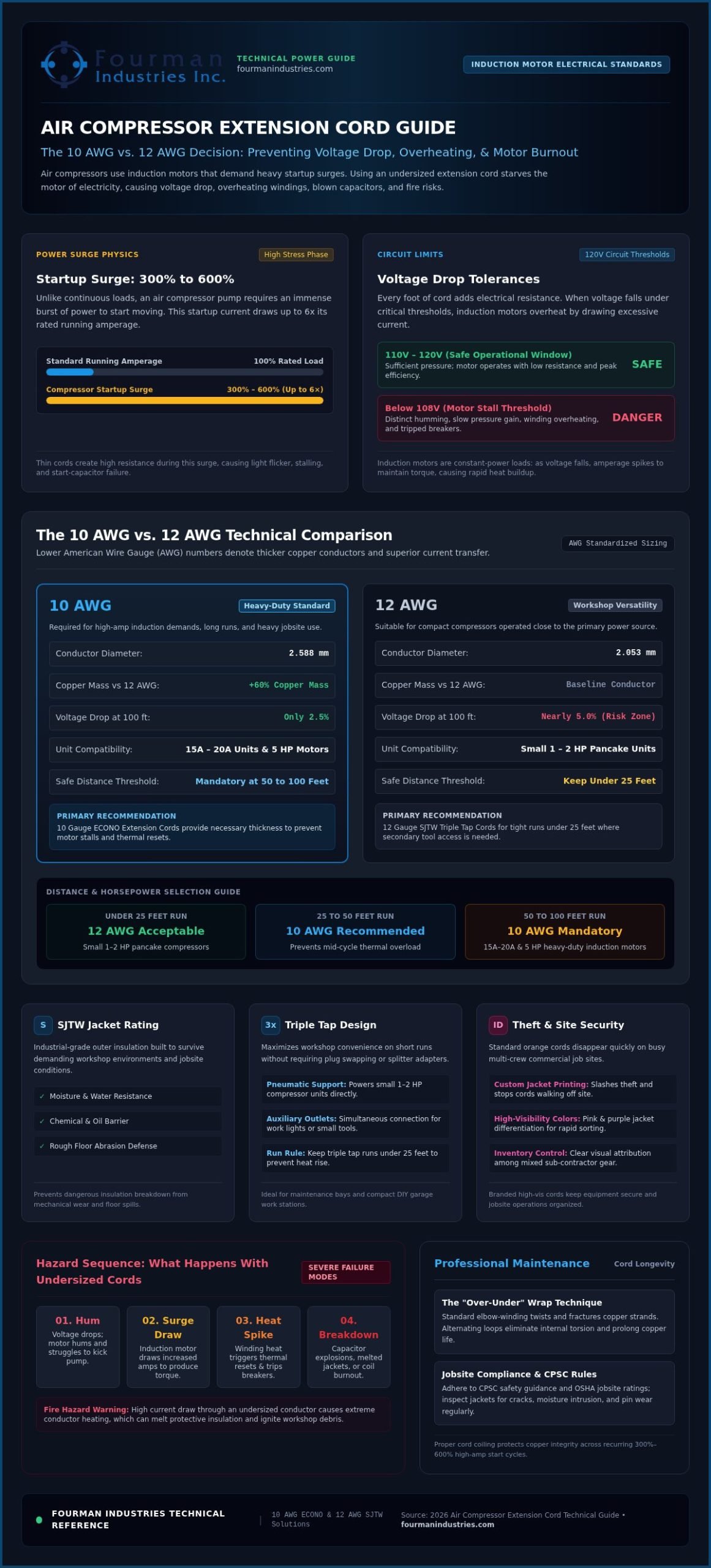
Air compressors are power-hungry machines. Unlike a work light that draws a steady stream of electricity, an air compressor requires a massive burst of energy just to get the pump moving. This startup surge can reach 300% to 600% of the motor’s rated running amperage. If your extension cord for air compressor use is too thin, it simply can’t deliver that surge. The motor struggles, the lights flicker, and you risk burning out expensive internal components before the job even starts. Standard household cords are built for lamps and fans; they aren’t designed to handle the raw demand of pneumatic tools.
The Science of Voltage Drop in Power Tools
Voltage drop is the reduction in voltage as it travels through a conductor. Every foot of wire adds resistance. If the wire is too long or the diameter is too small, the electricity loses pressure before it reaches your tool. Following American Wire Gauge (AWG) standards is the only way to ensure your cord has enough copper mass to fight this resistance. A 10 AWG cord contains roughly 60% more copper mass than a 12 AWG cord, which significantly cuts down on electrical resistance and heat dissipation issues.
When voltage drops below 108V on a 120V circuit, the motor risks stalling. You’ll hear a distinct humming sound, or the compressor will take forever to reach full pressure. These aren’t just annoyances; they are signs that your motor is overheating. Low voltage forces the motor to work harder, which can lead to blown fuses or tripped circuit breakers that halt your progress. Using a high-quality extension cord for air compressor tasks ensures the voltage stays within the safe 110V-120V range required for peak performance.
Induction Motors vs. Universal Motors: Why It Matters
Most handheld tools, like drills or circular saws, use universal motors. These are relatively forgiving when power fluctuates. Air compressors use induction motors, which are constant-power loads. If the voltage drops, the motor compensates by drawing even more current to maintain its torque. This creates a dangerous loop of heat buildup in the motor windings. Because compressors are more sensitive than simple tools, they require a stable, high-amperage connection to prevent thermal resets from triggering.
Using an undersized cord is a legitimate fire hazard. The insulation can melt under the stress of the high current draw, or the start capacitor can explode. To keep your equipment safe, you need a heavy-duty solution like a 10 Gauge ECONO or 12 Gauge SJTW cord. These specialized options provide the thick conductors necessary to protect your motor and your workshop. Investing in the right cord today prevents the costly downtime of equipment failure tomorrow.
Choosing the Right Gauge: The 10 vs. 12 Gauge Debate
Choosing the right gauge is the difference between a tool that works and a motor that smokes. American Wire Gauge (AWG) numbers can be confusing, but the rule is simple: a lower number means a thicker copper conductor. A 10 AWG wire has a diameter of 2.588 mm, while a 12 AWG wire is 2.053 mm. That extra thickness is vital for handling the massive startup surge of an induction motor. Following CPSC extension cord safety guidance is essential; using a cord that’s too thin for high-wattage equipment leads to insulation breakdown and fire hazards.
Use this simple framework to decide which extension cord for air compressor use you actually need. If you’re running a small 1-2 HP pancake compressor less than 25 feet from an outlet, a 12-gauge cord is a reliable choice. However, once you step up to a 15-amp or 20-amp unit, or if you need to reach 50 to 100 feet away, 10-gauge becomes the mandatory gold standard. At 100 feet, a 10 AWG cord only sees a 2.5% voltage drop, while a 12 AWG cord can drop nearly 5%, pushing your motor into the danger zone where it may fail to start.
When 12 Gauge is Sufficient for Your Workshop
For DIY enthusiasts using smaller compressors, 12 Gauge SJTW Triple Tap Extension Cords offer great versatility. These cords are perfect for short runs where space is tight. The SJTW rating means the jacket resists oil and moisture, which is common in any garage or shop. The triple tap design is a major convenience. It lets you plug in a work light or a small power tool alongside your compressor without swapping plugs constantly. Just keep these runs under 25 feet to maintain peak efficiency and prevent the motor from running hot during long cycles.
The Case for 10 Gauge ECONO Cords
If you’re a professional or running a high-draw 5 HP unit, don’t compromise. Our 10 Gauge ECONO Extension Cords are built for these high-stress scenarios. Thick 10-gauge wire minimizes heat buildup during long duty cycles, ensuring the cord stays cool while the compressor works hard. This is especially critical on remote job sites where the power source might already be fluctuating. A heavy-duty cord acts as a buffer, delivering stable current even when the grid is strained. For any run exceeding 50 feet, 10-gauge is the only way to protect your investment. If you want a setup that starts every time without tripping the breaker, investing in a thicker gauge is the smartest move you can make for your equipment.
Key Performance Features for Industrial Power Cords
Picking the right gauge is only half the battle. If the jacket cracks or the plug pulls loose, even the thickest copper is useless. Look for an SJTW rating printed directly on the cord. This acronym stands for Service grade, Junior (rated to 300V), Thermoplastic, and Weather-resistant. These features ensure your extension cord for air compressor use survives the daily grind of a professional workshop. This rating is the industry standard for balanced durability and cost, providing the ruggedness needed without the extreme price tag of specialized rubber cords.
High-quality industrial cords feature molded plugs with integrated strain relief. This design prevents the internal wires from pulling away from the brass prongs when the cord is yanked or stepped on. We also recommend choosing cords with lighted female ends. These clear PVC heads glow when power is present. It’s a simple feature that saves minutes of troubleshooting when a tool stops working. If you work in a multi-tool environment, a “Triple Tap” end is a game changer. It lets you run your compressor and a work light from the same drop, streamlining your workflow and reducing floor clutter.
Jacket Materials: SJTW vs. SJEOW
SJTW jackets are tough, but they can get stiff in freezing temperatures. If you work in extreme cold, you might consider SJEOW jackets. The “E” stands for Thermoplastic Elastomer, which remains flexible down to -50°C. In a typical garage, however, the oil and chemical resistance of an SJTW jacket is usually enough to prevent cracking and swelling. This protection is vital. A cracked jacket exposes live wires to moisture and metal floors, creating a shock hazard. For most users, SJTW is the industry standard for balanced durability and cost.
Plug Integrity and Safety Certifications
Always check for UL (Underwriters Laboratories) certification on your gear. This isn’t just a sticker; it’s proof the cord was tested to handle its rated load safely. For professionals, using UL-listed equipment is often a requirement for insurance compliance on the jobsite. Avoid the temptation to use “cheater” plugs or DIY-repaired ends. These often lack proper grounding and can cause arcing, which melts the outlet and damages your compressor’s sensitive electronics. Heavy-duty brass prongs ensure a tight connection, reducing heat damage at the point of contact. Invest in a cord that’s built to last, and you’ll spend less time replacing gear and more time getting the job done.
Security and Branding: Personalizing Your Gear
High-quality extension cords represent a significant investment, especially when you’ve opted for a heavy-duty 10-gauge model to protect your compressor motor. Your extension cord for air compressor use is a high-value asset, but unfortunately, expensive gear often goes missing on busy jobsites. Construction industry theft accounts for losses between $300 million and $1 billion annually, according to the Fourman Industries Loss Prevention Survey. Because fewer than 7% of stolen small tools are ever recovered, physical security starts with making your gear impossible to pawn or accidentally borrow.
Choosing the right extension cord for air compressor tasks is only the first step; keeping it in your possession is the second. We believe that a cord that’s easy to identify is a cord that stays in your truck. Customization isn’t just about vanity; it’s about asset management and safety.
High-Visibility Colors for Safety
High-visibility colors like pink and purple aren’t just for style. They are strategic tools for safety and organization. Using pink extension cords makes your power lines instantly recognizable from across a site. This visibility reduces trip hazards in dim workshops and makes it obvious if someone else tries to coil your cord into their truck. You can also use color-coding to identify your 10-gauge cords from your 12-gauge ones at a glance. This ensures your crew always grabs the right tool for the compressor without having to read the fine print on the jacket.
Custom Printing for Professional Credibility
Permanent branding takes security to the next level. We use a factory-direct hot-stamp process to imprint your company name or phone number directly onto the jacket every 12 inches. These custom printed extension cords are far more effective than spray paint or tape, which eventually rub off or peel away. According to a 2026 Jobsite Asset Protection Report, contracting crews using customized branding saw a 90% reduction in equipment walk-aways and cross-crew confusion.
Beyond theft prevention, personalized gear builds professional credibility with your clients. It shows you’re an established business that takes care of its equipment. When you consider that a heavy-duty cord can represent a triple-digit investment, preventing just one theft pays for the customization many times over. It’s a practical, low-cost way to manage your assets and keep your jobsite running smoothly. Customize your heavy-duty cords today to protect your investment and maintain your professional edge.
Final Checklist: Choosing and Maintaining Your Cord
Your extension cord for air compressor use is an investment in your equipment’s longevity. Selecting the right one doesn’t have to be a guessing game. Start by checking your compressor’s data plate for the running amperage and horsepower. Once you know the draw, determine the shortest length possible for your workspace. For runs under 25 feet, a 12-gauge cord is often sufficient. If you need 50 to 100 feet of reach, the 10-gauge ECONO is the only way to go. This simple logic prevents the voltage drop that kills induction motors and trips breakers.
Storage is the most overlooked part of cord care. Don’t wrap your cord tightly around your arm and elbow. This creates twists in the internal copper strands that eventually lead to wire fatigue. Use the “over-under” wrap method instead. This professional technique alternates the direction of the loops, allowing the cord to lie flat and uncoil without tangles. It keeps the copper conductors stress-free and ensures your cord lasts for years in rugged conditions.
Routine Maintenance for Heavy-Duty Cords
A quick inspection every week can save you from a major jobsite failure. Wipe down the SJTW jacket with a damp cloth to remove corrosive oils, grease, and chemicals from the garage floor. While cleaning, feel for “soft spots” or bulges in the wire. These are clear indicators of internal damage even if the outer jacket looks perfect. Check the plug prongs for any signs of arcing or black oxidation. If the prongs are bent, straighten them carefully to ensure a tight, cool connection at the outlet. A clean, straight plug reduces electrical resistance and prevents heat damage.
Where to Buy Professional Grade Power
Big-box retailers often stock cords with thinner jackets or lower-quality copper to hit a price point. Buying from specialized suppliers ensures you get a true 10 or 12-gauge conductor that meets the demands of high-draw pneumatic tools. We’ve been providing heavy-duty solutions since 1997, combining technical expertise with a commitment to blue-collar reliability. When you buy from us, you’re getting more than just a cord; you’re getting US-based customer support and a product designed for the professional trades. If you’re ready for a setup that starts every time, build your custom heavy-duty cord at Fourman Industries today!
Power Your Projects with Confidence
Don’t let a thin, generic cord choke your productivity or damage your expensive equipment. Choosing the right extension cord for air compressor use is the simplest way to prevent motor burnouts and frustrating circuit trips. By matching your tool’s amp draw to the correct gauge and length, you ensure that startup surge never stalls your progress. Whether you need the 10-gauge ECONO for long reaches or a 12-gauge triple tap for your workshop, the right connection makes every job safer and more efficient.
Since 1997, we’ve provided trusted industrial power solutions built to survive the toughest conditions. Our heavy-duty SJTW jackets offer a maximum lifespan, and our custom printing services on all bulk orders ensure your gear stays in your truck where it belongs. It’s time to stop fighting with underpowered tools and start focusing on the craft you love. You’ve done the research; now get the gear that works as hard as you do. Your compressor will thank you for the steady, reliable voltage.
Shop Heavy-Duty 10G and 12G Extension Cords at Fourman Industries to find your perfect power solution today and keep your jobsite running at peak performance.
Frequently Asked Questions
Can I use a 14 gauge extension cord for a small air compressor?
Using a 14-gauge cord is risky and usually results in a stalled motor. Most compressors require a higher amperage than 14-gauge wire can safely deliver. This thin wire creates significant resistance, which drops the voltage reaching your extension cord for air compressor setup. This causes the motor to run hot and can eventually blow the start capacitor. Always step up to at least a 12-gauge cord to ensure safety.
How long of an extension cord can I run for a 15-amp compressor?
You should limit a 12-gauge cord to 50 feet for a 15-amp compressor. If you need to reach 100 feet, a 10-gauge extension cord for air compressor use is mandatory. Running a thinner cord over long distances causes a voltage drop exceeding 5%, which starves the motor of power. For any distance beyond 100 feet, move the compressor closer to the outlet and extend your reach using a pneumatic air hose instead.
Why does my extension cord get hot when the compressor is running?
Excess heat is a clear sign that your wire is too thin for the electrical load. When electricity travels through a conductor with high resistance, it generates thermal energy as a byproduct. This happens if the cord is too long or the gauge is too small for your compressor’s startup surge. If your cord feels hot to the touch, stop using it immediately. Continued use can melt the insulation and lead to a fire or equipment failure.
Is it better to use a longer air hose or a longer extension cord?
It is always better to use a longer air hose than a longer power cord. Electrical voltage drops over distance, which can destroy your compressor motor. Compressed air doesn’t suffer from this type of power loss. For the best results, plug your compressor directly into a wall outlet or use a short, heavy-duty 10-gauge cord. Then, use a 50 or 100-foot hybrid polymer air hose to reach your actual work area.
What does the SJTW rating on an extension cord mean?
The SJTW rating identifies the cord’s construction and durability standards. S stands for Service grade, while J means Junior service, rated for 300 volts. The T indicates the jacket is made of Thermoplastic, and W confirms it is weather-resistant for outdoor use. This combination is the industry standard for workshops because it resists moisture and oils. It provides a rugged, dependable solution that handles the daily wear and tear of a busy garage or jobsite.
Will a 10 gauge cord stop my circuit breaker from tripping?
A 10-gauge cord reduces the risk of nuisance trips caused by voltage drop, but it won’t fix an overloaded circuit. If your compressor draws 18 amps on a 15-amp breaker, the breaker will still trip regardless of the cord’s thickness. However, a thicker cord ensures the motor starts quickly and efficiently. This prevents the extended high-amperage draw that often happens when a motor struggles to turn over, which helps keep the breaker from popping.
Can I plug two air compressors into one triple-tap extension cord?
No, you should never plug two air compressors into a single triple-tap cord. Each compressor has a massive startup surge that can be six times its running amperage. Plugging two units into one cord will exceed the cord’s ampacity and likely trip the circuit breaker immediately. Even if they don’t start at the same time, the combined load during a cycle can cause dangerous heat buildup. Use separate circuits and dedicated heavy-duty cords for each machine.
How does custom printing stay on the cord during outdoor use?
Our custom printing is applied using a factory-direct hot-stamp process that indents the text into the jacket. This isn’t just surface ink that can rub off with friction or moisture. The branding is repeated every 12 to 24 inches along the entire length of the cord. It withstands sunlight, rain, and the rough abrasion of being dragged across concrete. This permanent identification is the most effective way to prevent theft and keep your gear organized on busy sites.




