
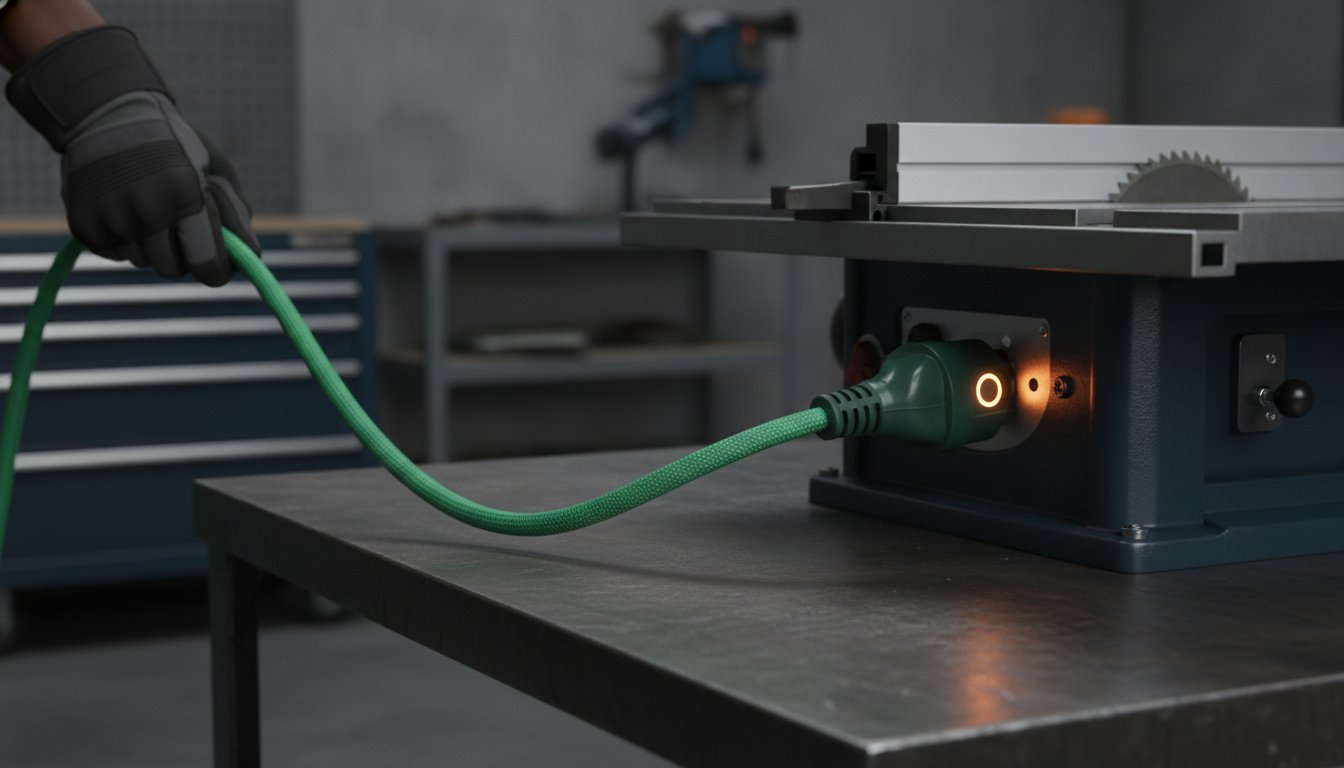
Did you know that construction site theft costs the industry up to $1 billion every year, and less than 7% of that stolen gear is ever recovered? It’s a frustrating reality for any professional, especially when you’re already dealing with the hidden costs of voltage drop and fried motors. You know that using a standard cord for high-draw tools is a recipe for disaster. To keep your equipment running at peak performance, you need a 10 gauge heavy duty extension cord that can handle the heat and the hustle of a busy site.
We understand that your tools are your livelihood. This guide will help you choose a 10-gauge cord that delivers full power over long distances while standing up to the harshest conditions. You’ll learn how to maximize job site efficiency and protect your investment with gear that’s easy to identify. We are going to break down the latest 2026 OSHA regulations, explain why the SJTW jacket rating matters for your safety, and show you how custom printing can turn your cords into a theft-proof asset that stays on your job site.
Key Takeaways
- Learn how to prevent voltage drop and “brownout” conditions that can permanently damage your high-draw power tool motors.
- Understand the technical breakdown of SJTW jacket ratings and why they are essential for weather resistance and job site safety.
- Compare copper volume and amperage capacity to see why a 10 gauge heavy duty extension cord is the superior choice for long-distance power runs.
- Identify critical hardware features like lighted ends and reinforced blades that ensure reliable power flow and long-term durability.
- Discover how custom printing and high-visibility colors serve as a permanent theft deterrent to keep your investment secure on busy sites.
Why Your High-Draw Tools Require a 10 Gauge Heavy Duty Extension Cord
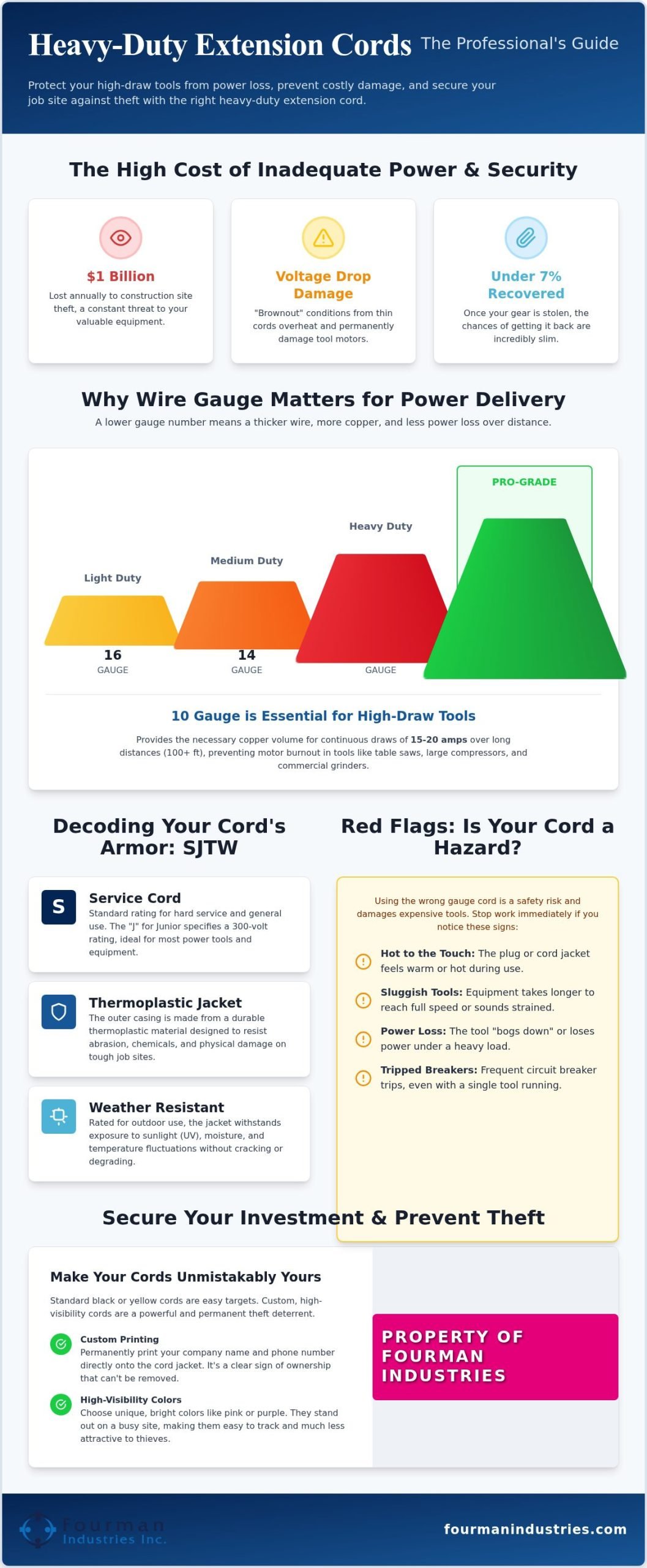
High-performance tools like table saws, large air compressors, and commercial grinders don’t just use power; they demand it. To keep these machines running without burning out their motors, a 10 gauge heavy duty extension cord is the industry standard for continuous draws between 15 and 20 amps. While a standard 14 or 16-gauge cord might work for a small drill or a work light, it acts like a bottleneck for high-voltage gear. This bottleneck creates a “brownout” condition. Your tool tries to pull the amperage it needs, but the thin wire can’t deliver it, causing the voltage to drop significantly. This forces the electric motor to run slower and much hotter, which eventually leads to permanent internal damage and a shorter lifespan for your most expensive equipment.
Think of your power cord as an investment in tool longevity rather than just a way to reach the outlet. Investing in a heavy-duty cord ensures that your tools receive the exact voltage they were designed to handle. This is especially critical on busy job sites where power sources might be limited or located far from the actual work area. Understanding Extension Cord Basics helps you realize that the lower the gauge number, the thicker the copper wire inside. That extra copper is what allows the current to flow freely without the performance-killing resistance found in cheaper, thinner alternatives.
Understanding Amperage and Heat Management
Electrical resistance is your enemy on the job site. When you push a high current through a thin wire, that resistance turns into heat. This isn’t just bad for your tools; it’s a major safety hazard. If the wire is too small for the load, the heat can build up until the thermoplastic jacket melts, exposing live wires or starting a fire. A 10/3 cord, which contains three conductors of 10-gauge wire, provides enough copper volume to move that electricity with minimal resistance. This design keeps the cord cool even during all-day use. For pros who need reliability without the high price tag, the 10 Gauge ECONO series provides this heavy-duty capacity while remaining budget-friendly.
Signs You Are Using the Wrong Gauge Cord
You don’t always need a voltmeter to know your cord is failing. Watch for these red flags during your next shift:
- Tools sound sluggish or take longer than usual to reach full operating speed.
- The plug or the cord jacket feels warm or hot to the touch after a few minutes of use.
- Circuit breakers trip frequently, even though you aren’t running multiple tools at once.
- The tool loses power or “bogs down” the moment it hits a heavy load.
If you notice these signs, stop your work immediately. Swapping to a 10 gauge heavy duty extension cord is the fastest way to protect your gear and keep your crew safe from electrical fires. It’s a simple fix that prevents thousands of dollars in tool repairs down the line.
Technical Breakdown: Gauge, Voltage Drop, and SJTW Jackets
Understanding the numbers on your cord is the first step to keeping your job site running smoothly. AWG stands for American Wire Gauge, and the numbering system is counterintuitive. A smaller number means a thicker wire with more copper. When you choose a 10 gauge heavy duty extension cord, you’re getting a massive amount of copper compared to a standard 14 or 16-gauge cord. In 2026, the durability of these thermoplastic jackets has reached new heights. They are designed to withstand the constant abrasion and heavy foot traffic found on modern construction sites without losing their protective integrity.
The Science of Voltage Drop Over Distance
Voltage drop is essentially the friction electricity faces as it travels through a wire. The longer the cord, the more power you lose before it reaches your tool. If you’re running high-draw equipment on 100-foot runs, 10-gauge isn’t just a suggestion; it’s mandatory. The increased copper mass in a 10-gauge wire significantly reduces electrical resistance, ensuring that your tools receive the full voltage they need even at the end of a 100-foot run. This prevents your motors from struggling and keeps your work consistent from start to finish.
Decoding Cord Jackets: What SJTW Means for You
You’ll see the letters SJTW printed on high-quality cords. This isn’t just alphabet soup; it’s a specific rating for durability and environment. Here’s what that actually means for your daily work:
- S: Service (rated for 600 volts, but the J indicates a lower rating)
- J: Junior (rated for 300 volts, perfect for standard tools)
- T: Thermoplastic (durable outer casing that resists wear)
- W: Weather-resistant (safe for outdoor use and moisture exposure)
This rating ensures your cord can handle moisture, oil spills, and chemical exposure without the jacket cracking or failing. For crews working in northern climates, these jackets are designed to stay flexible even when the temperature drops well below freezing. It makes coiling and uncoiling your gear at the end of a shift much easier.
Safety isn’t something to take lightly. Following extension cord safety guidelines means always looking for UL or ETL certification. These marks prove the cord has been tested to meet strict performance and fire safety standards. On a professional job site, OSHA inspectors will look for these certifications to ensure your gear is compliant. If you need a reliable solution that meets these standards while offering a bit of value, our 10 Gauge ECONO series is built to handle the toughest technical demands without blowing your budget.
10 Gauge vs. 12 Gauge: Choosing the Right Heavy Duty Power
Choosing between 12-gauge and 10-gauge often comes down to the specific demands of your gear. While 12-gauge is a solid choice for many job site tasks, it has its limits. A 10 gauge heavy duty extension cord contains roughly 60% more copper than a 12-gauge cord. That extra copper isn’t just for show. It provides the physical mass needed to carry high current without the internal resistance that causes voltage drop. At 50 feet, a 12-gauge cord is typically rated for 15 amps. In contrast, a 10-gauge cord safely handles 20 amps. This difference is critical when you’re running equipment that pushes the limits of a standard circuit.
There’s a trade-off in portability you need to consider. A 10-gauge cord is noticeably heavier and stiffer than its 12-gauge counterpart. It’s built for power, not for light travel. If you’re frequently moving small hand tools, 12-gauge might be more convenient. However, you should always check your tool’s nameplate amperage. When the draw approaches 15 amps, you should always reach for the 10-gauge option. It’s the best way to protect your motor from the heat generated by undersized wiring.
When 12 Gauge Isn’t Enough
Air compressors are notorious for their high startup surge. They can pull significantly more than their running amperage just to get the motor turning. A 12-gauge cord often fails here, causing the motor to hum or trip the breaker. Similarly, table saws and miter saws need consistent voltage to maintain high RPMs when biting into dense hardwoods. If the voltage drops because the wire is too thin, the blade slows down. This leads to poor cuts and unnecessary motor strain. Portable AC units and space heaters also require the heavy-duty capacity of 10-gauge wire because they draw high amperage continuously for hours at a time.
This level of durability is a common requirement across all heavy industries. For example, in material processing and mining, operators rely on high-performance aggregate screens from Compass Wire Cloth Corporation to ensure their machinery handles high-volume loads without failure, much like a 10-gauge cord handles high-amperage draws.
Industrial Applications for 10/3 Power Cords
For heavy industrial work, 10/3 power cords are often the only safe option. Welding equipment and plasma cutters require intense, stable current to maintain a consistent arc. Using a thin cord here will result in weak welds and potential equipment failure. Large demolition hammers and concrete grinders also put immense stress on their power source. These tools need the constant torque that only a thick 10-gauge wire can provide. On many large projects, pros use these cords to feed temporary power distribution boxes. This ensures that every tool plugged into the box gets the clean, stable power it needs to function correctly. Pairing reliable power delivery with the right cutting tool is equally important — understanding Bosch reciprocating saw blade applications ensures your demolition and cutting work stays efficient from start to finish.
Key Features to Look for in a 10 Gauge Cord
Selecting a 10 gauge heavy duty extension cord is about more than just the copper inside. You need hardware that survives the daily abuse of a busy job site. Start by looking for lighted ends. These provide a quick visual check that power is flowing from the source. You won’t waste time walking back to the breaker box just to find out your tool isn’t plugged in. It’s a simple feature that saves hours of troubleshooting over a long project.
Reinforced blades are another essential requirement. Cheap prongs bend or snap off after a few rough plug-ins, rendering an expensive cord useless. Heavy-duty blades stay straight and maintain a secure, low-resistance connection. You should also check the strain relief. This is the plastic molding where the wire enters the plug. It’s the most common point of failure because people often pull on the cord instead of the plug head. A robust strain relief prevents the internal wires from fraying or disconnecting under pressure.
Length Considerations: 25ft, 50ft, and 100ft Limits
Length plays a massive role in how much power actually reaches your equipment. Always choose the shortest cord that reaches your work area. This maximizes the voltage delivered and keeps your motors running at full speed. Never daisy-chain multiple extension cords together. This creates extra resistance at every connection point and significantly increases the fire risk. If you need a long reach, buy a single 100-foot cord. Be prepared for the physical weight, though. A 100-foot 10-gauge cord typically weighs between 25 and 30 lbs. They are built for serious power, not for light carrying.
High-Visibility Colors and Anti-Theft Customization
Most cords on a job site are standard yellow or orange. This makes them easy to “accidentally” swap or lose in the shuffle of a crowded crew. Using pink extension cords or purple models makes your gear stand out instantly. It’s a practical way to prevent tool bag swaps and discourage theft. High-visibility green is another professional alternative that stays visible in low-light conditions or cluttered environments.
Customizing your gear is the ultimate theft deterrent. When your company name is printed directly on the jacket, it’s much harder for someone to walk off with it. It keeps your investment where it belongs, working for you. If you’re ready to secure your job site with gear that lasts, check out our personalized extension cords today.
Heavy-Duty Solutions from Fourman Industries
Fourman Industries isn’t just another retail outlet. Since 1997, we’ve focused on providing high-quality power solutions that solve real-world problems for contractors and homeowners alike. Our approach is simple and no-nonsense. We understand that on a busy site, your gear needs to work every time without fail. Choosing a 10 gauge heavy duty extension cord from our lineup means you’re getting a product backed by decades of industry expertise. We don’t hide behind fancy marketing. Instead, we let the quality of our copper and the durability of our jackets speak for themselves. We’ve built our reputation on being a reliable partner for those who earn their living with their hands.
We know the frustrations of voltage drop and the high cost of tool repairs. That’s why every cord we offer is built to exceed standard expectations. Whether you’re powering a single high-draw compressor or setting up a temporary power grid for a whole crew, our gear is designed for the long haul. We prioritize the functional success of your projects because we know that when your tools have full power, you work more efficiently.
The 10 Gauge ECONO Series: Performance Meets Value
The 10 Gauge ECONO series is designed specifically for crews that need reliable power across multiple runs without breaking the bank. We maintain lower costs by streamlining our distribution and packaging, not by cutting corners on the internal materials. Every cord in this line features high-grade copper and a rugged 10/3 SJTW construction that meets the strict demands of 2026 job sites. It’s the perfect solution for large projects where you need several heavy-duty lines to power everything from table saws to industrial heaters. You get the same ruggedness and reliability you expect from a premium cord at a price that respects your bottom line.
Custom Printing: Branding Your Power Equipment
Theft is a constant threat on modern job sites. With construction theft costing the industry between $300 million and $1 billion annually, securing your gear is a top priority. Our permanent ink-jet printing process allows you to brand your 10 gauge heavy duty extension cord with your company name or logo. This makes your equipment instantly recognizable and nearly impossible for others to claim as their own. Since fewer than 7% of stolen tools are ever recovered, this customization is your best defense. You can learn more about this in The Ultimate Guide to Custom Printed Extension Cords (2026). This branding isn’t just a label; it’s a permanent deterrent that keeps your investment in your hands and off the black market.
Secure Your Power and Your Gear Today
Selecting the right setup is about more than just reaching the outlet. It’s about protecting your livelihood and keeping your job site running at full capacity. By upgrading to a 10 gauge heavy duty extension cord, you eliminate the risk of voltage drop. This ensures your high-draw motors receive the consistent power they need to last for years. Always prioritize safety by choosing UL-certified gear with rugged SJTW jackets that can handle the grit and weather of any project.
Don’t let your investment walk off the job site. Our custom printing service is the most effective way to deter theft and keep your equipment organized. We’ve provided no-nonsense industrial solutions since 1997. We’re ready to help you gear up for a successful and efficient year. Take the guesswork out of your power needs and invest in gear that works as hard as you do. You’ve got the tools; now give them the power they deserve.
Shop Heavy Duty 10 Gauge Extension Cords at Fourman Industries and get the reliable, personalized power your crew deserves.
Frequently Asked Questions
Can I run a space heater on a 10 gauge heavy duty extension cord?
Yes, you can safely run a space heater on a 10-gauge cord. Most portable space heaters draw around 12.5 to 15 amps of continuous power. A 10 gauge heavy duty extension cord is rated for up to 20 amps, which provides a safe buffer that prevents the cord from overheating during long periods of use. This extra capacity is essential for preventing the melted plugs and fire hazards often associated with using thinner, undersized cords for heating appliances.
Is a 10 gauge extension cord better than a 12 gauge cord?
For high-draw tools and long distances, a 10-gauge cord is superior to a 12-gauge cord. It contains significantly more copper, which allows it to carry more current with less resistance. While a 12-gauge cord is fine for smaller tools over short distances, it can’t match the power delivery of a 10-gauge wire when you’re running equipment like air compressors or table saws. The 10-gauge option is the better choice for protecting your expensive motors from voltage drop.
How long can a 10 gauge extension cord be before losing power?
A 100-foot run is generally the maximum recommended length for a 10-gauge cord before you see a noticeable drop in performance. While you can find longer cords, the voltage drop increases with every foot. Keeping your run to 100 feet or less ensures that high-draw tools receive enough voltage to operate at full RPM. If you need to go further, you may need to consider a temporary power box or a thicker specialty cable to maintain efficiency.
What does 10/3 mean on an extension cord?
The 10/3 designation indicates that the cord uses 10-gauge wire and contains three separate conductors. These three wires include the hot, neutral, and ground conductors required for safe operation. The “10” refers to the thickness of the copper wire according to the American Wire Gauge standard. Having three conductors is essential for grounding your tools, which protects you from electric shocks if a short circuit occurs within the equipment.
Can I use a 10 gauge cord for a portable generator?
Yes, 10-gauge cords are an excellent choice for portable generators because they can handle the high wattage these units produce. Many portable generators use NEMA L5-30 or 5-20 outlets, and a 10-gauge cord is thick enough to carry that current without overheating. Just make sure the plug configuration on the cord matches the specific outlet on your generator. For a complete walkthrough on matching the right gauge, length, and plug type to your unit, see our guide on choosing a heavy duty extension cord for generator use. It’s a reliable way to get power from your generator to your home or job site equipment safely.
What happens if I use a 14 gauge cord instead of a 10 gauge cord?
Using a 14-gauge cord for high-draw tools causes excessive resistance, leading to motor damage and potential fire hazards. The thin wire can’t deliver the amperage your tool demands, which forces the motor to work harder and run much hotter. This often results in the tool sounding sluggish or the cord’s jacket becoming hot to the touch. Over time, this “brownout” condition will burn out the motor’s windings, leading to an expensive repair or a total tool failure.
Are 10 gauge cords waterproof for outdoor use?
While not fully waterproof for submersion, 10-gauge cords with an SJTW rating are weather-resistant and safe for outdoor use. The “W” in the rating stands for weather-resistance, meaning the jacket is designed to handle moisture, sunlight, and temperature swings. They are built to withstand rain and damp ground on a construction site. However, you should still keep the plug connections dry and off the ground using protective covers or elevated stands whenever possible to ensure total safety.
How much weight can a 100-foot 10 gauge cord handle?
A 100-foot 10-gauge cord is rated to handle up to 20 amps of electrical load safely. In terms of physical weight, a cord of this length typically weighs between 25 and 30 lbs. It’s important to remember that these cords are heavy because of the high copper content. If you’re hanging the cord vertically, ensure you use proper strain relief or support grips. The weight of the cord itself can put significant stress on the plug and outlet if it’s left to hang unsupported over a long distance.




