
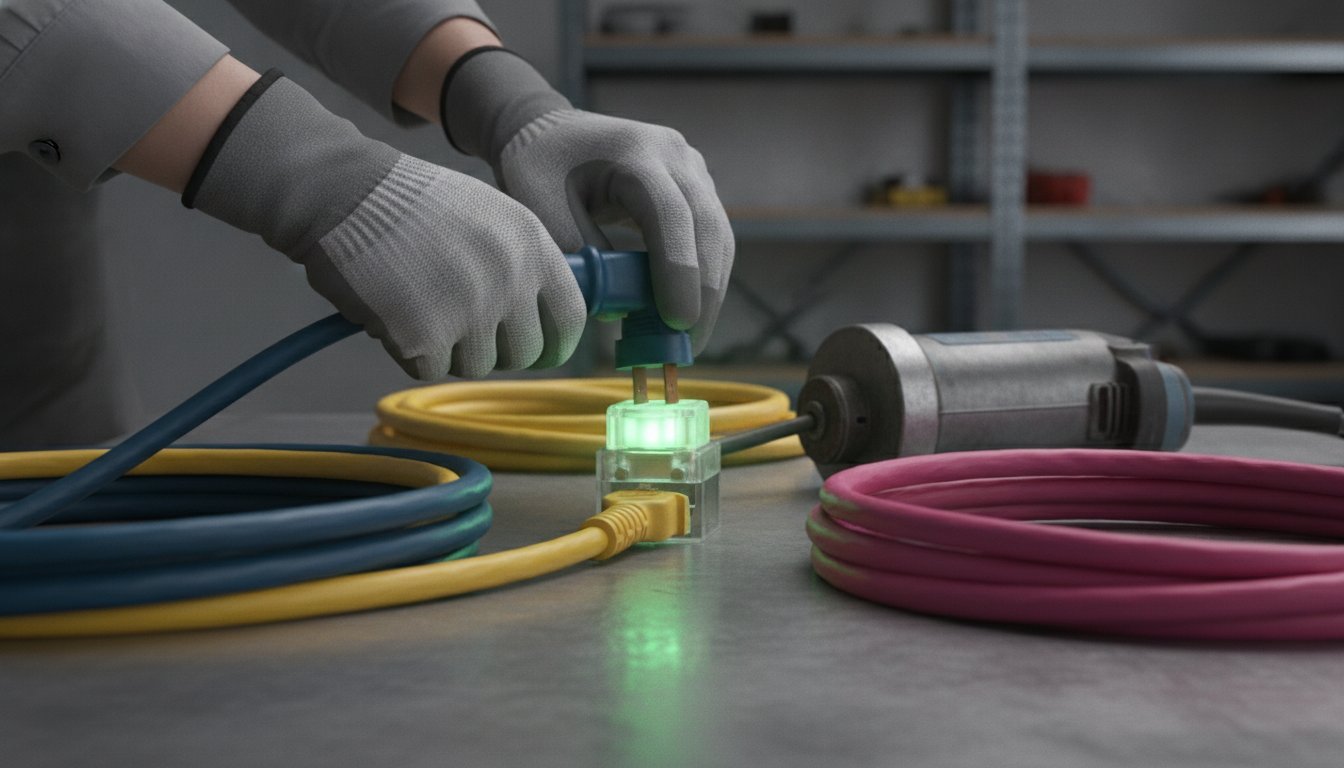
Is your extension cord slowly killing your most expensive tools? It’s a common mistake that costs contractors thousands in fried motors every year. You might think any cord will work, but using an accurate 2026 extension cord amperage chart is the only way to ensure your gear gets the juice it needs. Matching your equipment to the power source is a science, not a guess.
We understand the frustration of a lagging saw or a breaker that won’t stay reset. You need reliable power that doesn’t drop off when the run gets long. Our guide provides a clear, printable reference to help you master wire gauges and distance limits. Whether you’re choosing a 10 gauge ECONO cord for heavy industrial draws or a 12 gauge SJTW triple tap for daily jobsite use, we have the data to keep you running.
This guide breaks down confusing AWG numbers and explains how voltage drop affects your performance. You’ll gain the confidence to select the right cord for any amperage, ensuring your tools stay cool and your jobsite stays safe. Let’s get your equipment powered the right way.
Key Takeaways
- Learn why “ampacity” is the secret to preventing heat buildup and protecting your expensive tool motors from burnout.
- Use our 2026 extension cord amperage chart to accurately calculate voltage drop across distances up to 150 feet.
- Discover when to choose a 12 Gauge SJTW for standard jobsite tasks versus a 10 Gauge ECONO for high-draw industrial equipment.
- Identify the specific power requirements for heavy-duty gear like Bosch reciprocating saws to avoid performance lag.
- Find out how custom-printed cords solve ownership disputes and stop jobsite theft before it happens.
Understanding the Extension Cord Amperage Chart
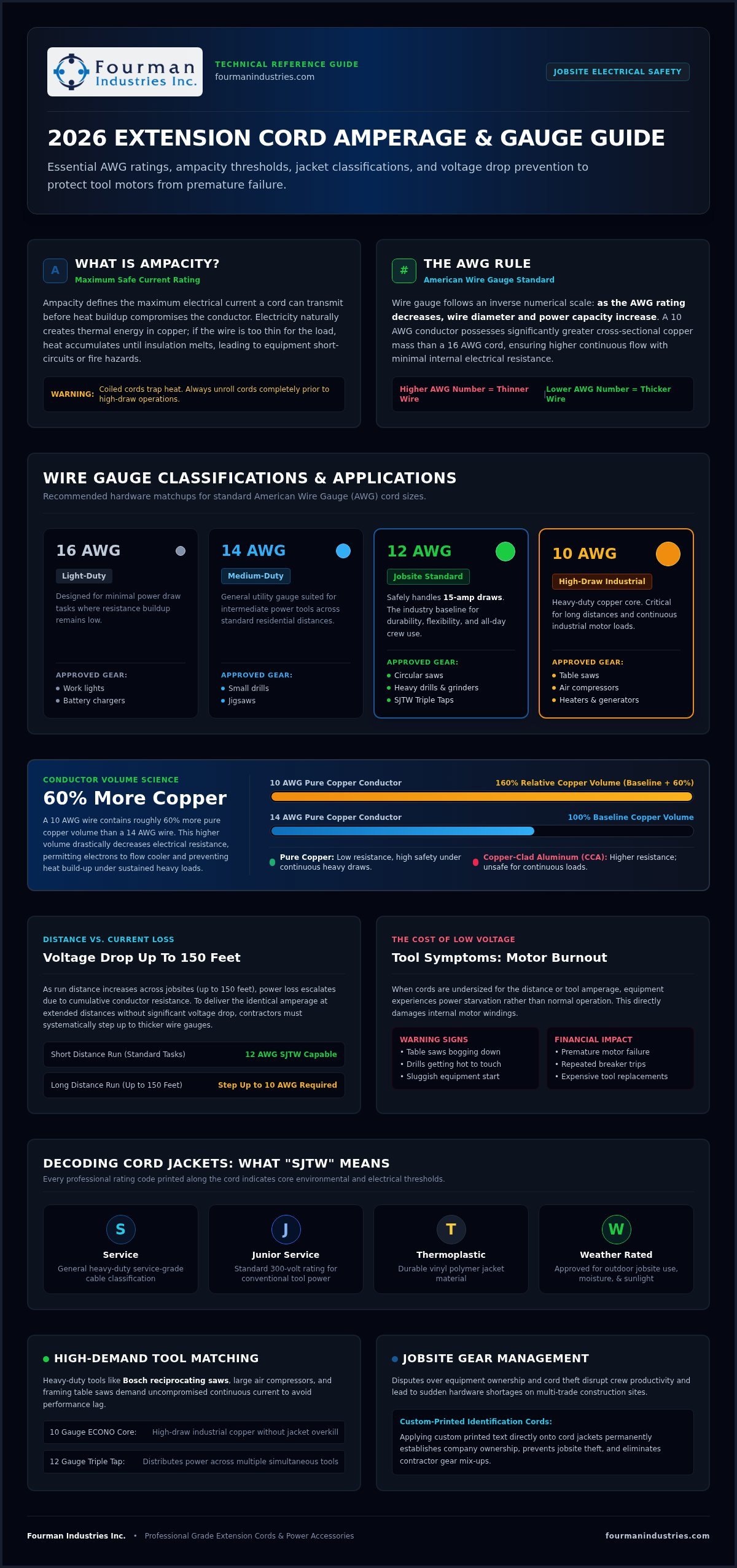
Ampacity is the most important term you’ll learn for jobsite safety. It defines the maximum amount of electrical current a cord can carry before it starts to fail. You need a reliable extension cord amperage chart because electricity naturally generates heat as it travels through copper. If your wire is too thin for the load, that heat can’t escape. It builds up until the insulation melts or a fire starts. Choosing the right cord isn’t just about making the tool work; it’s about protecting your property and your crew.
Two main variables dictate how much power reaches your equipment: wire gauge and cord length. We follow the American Wire Gauge standards to categorize these wires. It’s a bit counterintuitive at first. As the AWG number goes down, the physical thickness of the wire and its power capacity go up. For example, a 10 gauge cord is much thicker and more capable than a 16 gauge cord. When you look at an extension cord amperage chart, you’ll see that as the distance increases, you need a thicker wire to maintain the same amperage.
Why Amperage Ratings Matter for Safety
Using an undersized wire effectively turns your extension cord into a heating element. This creates a dangerous situation called voltage drop. When voltage drops, your tool doesn’t just feel sluggish; it’s actually starving for power. You’ll notice a table saw bogging down or a drill getting unusually hot. This isn’t just a performance lag. Operating tools on low voltage causes long-term motor damage. You’ll end up replacing expensive equipment far sooner than expected if you don’t match the cord to the tool’s draw. Heat dissipation is much harder in a coiled cord, so always unroll your lead completely before a high-draw task.
Decoding Cord Labels: SJTW and Beyond
Every professional cord has a code printed on the jacket. Understanding these letters helps you choose the right gear for your environment. “S” stands for Service, while “J” indicates a Junior Service rating of 300 volts. “T” means the jacket is Thermoplastic, and “W” signifies it’s rated for Weather and outdoor use. For most contractors, 12 Gauge SJTW Triple Tap Extension Cords are the industry standard. They provide the durability needed for rough jobsites while offering the flexibility to power multiple tools at once. Indoor-only cords lack the weatherproofing needed to survive UV exposure or damp ground. Always check your labels before plugging in.
AWG vs. Amps: How Wire Gauge Dictates Power Flow
Understanding the physical cross-section of your wire is the difference between a productive day and a costly fire. When you consult an extension cord amperage chart, you’re looking at the conductor’s diameter. A 10 AWG wire has roughly 60% more copper than a 14 AWG wire. This extra volume allows more electrons to flow with less resistance. Less resistance means less heat. While many big-box stores sell copper-clad aluminum (CCA) wires to save money, professional-grade cords use pure copper. CCA has higher resistance and can’t handle the same continuous loads safely. Following Consumer Product Safety Commission safety recommendations is essential here; using a wire that’s too thin for your amperage is a leading cause of electrical fires.
In the industry, you’ll often see “Econo” and “Professional” labels. Our 10 Gauge ECONO cords provide a heavy-duty copper core designed for high-draw tools without the overkill of extreme-environment jacketing found in some premium lines. It’s about getting the right amount of copper for the job at a fair price. Here’s how the gauges typically break down for daily use:
- 16 AWG: Best for light loads like work lights or battery chargers.
- 14 AWG: Suitable for medium-duty power tools like small drills or jigsaws.
- 12 AWG: The jobsite standard for circular saws and heavy drills.
- 10 AWG: Necessary for high-draw equipment like table saws and compressors.
The 12-Gauge Standard for Construction
Most jobsites rely on 12 AWG as the baseline. It safely handles 15-amp draws, which covers the majority of circular saws, grinders, and hammer drills used in residential framing. Using a 12 Gauge SJTW Triple Tap cord allows you to run multiple smaller tools from one lead without constantly tripping breakers. It’s the workhorse of the industry because it balances weight, flexibility, and power capacity perfectly for an eight-hour shift. If you’re running a crew, having a few of these in your trailer is non-negotiable for maintaining efficiency.
When to Step Up to 10 Gauge
Sometimes 12 gauge isn’t enough. For high-voltage equipment like large air compressors, portable heaters, or generators, you need 10 Gauge extension cords. These cords are built for continuous-use industrial environments where heat buildup is a constant threat. Stepping up to a 10-gauge lead ensures your high-draw motors start quickly and run cool, even under heavy load. If you’re tired of replacing burnt-out equipment or dealing with voltage drop on long runs, it’s time to invest in a thicker gauge. You can browse our heavy-duty cord selection to find the right fit for your rig.
The Extension Cord Amperage and Distance Chart
Choosing the right cord isn’t just about the plug fitting the socket. It’s about distance. This extension cord amperage chart shows how capacity drops as you add length. If you ignore these limits, you enter the “Danger Zone” where voltage drop exceeds 3%. This causes excessive heat and robs your tools of torque. It’s also vital to follow Electrical Safety Foundation International guidelines; never daisy-chain cords to reach a far corner of the site. One long, continuous cord is always safer than three short ones plugged together.
| Wire Gauge (AWG) | 0-25 Feet | 26-50 Feet | 51-100 Feet | 101-150 Feet |
|---|---|---|---|---|
| 16 AWG | 13 Amps | 10 Amps | Not Recommended | Not Recommended |
| 14 AWG | 15 Amps | 13 Amps | 10 Amps | Not Recommended |
| 12 AWG | 20 Amps | 15 Amps | 13 Amps | 10 Amps |
| 10 AWG | 30 Amps | 20 Amps | 15 Amps | 12 Amps |
One common mistake is leaving a cord coiled on a reel while under load. This creates a derating factor. When a cord is tightly wound, it can’t dissipate heat efficiently. The core temperature rises rapidly, which can melt the insulation from the inside out even if you aren’t exceeding the amperage on the chart. Always unspool the entire length if you’re pulling more than 50% of the cord’s rated capacity for more than a few minutes.
Calculating Voltage Drop for Long Runs
Contractors live by the 3% rule. You don’t want your voltage to drop more than 3% between the outlet and the tool. On a standard 120V circuit, that’s a loss of only 3.6 volts. Once you hit a 100-foot run, resistance becomes a major factor. This is usually when to use a 100-foot 12 gauge extension cord instead of a 14 gauge, even for tools that only draw 12 or 15 amps. Stepping up a full gauge compensates for the distance and keeps your motor running at peak efficiency without the sluggish performance caused by power loss.
Amps to Watts Conversion Table
Most tool nameplates list amperage, but some only show watts. Use this quick math: Amps x Volts = Watts. On a 120V circuit, a 15-amp tool draws about 1800 watts. However, you must factor in the “startup surge.” Motorized tools like table saws or compressors can draw two to three times their running amperage for a split second when they kick on. If your cord is already at its limit, that surge can trip the breaker or cause a brownout that damages the internal capacitors. Always leave a 20% safety margin on your amperage calculations to account for these spikes and keep your gear healthy.
Matching Tool Requirements to Cord Specifications
Matching your gear to the right power source shouldn’t require a degree in electrical engineering. Instead of memorizing every line on an extension cord amperage chart, use a simple three-tier rule of thumb. Look at your tool’s nameplate. This quick check prevents you from starving your equipment of the power it needs to function correctly. Categorize your tools into these three groups:
- Light Draw (Under 7 Amps): Work lights, battery chargers, and small fans.
- Medium Draw (7-12 Amps): Handheld drills, orbital sanders, and jigsaws.
- Heavy Draw (12-15+ Amps): Table saws, miter saws, and large air compressors.
Stop daisy-chaining your cords. Every connection point adds resistance and heat. Plugging two 50-foot 14-gauge cords together doesn’t give you a 100-foot 14-gauge run. It creates a safety hazard that significantly lowers the amperage capacity of the entire line. Always buy the length you actually need for the job. Before you plug in, inspect your plugs for burn marks or loose blades. If the connection feels loose, you’re looking at a fire risk that no chart can fix.
Powering Precision Tools
Precision work requires steady voltage. When you’re using DeWALT FLEXTORQ bit sets and high-torque impact drivers, inconsistent power causes performance lag. This often leads to cam-out and stripped fasteners because the tool’s motor isn’t delivering the torque it was designed for. A high-quality 12-gauge cord ensures your impact driver gets a full 120 volts, which directly extends the lifespan of your tool’s internal electronics. Don’t let a cheap cord ruin a professional bit set.
High-Draw Industrial Equipment
Large table saws, dust extractors, and air compressors are the biggest power hogs on any jobsite. These tools often pull a full 15 or 20 amps, especially during startup. To protect your Bosch reciprocating saw blades, you need the motor to maintain full RPM. If the voltage drops, the blade speed slows down, causing it to bind and overheat. This ruins the blade’s temper and slows down your production. For any tool on a 20-amp circuit, use a dedicated 10 or 12 AWG cord to keep the motor running cool. You can get the right heavy-duty cord for your tools here to ensure your gear stays in top shape.
Professional Gear Management: Custom Cords for the Jobsite
Once you’ve used an extension cord amperage chart to pick the right gauge, your next challenge is making sure those cords stay in your truck. Generic cords are a dime a dozen on big jobsites. They get mixed up, lost, or borrowed by other crews who didn’t plan ahead. This isn’t just an inconvenience. It’s a safety liability. If someone grabs your 16-gauge light-duty cord to run a table saw, they’re risking a fire. Professional gear management starts with clear ownership and organization.
High-visibility options like Pink extension cords or Purple extension cords are game-changers for jobsite safety. These bright colors stand out against gray concrete and brown dirt, which significantly reduces trip hazards for your crew. They also make it impossible for another contractor to claim your gear as their own. Organizing your crews by color allows for faster setup and breakdown. If the framing crew knows they only use purple leads, there’s no confusion at the end of the day. While an extension cord amperage chart tells you what wire you need, custom branding tells everyone else whose wire it is.
Custom Printing and Brand Awareness
We provide custom printed extension cords that put your company name and phone number directly on the cable jacket. This acts as a permanent ID. Electrical tape falls off and permanent markers fade in the sun. A factory-printed name stays for the life of the cord. It also improves your professional image. When a homeowner sees a clean, branded setup, they know they’re dealing with a pro who cares about the details. It’s a simple way to market your business while you work.
Theft Prevention and Accountability
Personalized extension cords are a simple way to lower your annual equipment replacement costs. Theft is a major drain on profit margins, but branded gear is much harder to fence or hide in a competitor’s trailer. By assigning specific colors to different teams, you create instant accountability. If a pink cord is left out in the rain, you know exactly which crew was responsible. It turns your power leads from a consumable expense into a long-term asset. When everyone knows which gear belongs to whom, the jobsite runs smoother, safer, and more efficiently.
Power Your Jobsite with Confidence
Choosing the right power solution shouldn’t be a guessing game. By mastering the extension cord amperage chart, you protect your expensive tool motors from the silent damage of voltage drop and heat buildup. Remember that distance is just as important as the wire gauge itself. Stepping up to a 10 or 12 gauge cord ensures your equipment gets the steady current it needs to perform at peak efficiency. It’s the simplest way to lower your long-term equipment replacement costs and keep your production schedule on track.
Don’t let generic gear slow you down or walk off the site. Our UL-certified power solutions are built for the toughest environments. We specialize in heavy-duty cords that feature custom printing and specialty high-vis colors like Pink and Purple. This level of organization prevents trip hazards and stops ownership disputes before they start. You’ve done the research. Now it’s time to get the gear that works as hard as you do every single day.
Ready to upgrade your professional setup? Build Your Custom Heavy-Duty Extension Cord at Fourman Industries today. Let’s keep your tools running strong and your jobsite safe.
Frequently Asked Questions
How many amps can a 12 gauge extension cord handle?
A 12 gauge cord can handle up to 20 amps for short runs under 50 feet. As distance increases, the safe capacity drops to prevent overheating. Our 12 Gauge SJTW Triple Tap cords are designed to manage these loads efficiently on the jobsite. Always consult an extension cord amperage chart to verify the safe limit for your specific length, as voltage drop becomes a major factor beyond 50 feet.
Can I use a 14 gauge cord for a 15 amp saw?
It’s not recommended for safety or tool performance. A 14 gauge wire is generally rated for 15 amps only at very short distances, but a high-draw saw often pulls more during startup. Using an undersized cord causes voltage drop, which can burn out your saw’s motor over time. Stick with a 12 gauge cord for any tool drawing 15 amps to ensure consistent, safe power flow.
What happens if I use an extension cord with too low an amperage rating?
The wire will overheat and the voltage reaching your tool will drop significantly. This creates a fire hazard as the insulation melts and it can permanently damage your equipment’s motor. You’ll notice the tool sounds weak or bogs down under load. Referring to a proper extension cord amperage chart prevents these issues by matching the wire’s capacity to the tool’s specific electrical demand.
Is a 10 gauge cord better than a 12 gauge cord for long distances?
A 10 gauge cord is significantly better for long distances because the thicker copper reduces electrical resistance. For runs reaching 100 feet or more, 10 Gauge ECONO cords provide more consistent power than standard 12 gauge options. This prevents your tools from losing torque and keeps the cord from overheating. When you’re working far from a power source, the lower AWG number ensures your equipment stays healthy.
How do I calculate the wattage of my tool if only amps are listed?
Use the simple formula: Amps x Volts = Watts. For most standard US outlets, the voltage is 120V. If your tool is rated for 15 amps, the calculation is 15 x 120, which equals 1800 watts. Keep in mind that motorized tools have a startup surge that can briefly double this wattage. Always choose a cord that can handle this initial spike to avoid tripping breakers or damaging electronics.
Why do extension cords get hot during use?
Heat is a byproduct of electrical resistance. When you pull more current through a wire than it’s rated for, the copper atoms collide with flowing electrons, creating thermal energy. This is especially common if the cord is too thin or too long for the load. If a cord feels hot to the touch, unplug it immediately and switch to a thicker gauge wire to prevent a fire or motor failure.
Does the color of the extension cord jacket affect its amperage rating?
The jacket color has no impact on the electrical capacity of the internal copper wire. Color is used for visibility, organization, and theft prevention. For example, using Pink or Purple extension cords makes them much easier to spot on a busy jobsite. The amperage rating is determined strictly by the wire gauge and the length of the cord, rather than the color of the outer plastic jacket.
Can I plug two extension cords together to reach 100 feet?
You can, but it’s not ideal for high-draw tools. Every connection point creates additional resistance and potential for heat buildup. It’s much safer to use a single 100-foot 12 gauge cord than joining two 50-foot cords together. If you must connect them, ensure both cords are rated for the tool’s amperage and be aware that your total capacity is limited by the thinnest wire in the chain.




