
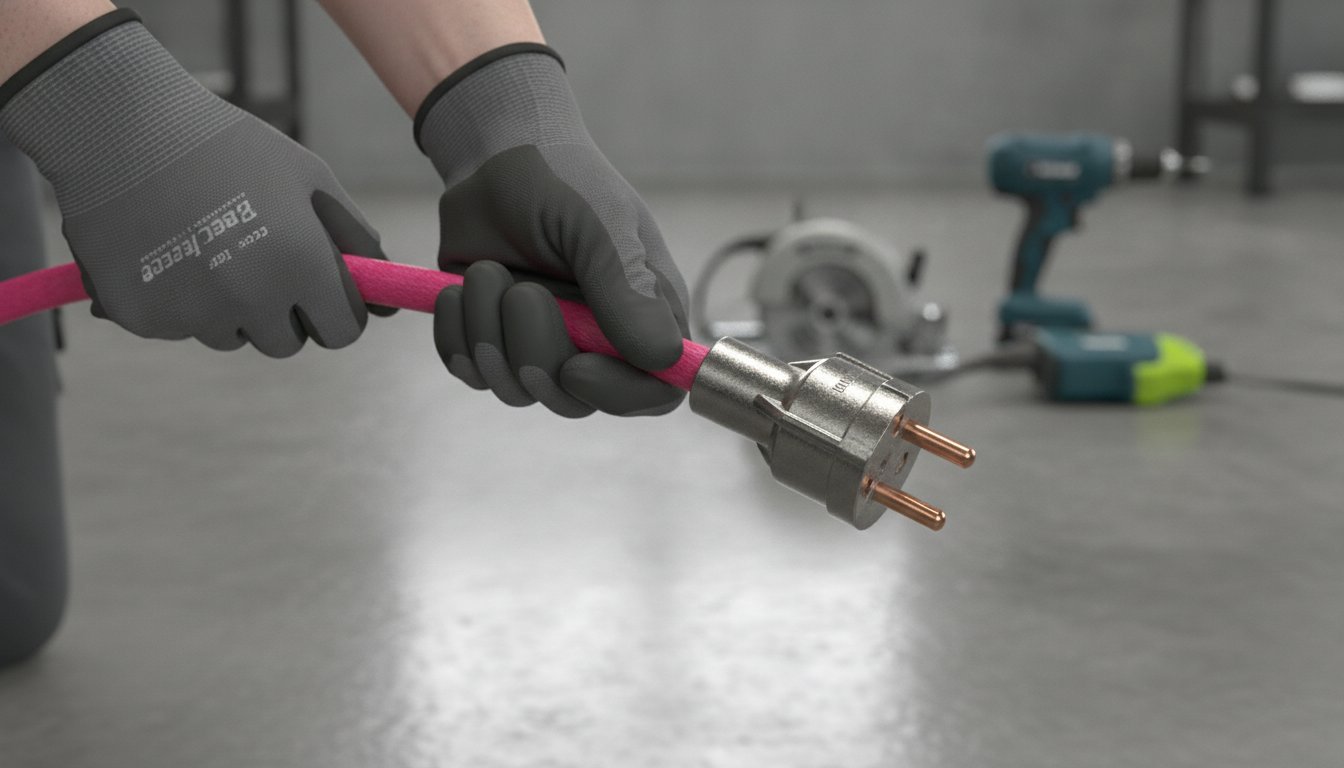
Did you know that the wrong drop cord can slowly burn out the motor of your expensive power tools before you even notice a puff of smoke? It’s a common mistake that costs professionals thousands in equipment repairs and replacement every year. You probably already know the frustration of cords that run hot or the headache of untangling a mess of damaged jackets at the start of a shift. With copper prices trading around $6.00 per pound in 2026, your power leads are also bigger targets for job site theft than ever before.
You need a power setup that’s reliable, safe, and easy to identify. This guide helps you master the essentials of drop cord safety, selection, and management with a comprehensive professional checklist. We’ll walk you through the technical specs needed to prevent voltage drop, explain how to decode OSHA jacket ratings, and show you why custom branding is the best way to keep your gear from walking off the site. Let’s make sure your equipment lasts as long as your reputation for quality work.
Key Takeaways
- Master the G-L-A rule to properly balance gauge, length, and amperage for a fire-safe power setup.
- Learn the hand-over-hand inspection technique to identify hidden jacket damage and faulty ground pins before every shift.
- Protect your investment by choosing a high-visibility drop cord in colors like pink or purple to immediately deter job site theft.
- Discover how custom printing and personalized jackets turn your essential gear into a professional branding and identification tool.
- Understand the performance link between industrial-grade power cords and the long-term health of your heavy-duty tools and blades.
What is a Drop Cord? Understanding the Foundations of Portable Power
A drop cord is more than just a length of wire; it’s a flexible power bridge designed to “drop” electricity from a fixed wall outlet to where the action is happening. Whether you’re on a muddy construction site or in a high-voltage industrial workshop, this tool is the lifeblood of your operation. It provides the necessary reach for tools that would otherwise be tethered to a wall. In professional circles, we don’t just call any wire a drop cord. We reserve that name for gear that can handle the grit and grind of a real workday.
Pros look at two specific factors to define a cord’s rating: jacket durability and copper thickness. The American Wire Gauge (AWG) rating tells you how much juice that cord can carry without overheating. A professional-grade cord, like a 10 Gauge ECONO or a 12 Gauge SJTW, uses thicker copper to handle the heavy draw of high-amperage saws and drills. If the copper is too thin, you’ll see a voltage drop that starves your motor and kills your productivity.
Anatomy of a Professional Grade Drop Cord
A real workhorse consists of three main parts. First, you have the copper conductors. These need to be pure and thick enough to prevent power loss over long distances. Second, the jacket protects those wires from oil, water, and harsh sunlight. Look for specific ratings like “W” for weather resistance to ensure your gear survives the elements. Finally, consider the plug ends. Molded plugs are essential. They seal the connection point to prevent moisture from getting inside and causing dangerous arcing. If you’re running multiple tools at once, a 12 Gauge SJTW Triple Tap design is a game changer. It lets you plug in three devices at one end, which keeps your workspace organized and cuts down on cord clutter.
Drop Cord vs. Extension Cord: Is There a Difference?
The term “drop cord” has deep roots in industrial history. In old-school workshops, power outlets were often mounted on the ceiling to keep floors clear. Mechanics would literally “drop” the cord down to their workstations. Today, the terms are often used interchangeably, but “drop cord” usually implies a heavier-duty lead or a retractable reel system meant for professional use. You don’t need a heavy-duty drop cord to power a desk lamp, but you definitely need one for high-draw gear on a job site. Knowing when to reach for a specialized lead instead of a standard household extension cord can save your tools and your timeline. When you’re using professional equipment, sticking to industrial extension cord solutions is the only way to ensure your gear performs as intended.
The Drop Cord Selection Checklist: Matching Gauge to Your Power Needs
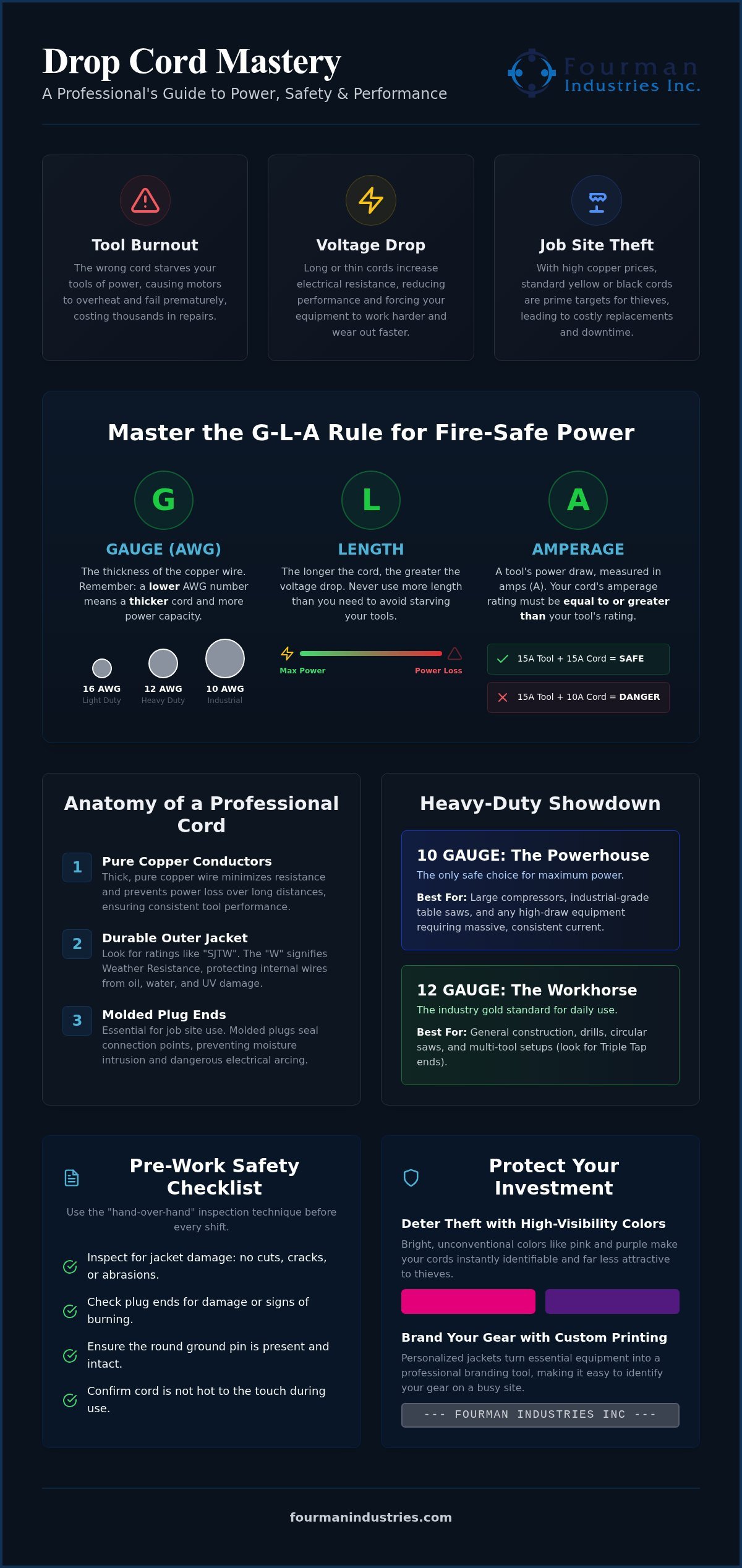
Choosing a drop cord isn’t as simple as grabbing the first yellow reel you see at the store. To keep your site safe, you need to follow the G-L-A rule: Gauge, Length, and Amperage. These three factors must stay in balance. If they don’t, you risk overheating the cord or even starting a fire. Every tool has a specific amperage rating. A heavy-duty table saw might pull 15 amps, while a small drill pulls much less. If your cord isn’t rated for that specific draw, the copper will get hot. This isn’t just a safety issue; it’s a performance killer. When a cord gets too hot, it creates resistance. That resistance starves your tools of the power they need to run at full capacity.
Understanding American Wire Gauge (AWG) ratings is the first step toward a better setup. These numbers work in reverse. A lower number means thicker copper and more power capacity. For example, a 10-gauge cord is much beefier than a 14-gauge cord. Thicker copper offers less resistance, which prevents the dreaded “voltage drop.” When voltage drops, your tool motors have to work twice as hard to perform the same task. This extra strain creates internal heat that can permanently damage your equipment. Don’t let a cheap cord ruin your investment in high-end gear.
10 Gauge vs. 12 Gauge: Which Heavy-Duty Cord Wins?
For high-draw equipment like large compressors or industrial saws, a 10 gauge heavy duty extension cord is the only safe choice. It provides the massive current flow required for intense industrial work without breaking a sweat. For general construction and daily tasks, 12 Gauge SJTW Triple Tap cords are the industry gold standard. They offer a perfect balance of flexibility and high power capacity. Always look for cords with high copper purity. Pure copper ensures a consistent current flow, which is vital when you’re running precision tools all day long.
Length Matters: Avoiding the 100-Foot Voltage Trap
Length is the silent killer of portable power. As a drop cord gets longer, the electrical resistance increases naturally. If you double your cord length from 50 to 100 feet, you often need to move up to a thicker gauge to maintain safety. Never “daisy-chain” multiple cords together to reach a work area. This creates multiple points of resistance and heat buildup. For high-draw saws and compressors, try to keep your power runs under 50 feet. If you must go longer, always use a thicker gauge than the tool’s minimum requirement. If you’re tired of gear that can’t handle the load, take a look at our heavy-duty 10 Gauge ECONO cords built for the toughest job sites.
Critical Safety Inspections: A Pre-Work Checklist for Every Job Site
Safety on a busy job site isn’t just about wearing your hard hat. It starts with the power under your feet. Before you plug in a single tool, you need to perform a thorough “Hand-Over-Hand” inspection of your drop cord. Physically run your hand down the entire length of the cable. You’re feeling for nicks, deep cuts, or unusual bulges in the outer jacket. If you feel a “soft spot” or a mushy section, that’s a sign of internal wire damage. A damaged jacket is an invitation for a short circuit or a fire. Don’t risk it; if the cord feels compromised, pull it from service immediately.
Next, take a hard look at the plug ends. Ensure the ground pin is present and firmly attached. Many workers make the mistake of breaking off a ground pin to fit an old outlet, but this removes your primary protection against electric shock. Check that the blades aren’t bent, loose, or showing signs of discoloration from heat. While your tools are running, perform a “Warm to Touch” test. If the cord feels hot to the hand, you likely have internal wire breakage or you’re pulling too much amperage for that specific gauge. Heat is a warning sign that a spark is coming next.
Environment matters just as much as the gear itself. Keep your connections out of standing water and away from high-traffic areas where they can be crushed by heavy machinery. If you’re working around sharp metal edges or abrasive gravel, use cord protectors or high-visibility ramps to prevent the jacket from being sliced open during the day.
Understanding Jacket Codes: SJTW, STW, and Beyond
Every professional drop cord has a code stamped into the jacket that tells you exactly what it can handle. “S” stands for Service, while “J” means Junior Service, which is rated for up to 300 volts. The “T” tells you the jacket is Thermoplastic, and “W” indicates it’s weather-resistant. For most outdoor job sites, SJTW is the gold standard because it stays flexible in cold weather and resists moisture. If you’re working on rough surfaces like gravel or jagged concrete, you’ll want a thicker “STW” rating to handle the extra abrasion. Matching your cord’s skin to your work surface is the best way to extend the life of your gear.
Safe Powering for Generators and High-Draw Gear
Running power from a generator requires even more precision than a wall outlet. There are specific rules for choosing & using heavy duty generator cords to ensure you don’t blow a circuit or damage the stator. You must verify that your cord setup supports proper neutral bonding and grounding to keep the current stable. Using the wrong cord to connect a generator to a building can cause backfeeding, which sends electricity back into the utility lines and puts line workers at risk of electrocution. Always use a dedicated transfer switch and a cord rated for the generator’s full output to stay within code.
Managing Your Gear: Preventing Theft and Cord Damage on Site
Job site theft is a massive financial drain. With copper trading at $6.00 per pound as of July 2026, every drop cord on your site is a valuable target for thieves. Standard yellow or orange leads are easy to steal because they look like everyone else’s. Once they’re gone, the recovery rate is less than 7%. You don’t just lose the cord; you lose the time it takes to replace it and the productivity of the crew waiting for power. Making your gear stand out is the first line of defense against “disappearing” equipment.
Damage often happens from the inside out. Use the “Over-Under” coil method when packing up for the day. This technique prevents internal wire memory and stops the jacket from kinking or twisting. If you just wrap a cord around your arm, you’re stressing the copper and shortening the life of your gear. In high-traffic zones, use mechanical cord locks or heavy-duty covers. These keep connections secure even if someone accidentally trips or a cart rolls over the lead. Taking these small steps ensures your gear stays in service longer and performs safely every time you plug in.
The Power of Custom Printed Extension Cords
Investing in custom extension cords is the most effective way to stop theft on a crowded job site. When your company name is printed directly on the jacket, it’s impossible for another crew to claim your lead is theirs. You can also use imprinting for maintenance tracking by adding specific dates like “Inspected Jan 2026.” This level of personalization improves crew accountability and shows clients that you run a professional, organized operation. It’s a simple branding tool that pays for itself by reducing replacement costs.
High-Visibility Solutions: Pink and Purple Cords
Visibility is a safety requirement. Using pink extension cords or purple options makes your power lines stand out against gray concrete and brown dirt. This high contrast significantly reduces trip hazards in low-light environments. There’s also a psychological benefit to unique colors. Thieves usually look for generic gear they can resell easily. A bright pink or purple drop cord is much harder to move on the black market, making it a natural deterrent. Stop losing money to “disappearing” leads and secure your job site with personalized extension cords that stay where you put them.
Why Professional-Grade Drop Cords Outperform Standard Retail Options
Walking into a big-box retailer and grabbing the cheapest reel on the shelf is a gamble that rarely pays off for professionals. “Big Box” cords are designed for light residential use, often featuring thinner jackets and lower-purity copper that can’t handle the heat of a 10-hour shift. In contrast, industrial extension cord solutions are built to withstand being stepped on, driven over, and exposed to the elements. A high-quality drop cord ensures your tools receive a steady, clean stream of electricity. This consistency is vital for the performance of precision equipment. For example, using high-end Bosch reciprocating saw blades requires your saw to maintain its full strokes-per-minute (SPM) rating. If your cord causes a voltage drop, the motor bogs down, your blades dull faster, and your cuts become jagged.
UL Certification is another area where professional cords pull ahead. While many retail options claim to meet standards, a true professional lead is officially certified by a Nationally Recognized Testing Laboratory (NRTL). As of 2026, OSHA requires all workplace cords to carry these marks. Using uncertified gear doesn’t just risk a fire; it risks heavy fines and voided insurance claims. Before you pull the trigger on your next purchase, run through this final checklist:
- Is the copper 100% pure, or is it a cheaper aluminum blend?
- Does the jacket have a “W” rating for moisture and sunlight resistance?
- Is the plug molded to the cord to prevent arcing and water ingress?
- Is the gauge thick enough (10 or 12 AWG) for my highest-draw tool?
- Does the cord have a lighted end to quickly verify power flow?
The ROI of Durability and Customization
The math on cheap cords simply doesn’t add up. If you replace a light-duty lead three times a year due to jacket failure or stolen gear, you’ve spent more than the cost of one premium 10-gauge cord. Industrial leads are a one-time investment that lasts for years. Custom printing also changes the financial equation. Some industry professionals report that personalized branding can reduce annual gear loss by up to 50%. When your name is permanently imprinted on the jacket, it stops being a “disposable” item and becomes a tracked asset. Using “Triple Tap” ends further increases your ROI by allowing one heavy-duty run to power three tools, reducing the number of expensive leads you need to manage on-site.
Fourman Industries: Your Partner in Portable Power
Since 1997, we’ve focused on providing the rugged gear that keeps American job sites running. We don’t cut corners with copper-clad aluminum; our cords use 100% copper for maximum conductivity. Our specialized 10 Gauge ECONO and 12 Gauge SJTW Triple Tap designs are built to survive the harshest environments. We know that downtime is lost money, which is why we offer fast turnaround on personalized and custom-printed orders with national delivery. You deserve power that is as reliable as your handshake. Build your custom heavy-duty drop cord today at Fourman Industries and protect your tools, your crew, and your bottom line.
Secure Your Power and Protect Your Tools
Mastering your power setup comes down to choosing the right gauge and keeping a close eye on your gear. By following the G-L-A rule and performing daily hand-over-hand inspections, you protect both your crew and your expensive equipment from avoidable damage. Don’t let your job site leads become easy targets for theft. High-visibility colors and custom imprinting are the most effective ways to keep your inventory exactly where it belongs while maintaining a professional image.
Since 1997, Fourman Industries has specialized in heavy-duty 10 and 12-gauge industrial cords built for the grit of a real workday. We understand that a reliable drop cord is the foundation of every successful project. Whether you need the massive capacity of a 10-gauge lead or the multi-tool efficiency of a triple tap, we provide the durability your tools demand with the personalization your business needs to stay organized and secure.
Shop Heavy Duty Custom Drop Cords at Fourman Industries
Stay safe on the job and keep your project moving forward with power you can trust.
Frequently Asked Questions
What is the difference between a drop cord and an extension cord?
Historically, a drop cord was a power lead that literally “dropped” from a ceiling-mounted outlet in an industrial workshop to keep the floor clear. Today, the term usually refers to heavy-duty, professional-grade leads or retractable reels, while “extension cord” is the general name for any flexible power cable.
Can I use an indoor drop cord outside if it’s not raining?
No, you shouldn’t use indoor-rated cords for outdoor projects even in dry weather. Outdoor jackets are specifically engineered to resist UV rays and extreme temperature shifts, while indoor insulation can quickly crack or degrade when exposed to sunlight and humidity.
Why is my drop cord getting hot during use?
Heat is a sign of electrical resistance, which happens when your cord’s gauge is too thin to handle the tool’s amperage draw. It can also be caused by using a cord that’s too long or having internal copper damage that forces the current through a smaller, restricted path.
How do I know if I need a 10-gauge or 12-gauge cord?
You need a 10-gauge cord for high-draw equipment like air compressors, large table saws, or any tool running on a long 100-foot run. A 12-gauge cord is the industry standard for most handheld tools, providing a great balance of flexibility and power for daily construction tasks.
What do the letters SJTW stand for on a drop cord?
These letters identify the cord’s technical specs: S is for Service, J is for Junior Service (rated for 300 volts), T is for Thermoplastic, and W is for Weather-resistance. This combination is the preferred choice for pros who need a lead that stays flexible and safe in outdoor environments.
Is it safe to plug one drop cord into another?
No, you should never “daisy-chain” power leads together because it creates excessive resistance and heat at the connection points. This practice violates OSHA and NEC safety standards and can lead to significant voltage drop, which starves your tools of power and risks a fire.
How can I prevent my drop cords from being stolen on a job site?
The best defense is using high-visibility colors like pink or purple and investing in custom printing with your company name. With copper prices at $6.00 per pound as of July 2026, unique branding makes your gear much harder for thieves to resell on the black market.
What should I do if the ground pin breaks off my drop cord plug?
Take the cord out of service immediately and don’t attempt to use it. A broken ground pin removes your primary protection against electrical shocks; you must either install an OSHA-approved replacement plug or cut the cord to ensure it isn’t used by mistake.




