
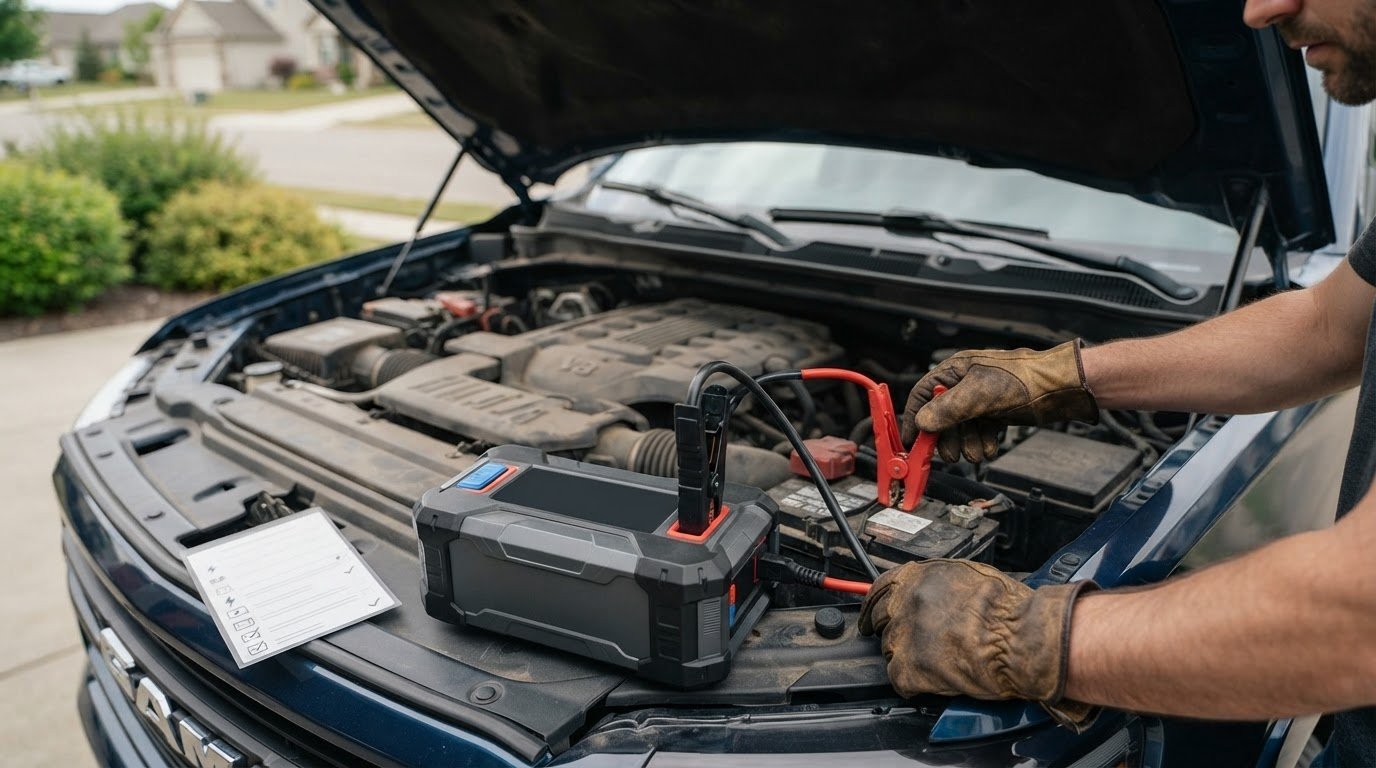
What if the jump starter with the biggest peak-amp number still isn’t the right fit for your truck or car? Product claims can be hard to compare, and “V8” alone doesn’t tell the whole story. A portable jump starter for V8 engine use must match your vehicle’s requirements, including whether its engine is gasoline or diesel. Check the details behind the headline rating before you buy.
This guide explains which specifications to verify and how to assess engine compatibility without relying on peak amps alone. You’ll also learn how to prepare for a jump-start safely, follow your vehicle and jump starter manuals, and keep your unit charged and ready for the road. Fourman Industries, founded in 1997, sells truck and car battery jump starters. Use these steps to narrow your options and make a more confident choice in 2026.
Key Takeaways
- Match the jump starter’s documented capability to your vehicle’s specific requirements, not just its V8 cylinder layout.
- Compare ratings using manufacturer documentation, and weigh peak-current claims alongside stated engine compatibility.
- Use a vehicle-specific checklist to rule out options with unclear or mismatched compatibility details.
- Before an emergency, check your unit’s charge and review the manuals for the correct connection points and starting procedure.
- Choose a portable jump starter for V8 engine use by verifying compatibility first, then comparing practical features for your needs.
Portable jump starter for a V8 engine: what compatibility really means
Compatibility means the jump starter’s documented capabilities match the requirements of your specific vehicle. A product page that says “for V8 engines” gives you a starting point, not a complete fit check. V8 describes an engine’s cylinder arrangement. It doesn’t identify the vehicle’s battery, fuel type, starting requirements, or manufacturer precautions.
Engine configuration alone cannot prove jump-starter compatibility. Before choosing a portable jump starter for V8 engine use, compare the unit’s published guidance with your vehicle’s documentation. If the product description makes a broad engine-size claim without explaining its limits, there isn’t enough information to confirm a match.
Consider gasoline and diesel vehicles separately. They can have different starting requirements, so don’t assume a device described for one fuel type is suitable for the other. Check the exact engine and fuel type in your owner’s manual, then compare them with the jump starter’s documented compatibility information.
A jump starter is one way to start a vehicle when its battery can’t do so on its own. For background on the process and its safety considerations, see Jump start (vehicle). For your vehicle, the manufacturer’s instructions take priority over general guidance.
Why V8 engine size does not settle the compatibility question
V8 vehicles differ in design, battery setup, fuel, and operating conditions. Temperature, battery condition, and the vehicle’s electrical system can also affect a starting attempt. One engine label can’t stand in for the vehicle’s full requirements, so don’t assume a starter suited to one V8 will work for every other V8.
Use the product’s published specifications to check against the vehicle details you’ve gathered. Don’t rely on a broad claim or a single headline figure without supporting compatibility information.
Start with the owner’s manual and battery information
Look in the owner’s manual for sections on the battery, jump-starting, emergency procedures, or vehicle electrical equipment. Note the specified battery type, approved connection points, and any warnings or restrictions. If the battery label is accessible, use it to identify the information the manual asks you to check. Don’t remove covers or handle components if the manual says not to.
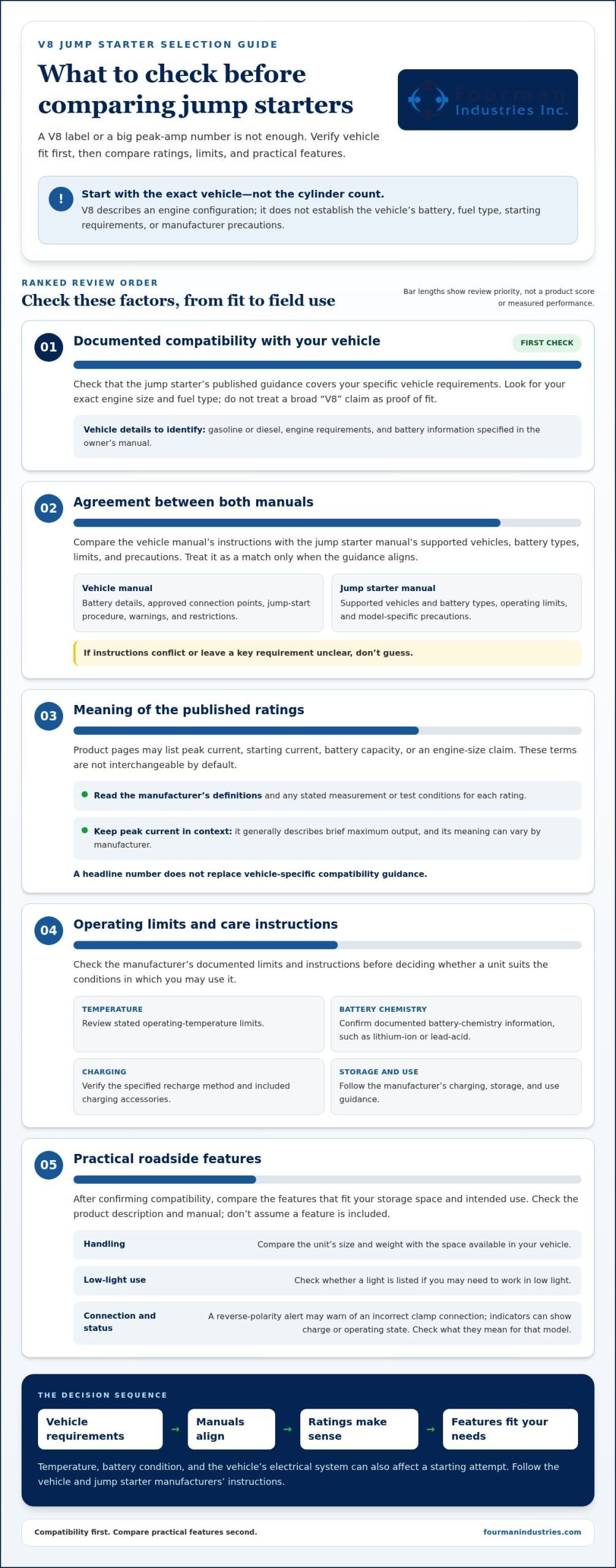
Compare the two manuals. The vehicle manual explains what your car or truck requires and how its manufacturer permits a jump-start. The jump starter manual states which vehicles and battery types the unit is designed to support, along with its limits and precautions. Treat compatibility as a match only when both sets of instructions align. If they conflict or leave a key requirement unclear, don’t guess. Choose an option with clear documentation for your vehicle.
Which jump-starter specifications matter for a V8 vehicle?
Once you’ve recorded your vehicle’s requirements, compare them with the jump starter’s documentation. Product pages may show peak current, starting current, battery capacity, or an engine-size claim. These terms aren’t interchangeable by default. Read the manufacturer’s definitions and test conditions instead of assuming one headline number tells you how the unit will perform in your vehicle.
A headline rating is not a substitute for vehicle-specific fit. For a portable jump starter for V8 engine use, look for compatibility guidance that accounts for your vehicle’s exact fuel type and engine requirements.
How to read current ratings and engine-compatibility claims
Peak current generally refers to a brief maximum output, but its meaning and measurement conditions can vary by manufacturer. Other labels may describe a different current rating or battery capacity. Don’t compare figures as if they measure the same thing. Use each rating as the manufacturer defines it in the product manual or specification sheet.
Check whether the manufacturer specifically lists your vehicle’s fuel type and engine size. If the claim is broad, look for supporting documentation before treating it as a match. A general V8 label alone doesn’t establish suitability for every V8 vehicle. For another overview of practical selection factors, see this truck and car battery jump starter buying guide.
Technical guidance can add context, too. The SAE International Recommended Practice for Jump Starting addresses jump-starting 12V automotive vehicles. Use references like this for background, not as a replacement for your vehicle’s instructions or the jump starter’s documented limits.
Features that make roadside use more practical
After confirming compatibility, compare features that affect storage and use. Check the product description and manual rather than assuming a feature comes standard. For example, a reverse-polarity alert may warn about an incorrect clamp connection, while status indicators can show the unit’s charge or operating state. Check the manual to understand what each indicator means for that model.
Consider the conditions in which you’ll use the unit. Review any documented operating-temperature limits and battery-chemistry information, such as whether it uses lithium-ion or lead-acid technology. Don’t assume a chemistry or temperature range based on the unit’s appearance or category. Confirm the manufacturer’s charging and storage guidance as well.
- Handling: Compare the unit’s size and weight with the space available in your vehicle.
- Visibility: Check whether a light is listed if you may need to work in low-light conditions.
- Charging: Verify the specified recharge method and any included charging accessories.
- Limits: Note stated temperature, battery-type, and use restrictions before purchase.
Choose features that suit your roadside needs, but don’t let extras distract from documented vehicle compatibility. Fourman Industries sells a truck and car battery jump starter to consider alongside the specifications that matter for your vehicle.
Compare V8 jump starters with a vehicle-specific buying checklist
A shortlist is easier to evaluate when you check every option against the same vehicle details. Start with the owner’s manual, then compare current manufacturer specifications. If a product page says “fits V8 engines” but doesn’t clearly cover your vehicle’s fuel type or requirements, set it aside until the documentation resolves the gap.
Compare documented vehicle fit first, then convenience features. This keeps compact design, extra functions, or an attention-grabbing rating from outweighing the basic question: does the manufacturer’s guidance cover your vehicle?
A step-by-step shortlist for your exact V8 vehicle
Write down your vehicle’s year, make, model, engine fuel type, and manual-stated jump-start guidance. Use the same record for every candidate. Compare each unit’s current manufacturer specifications against those details, and eliminate options with unclear or mismatched compatibility information.
Use this comparison grid to organize the decision:
| Check | Your vehicle | Candidate jump starter |
|---|---|---|
| Vehicle type | Year, make, model, and engine | Manufacturer’s listed vehicle or engine compatibility |
| Fuel | Gasoline or diesel | Does the documentation cover that fuel type? |
| Manual guidance | Battery details, jump points, and precautions | Are the unit’s instructions compatible with the vehicle manual? |
| Documented ratings | Requirements identified in vehicle documentation | Manufacturer-defined ratings and stated limits |
| Storage and routine | Available space and likely use conditions | Size, weight, charging needs, and listed features |
Keep the comparison factual. Copy the manufacturer’s terminology instead of turning a rating into a promise the documentation doesn’t make. If the exact vehicle or fuel type isn’t clearly covered, don’t treat a general V8 claim as proof of fit.
When a compact unit may not suit your priorities
A small unit can be easier to store, but size alone says nothing about whether it’s suitable for a V8. Weigh portability against documented capability and how you’ll use it. Consider whether it will stay in a glove box, under a seat, or in a larger emergency kit, and whether its stated operating limits suit your routine.
Consider convenience features after compatibility. A built-in light may help with roadside setup in low visibility, while charging functions may be useful on longer trips. Include either only if it’s listed and serves a real need. Compare manufacturer specifications before choosing, and don’t call any option “best” without evidence for your exact vehicle. Fourman Industries also sells a truck and car battery jump starter for roadside preparedness.
Prepare and use a portable jump starter safely with a V8
A jump starter is useful in an emergency only if it’s charged, in working condition, and used according to its instructions. Prepare before you need it. Keep the vehicle’s owner’s manual and the jump starter manual accessible, and read the procedures for your vehicle and device. Don’t rely on a remembered clamp sequence, because connection points and steps can vary.
Before using a portable jump starter for a V8 engine, stop if anything looks unsafe. A damaged battery, visible leaks, damaged cables, or another unusual condition calls for caution, not guesswork. Don’t connect the unit. Seek qualified assistance instead.
What to check before connecting the clamps
Use this pre-start check. Follow any location-specific directions and warnings in both manuals, and don’t proceed if the instructions are unclear or the equipment appears damaged.
- Position the vehicle: Park in a safe location, switch the vehicle off, and follow the manuals’ directions for the setting and setup.
- Inspect the equipment: Look over the jump starter, cables, clamps, and battery area for visible damage, leaks, or other unusual conditions.
- Confirm the connection points: Use the vehicle manual to identify approved connection points and confirm polarity. Don’t choose a connection point based on appearance alone.
- Follow the procedure: Use the clamp order and start procedure stated in both manuals. If the instructions differ, stop and resolve the conflict before connecting anything.
Once connected, follow the device’s instructions for starting and disconnecting. Don’t improvise extra attempts or steps if the vehicle doesn’t start as directed. Stop and consult the manuals for next steps, or seek qualified help if you’re unsure.
Keep the unit ready between emergencies
Read the jump starter manual to learn how to check its charge status and when to recharge it. Make checking the unit part of your vehicle-preparation routine, especially after use or before a trip. Recharge it using the method specified by its manufacturer rather than assuming any cable or power source is suitable.
Storage guidance varies by unit. Follow the manufacturer’s stated conditions for temperature, location, and charging during storage. Don’t assume one device’s rules apply to another. Store the manual where you can find it, and keep the unit secure and accessible without obstructing the driver or vehicle controls.
A charged jump starter is one part of roadside readiness. Build a broader plan around the equipment and supplies you may need with these emergency car kit essentials. For a practical addition to your vehicle kit, explore Fourman Industries truck and car battery jump starter.
Choose a V8-ready jump starter and make your next move
Make the final choice in this order: identify what your vehicle needs, match those needs to the jump starter’s published compatibility information, then compare practical features. This keeps a convenient size or extra function from distracting you from the essential question: does the manufacturer’s documentation cover your exact vehicle?
No single rating or feature proves that every V8 is supported. A suitable portable jump starter for V8 engine use is one whose documented limits align with your vehicle’s manual and battery information. If an important detail is missing or unclear, don’t fill the gap with an assumption. Look for specifications that let you make a direct comparison.
A final checklist before selecting your jump starter
Before buying, put your vehicle information and product details side by side. Work through these checks:
- Confirm the engine and fuel: Record whether your V8 runs on gasoline or diesel, along with the vehicle’s year, make, and model.
- Review the vehicle manual: Note battery details, jump-start instructions, approved connection points, and any precautions that apply to your vehicle.
- Match documented compatibility: Compare those details with the jump starter manufacturer’s current compatibility statement and published limits. Don’t rely on a general V8 claim if it doesn’t clearly cover your vehicle and fuel type.
- Check your routine: Consider how you’ll charge and store the unit, where it will fit in your vehicle, and which listed safety or convenience features you’ll actually use.
- Keep the instructions handy: Make sure you can access both manuals when it’s time to use the unit, and follow their directions for preparation and operation.
Use the checklist to rule out mismatches first. Then compare the remaining options by size, storage, charging, and useful features. This gives you a practical shortlist without treating a single headline number as a guarantee of fit.
Explore Fourman’s automotive emergency equipment
Fourman Industries sells a truck and car battery jump starter as part of its automotive emergency equipment. Consider this product as you build a roadside kit, and use the same careful approach: compare its published specifications with your vehicle’s documented requirements before deciding whether it’s the right fit.
Ready to explore automotive emergency equipment? Explore Fourman Industries and review the truck and car battery jump starter as you plan your vehicle’s roadside setup.
Make roadside readiness part of your next trip
Don’t wait for a weak battery to turn a routine drive into a stressful roadside problem. Take a few minutes to make your vehicle’s jump-start information easy to find, and decide where emergency equipment will stay so it’s accessible when needed. Preparing now can make your next decision clearer and help you avoid buying based on a headline claim alone.
As you shop for a portable jump starter for V8 engine use, let documented fit guide your choice. Then consider how the unit will fit into your vehicle and travel routine. Fourman Industries offers a truck and car battery jump starter as part of its automotive emergency equipment. Review the product details alongside your vehicle’s requirements before deciding whether it fits your needs.
Explore Fourman’s truck and car battery jump starter, and take a practical step toward feeling more prepared for the road ahead.
Frequently Asked Questions
Will any portable jump starter labeled for a V8 work with my vehicle?
No. A V8 label doesn’t guarantee the unit is suitable for every V8 vehicle. Check whether the manufacturer’s current documentation covers your exact vehicle and fuel type, and whether it aligns with your owner’s manual. For example, a listing that only says “V8 compatible” may not clarify whether it applies to a gasoline or diesel engine. If the fit remains unclear, don’t treat the label as proof.
How many amps does a jump starter need for a V8 engine?
There isn’t one amp figure that applies to every V8. Peak current and other rating labels may describe different measures, so compare them only as the manufacturer defines them. Start with your vehicle’s manual, then look for a jump starter whose documented engine compatibility matches your vehicle and fuel type. A larger number on a product page alone doesn’t establish that the unit is a suitable match.
Can a portable jump starter start a V8 diesel engine?
Some units may be specified for diesel engines, but don’t assume a gasoline-V8 claim also covers a diesel V8. Check the jump starter manufacturer’s compatibility information for diesel use and compare it with your vehicle’s manual and battery details. The exact engine and vehicle matter. If the product documentation doesn’t clearly cover your application, choose an option with a clearer published fit rather than guessing.
What happens if a jump starter is too small for my V8?
A unit that doesn’t meet the vehicle’s documented requirements may be unable to start it. The attempt could fail, leaving you with a vehicle that still won’t start and a jump starter that may need recharging. Don’t repeat attempts beyond the device’s instructions. Stop, review the manuals, and use a unit whose documented capability matches the vehicle, or seek qualified assistance if the situation is unclear.
Is it safe to leave a portable jump starter in my vehicle?
It depends on the jump starter’s storage instructions and the conditions inside your vehicle. Temperature limits and charging guidance can vary by model, so read the manual before deciding where to keep it. Store the unit securely so it won’t move around or interfere with driving controls. Check its charge status periodically, especially after use or extended storage.
How do I connect a portable jump starter to a V8 vehicle?
Use the vehicle and jump starter manuals for the exact connection points, clamp order, and start procedure. Park safely, switch off the vehicle, and inspect the battery area, clamps, and cables before connecting. Confirm polarity and approved connection points using the vehicle instructions. Don’t rely on a sequence remembered from another car. Stop if the battery is damaged, leaking, or otherwise looks unsafe.
How often should I recharge a portable car jump starter?
Follow the charging schedule and storage guidance in your unit’s manual, since recommendations vary by model. Check its charge indicator as part of regular vehicle-kit maintenance, and recharge it after use or whenever the display shows that it needs charging. Use only the charging method specified by the manufacturer. A quick status check before a long drive can help you spot a low charge before an emergency.




