
The biggest peak-amp number isn’t automatically the right choice. If you’re asking, “how many amps do I need in a jump starter,” the answer depends on your vehicle, battery condition, and the temperatures where you expect to use it. The labels can be confusing, and choosing a unit that’s either underpowered or more than you need is an easy mistake.
Start by identifying what the rating measures. Peak amps describe a brief maximum output, while cranking amps and cold cranking amps describe power delivered over 30 seconds under specified temperature conditions. This guide explains how to compare those ratings, assess options for a car, SUV, truck, or diesel, and account for cold weather and a weakened battery. You’ll also learn what to check in your vehicle manual and on the jump starter’s label before choosing and using a unit.
Key Takeaways
- There’s no single amp rating for every vehicle. Match the jump starter to your vehicle’s documented requirements.
- To answer “how many amps do I need in a jump starter,” consider engine type, battery condition, and the temperatures where you’ll start the vehicle.
- Compare options for cars, SUVs, trucks, and diesels by rating type and stated engine compatibility, not by vehicle category alone.
- Check your vehicle manual and jump starter documentation for compatibility before buying or connecting the clamps.
- If the vehicle still won’t start, the battery may be damaged or another fault may be involved. A jump starter can’t repair either problem.
Jump Starter Amps: Choosing the Right Rating
There’s no single amp rating that suits every vehicle. Amps measure electrical current, and a jump starter needs to provide enough starting output for the engine and conditions. If you’re asking, “how many amps do I need in a jump starter,” first find out what the label’s rating measures. Peak amps and cranking amps describe different things, so the largest number isn’t automatically the most useful one.
Quick answer: Choose a jump starter whose documented output meets your vehicle’s requirements. Check your vehicle manual and the jump starter’s engine-compatibility guidance. When comparing products, compare the same type of amp rating.
Peak amps, cranking amps, and CCA: what the labels mean
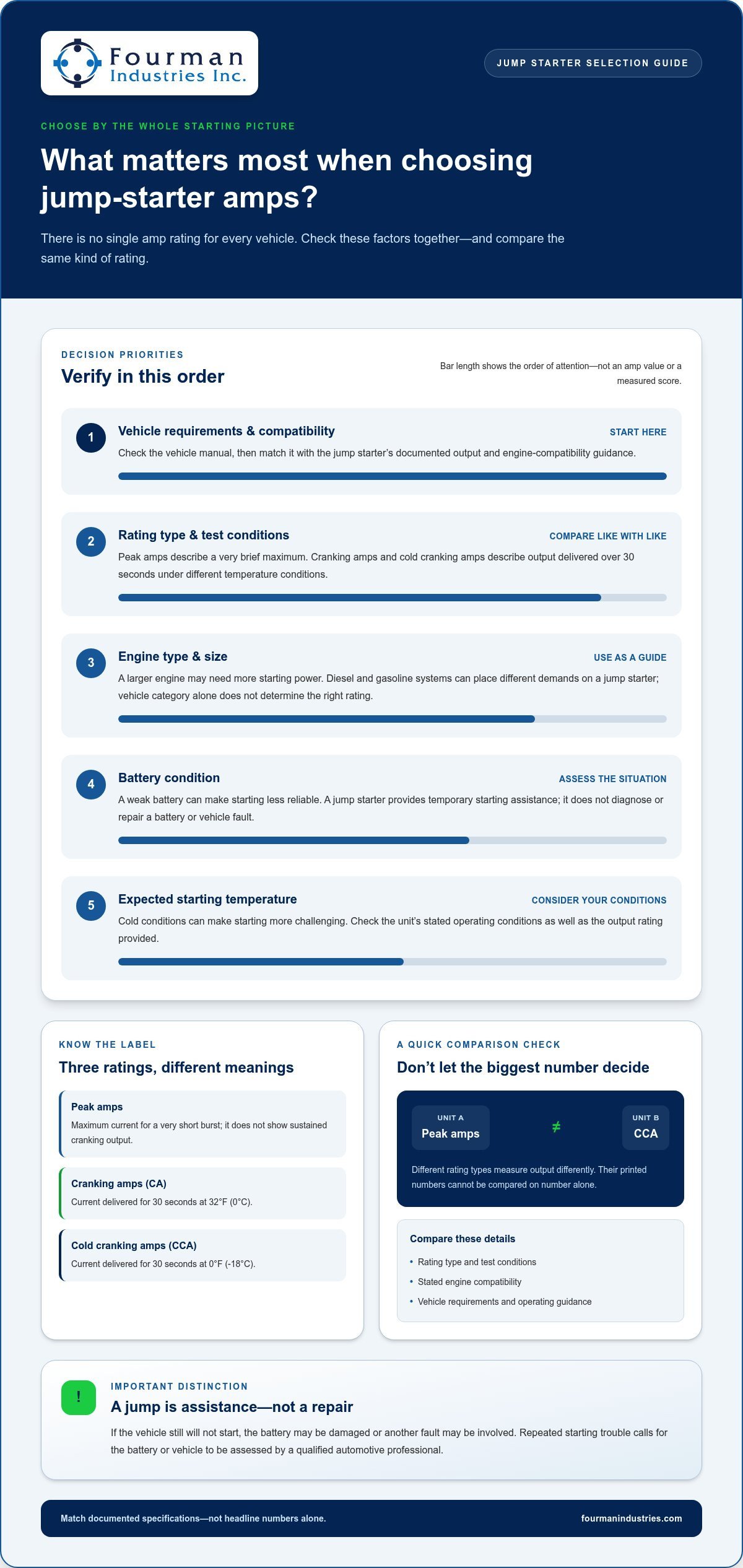
Peak amps indicate the maximum current a jump starter can deliver for a very short burst. This headline figure describes brief output, but it doesn’t tell you how much current the unit can sustain while the engine turns over.
Cranking amps (CA) describe current delivered for 30 seconds at 32°F (0°C). Cold cranking amps (CCA) measure current for 30 seconds at 0°F (-18°C). These ratings use different temperature conditions, so don’t treat them as interchangeable. For a basic overview of the equipment and process involved in jump starting a vehicle, see Wikipedia’s reference.
Compare like with like. If one label lists peak amps and another lists CCA, you can’t judge the units by comparing the numbers alone. Check the rating type, its test conditions, and the manufacturer’s stated vehicle guidance.
Why the biggest peak-amp number is not automatically best
A high peak-amp figure may catch your eye, but it doesn’t confirm that a unit suits your vehicle. The compatibility guidance and instructions for both the vehicle and jump starter still matter. Look for a label that identifies the rating and the engine types the unit is intended to support.
For example, one jump starter might advertise peak amps while another lists cranking amps. The larger printed number doesn’t prove that the first unit delivers more usable starting power. The ratings measure output differently, so the comparison is incomplete. Check each product’s documentation rather than choosing by the biggest figure on the box.
Apply the same approach when comparing truck and car jump starters. Fourman Industries offers truck and car battery jump starters. Review the specific unit’s label and compatibility information alongside your vehicle requirements before choosing. Matching the documented specifications is more useful than comparing headline numbers alone.
How engine size, fuel type, and temperature affect jump-starter amps
Engine displacement is a useful starting point, not a complete buying rule. A larger engine may need more starting power, but displacement alone doesn’t tell you which jump starter will work. Fuel type, the vehicle’s electrical system, battery condition, and operating temperature also affect starting demand. Use engine size to guide your research, then confirm compatibility using your vehicle manual and the jump starter’s documentation.
Does a truck or diesel engine need more starting power?
It often needs closer checking. A larger engine can take more effort to turn over, and a diesel starting system may place different demands on a jump starter than a gasoline engine. But “truck” or “diesel” alone doesn’t determine the right amp rating. Check your vehicle’s stated requirements and look for a jump starter whose documentation specifically addresses your vehicle type and engine.
How a weak battery and cold conditions change the decision
A weak battery can make starting less reliable, and cold conditions can make an already difficult start more challenging. If you regularly start your vehicle in low temperatures, pay close attention to the jump starter’s stated operating conditions and the type of output rating provided. Consumer Reports offers jump starter test results that may help you compare independently evaluated options. Use those results alongside the product label and vehicle guidance, not in place of them.
A jump starter provides temporary starting assistance. It doesn’t diagnose why a battery is weak, fully recharge it, or repair a fault elsewhere in the vehicle. If the battery is aging, deeply discharged, or repeatedly unable to hold a charge, a jump may not resolve the underlying problem. Follow your vehicle manual’s instructions. If starting trouble continues, have the battery or vehicle assessed by a qualified automotive professional.
Choose based on the combined demands of the engine, the battery’s condition, and the temperatures where you expect to start the vehicle. Consider these factors together rather than relying on engine size or a broad vehicle category alone. Fourman Industries offers truck and car battery jump starters. Review the specific unit’s label and compatibility information alongside your vehicle requirements.
How to compare jump starters for your car, SUV, or truck
Compare each product with your specific vehicle, not just a broad label such as “car” or “truck.” Use the table as a checklist for what to verify. Its prompts are general selection guidance, not manufacturer-verified fit claims or guaranteed amp recommendations. Before buying, confirm your vehicle’s requirements in its manual and check the jump starter’s documentation.
| Vehicle and engine type | What to verify | Conditions to consider |
|---|---|---|
| Car, gasoline | Vehicle starting requirements, jump-starter rating type, and manufacturer-stated engine compatibility. | Battery condition and expected starting temperature. |
| SUV, gasoline | Engine details and whether the jump starter’s documentation lists the vehicle’s engine type and size. | Frequent cold starts or a battery that struggles to crank. |
| Truck, gasoline | Vehicle manual requirements and explicit compatibility guidance for the intended engine. | How often it will be used in cold weather and whether the battery is in good condition. |
| Car, SUV, or truck with a diesel engine | Confirm diesel compatibility directly. Don’t assume a unit listed for gasoline engines also supports diesel. | Cold starts, battery condition, and any vehicle-specific starting instructions. |
These categories help organize your research, but they don’t establish a guaranteed amp rating for every car, SUV, truck, or diesel. Treat any rating or engine-size limit in product materials as guidance for that specific unit, then check whether it matches your vehicle.
Which specifications matter besides amps?
Start with the essentials. Confirm that the jump starter supports your vehicle’s battery voltage and engine type. Check the documented rating and its type, along with any stated operating temperature limits. Read the instructions for connection, use, and recharging before relying on the unit.
Then review any clearly described safety protections. Don’t assume every model includes the same features. Portability and charging method are also practical considerations: think about where you’ll store the unit and how you’ll keep it ready. These details can help distinguish compatible options, but they don’t replace compatibility checks.
A larger peak-amp figure alone doesn’t guarantee a successful start. If one product lists peak amps and another lists a different rating, their headline numbers aren’t directly comparable. Even products with the same rating type may have different vehicle guidance or operating limits. Match the product information to your manual and intended conditions before deciding how many amps do I need in a jump starter. That check is more useful than choosing the biggest number on the box.
How to choose the right jump-starter rating in five steps
Use a verification process rather than guessing from your vehicle category or a large number on a product label. Your owner’s manual and the jump starter’s documentation are the key compatibility references. Together, they help answer “how many amps do I need in a jump starter” for your vehicle and expected conditions.
Check your vehicle before shopping
Write down the details you can find: vehicle type, fuel type, engine information, battery voltage, and any stated starting requirements. Check the owner’s manual or official vehicle resources. If you can’t find a required specification, don’t substitute a generic recommendation for a car, SUV, or truck. Have the vehicle assessed by a qualified automotive professional.
Compare labels and make a confident shortlist
Once you have your vehicle information, compare candidate jump starters using these five steps:
- Identify vehicle requirements. Keep the manual’s starting guidance and battery information handy.
- Confirm the rating type. Note whether each label lists peak amps, cranking amps, or cold cranking amps. Don’t compare unlike ratings as if they mean the same thing.
- Assess your conditions. Consider fuel and engine type, battery condition, and whether you’ll need to start the vehicle in cold weather.
- Compare product labels. Check the stated engine and vehicle compatibility, supported battery voltage, rating details, and operating limits. A higher peak figure alone doesn’t guarantee a successful start.
- Follow the instructions. Before buying or using the unit, read its safety directions, connection procedure, and charging guidance, along with your vehicle manual’s jump-start instructions.
Shortlist products whose documentation addresses your vehicle and conditions. If an amp figure is unclear, the label doesn’t specify its rating type, or the product information doesn’t cover your engine type, don’t assume the unit is compatible. Choose an option with clearer guidance instead of relying on its name or a broad category description.
For more background on comparing vehicle-focused options, see The Professional Guide to Choosing a Truck & Car Battery Jump Starter in 2026. Compare the information for each unit with your vehicle requirements before deciding.
What to check before buying and using a jump starter
A few checks can prevent a mismatch and help you use a jump starter carefully. Don’t rely on the amp number alone. Confirm compatibility in your vehicle manual and the documentation for the specific jump starter you’re considering. If you’re still wondering how many amps do I need in a jump starter, verify the rating type and the product’s vehicle guidance before buying.
Compatibility and safety checks before purchase
Use this checklist to review the product listing and manual:
- Voltage: Confirm the unit supports your vehicle’s battery voltage.
- Engine compatibility: Check that the product information names your engine type and, where specified, engine size.
- Amp rating: Identify whether the label gives peak amps, cranking amps, or cold cranking amps. Don’t infer compatibility from the number alone.
- Operating directions: Read the stated conditions, charging instructions, and connection procedure.
- Protection features: If the listing mentions safety protections, confirm the exact features in that model’s documentation rather than assuming they’re standard.
If a key specification is missing or unclear, don’t assume the unit will suit your vehicle. Choose a product with enough detail to compare its compatibility with your vehicle’s requirements.
Safe use and what to do if the vehicle will not start
Before connecting anything, read both manuals. Follow the vehicle and jump starter manufacturers’ connection sequence and precautions exactly. First inspect the clamps, cables, battery terminals, and battery casing for visible damage. If a cable is frayed, a terminal is damaged, the casing is cracked, or the equipment appears faulty, stop. Don’t connect or use it; seek qualified help.
If the vehicle doesn’t start, don’t repeat the procedure beyond the manufacturers’ instructions. A jump starter may provide temporary starting assistance, but it won’t repair a damaged battery or resolve another vehicle fault. Repeated failed starts, a battery that won’t hold a charge, or signs of battery damage call for professional diagnosis. Follow the manuals and don’t guess at the cause.
Before buying, confirm that the unit’s specifications and safe-use instructions suit your vehicle. Before using it, inspect the equipment and follow the documented procedure. Fourman Industries offers truck and car battery jump starters for shoppers comparing options.
Choose a Jump Starter with Confidence
The right choice isn’t simply the unit with the biggest number. To answer “how many amps do I need in a jump starter,” check your vehicle’s requirements, compare the same type of amp rating, and confirm the jump starter’s compatibility guidance. Factor in your battery’s condition and the temperatures you expect, then follow both manuals when using the unit.
Fourman Industries’ catalog includes truck and car battery jump starters. Review each option’s details and compare them with your vehicle’s specifications before choosing. Browse Fourman Industries’ truck and car jump starters to explore the category and find an option to evaluate against your requirements.
Frequently Asked Questions
How many amps do I need to jump-start a regular car?
For a small gasoline car, a jump starter rated around 800 to 1,200 peak amps is a general starting point, not a guarantee of compatibility. The right answer to “how many amps do I need in a jump starter” depends on your vehicle’s requirements, battery condition, and starting conditions. Check the owner’s manual and the jump starter’s engine guidance, and compare the same type of amp rating across products.
Is a higher-amp jump starter always better?
No. A higher rating may indicate more capacity, but it doesn’t prove that a unit suits your vehicle or will start a weak or damaged battery. Check the rating type, supported engine guidance, and operating instructions. A large peak-amp figure is especially easy to misread because it measures a brief maximum, not necessarily sustained starting output. Base your choice on documented compatibility, not the biggest number.
Can a jump starter with too many amps damage my car?
A higher available current rating doesn’t automatically force that amount of current into a vehicle. Still, don’t assume a jump starter is safe just because its amp rating is high. Confirm the unit’s voltage and vehicle compatibility, inspect the equipment, and follow both manuals’ connection procedures. Incorrect voltage, reversed connections, or ignoring manufacturer instructions can create risks. Stop if a battery or cable appears damaged.
How many amps do I need for a truck or diesel engine?
There isn’t one dependable amp figure for every truck or diesel. Engine details, battery condition, and the vehicle’s starting requirements all matter. Confirm diesel compatibility rather than assuming it. Check the vehicle manual, then match its requirements to the jump starter’s stated engine guidance and rating type. Don’t choose a unit based on “truck” or “diesel” in its description alone.
What is the difference between peak amps and cranking amps?
Peak amps describe the maximum current a jump starter can provide for a very short burst. Cranking amps describe current delivered over a specified period under stated test conditions. Cold cranking amps use colder test conditions than cranking amps, so the terms aren’t interchangeable. Check which rating a label gives, and compare products using the same rating type. A higher peak-amp number alone doesn’t establish better real-world starting performance.
Do I need more jump-starter amps in cold weather?
Cold weather can make starting harder because the battery may deliver less starting power, while the engine may take more effort to turn over. Consider the temperatures where you expect to use the unit and review its documented operating conditions. Check whether the product information provides cranking or cold-cranking details, and follow the vehicle manual. If cold starts are common, choose based on documented compatibility for those conditions, not peak amps alone.
What happens if my jump starter has too few amps?
An underpowered or incompatible jump starter may fail to turn the engine over, or may not provide enough output for the stated application. Repeated attempts won’t make an unsuitable unit compatible and may not resolve the cause of a starting problem. Stop and check the manuals. If the vehicle still won’t start, or the battery appears damaged or repeatedly loses charge, seek qualified diagnosis rather than relying on a jump starter alone.




