
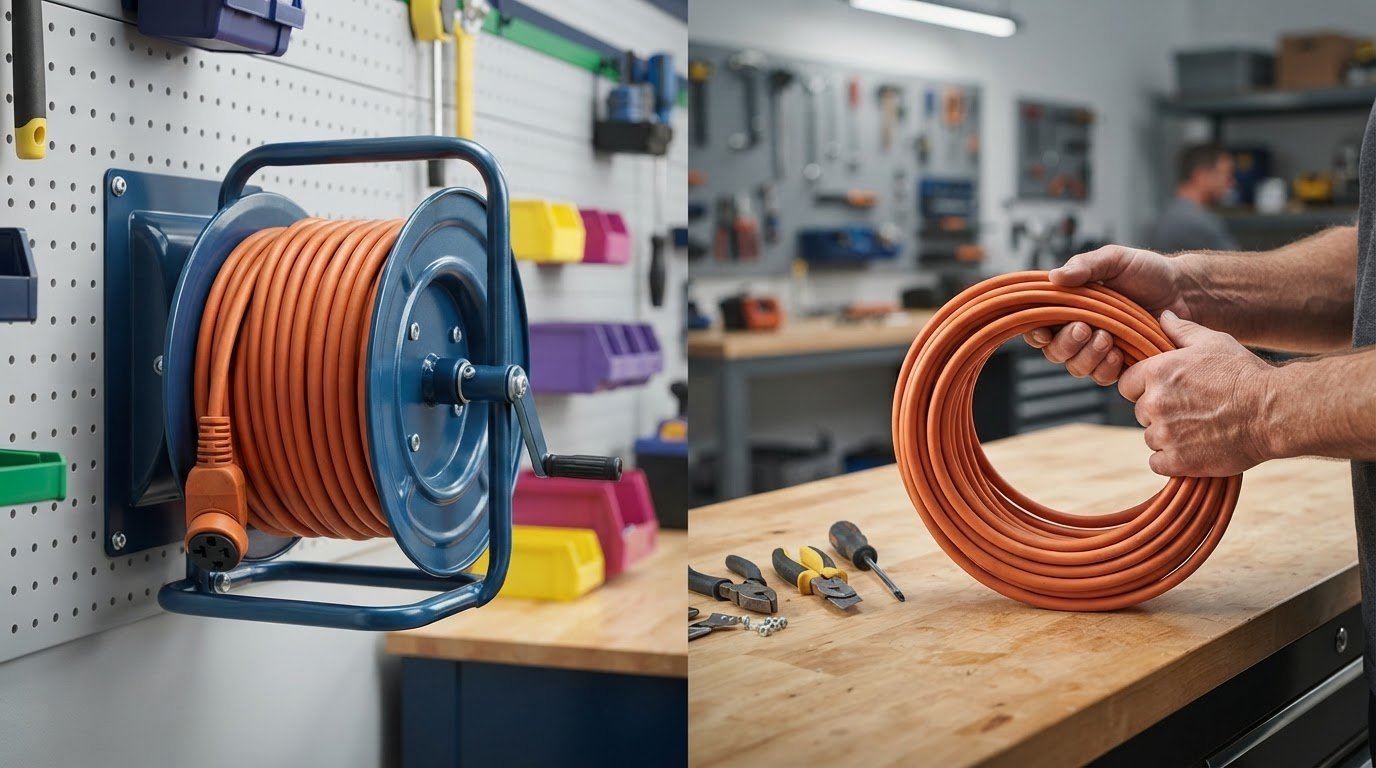
A cord reel can save time, but it isn’t automatically the best choice for every job. In the extension cord reel vs manual wrapping decision, how often you deploy the cord, where you work, and how you’ll carry and store it all matter.
If you’re tired of tangles and slow setup, a reel can make repeated winding more convenient. Manual wrapping may be simpler if you want a portable setup or use the cord occasionally. Neither method makes a damaged cord safe or a poor match for your equipment suitable.
This guide compares both options for setup, storage, portability, and safe use. It also covers what to check about cord length, gauge, reel compatibility, and the manufacturers’ instructions before you choose.
Key Takeaways
- Neither storage method works best for every job. Match your choice to how often you deploy the cord and how you work.
- In the extension cord reel vs manual wrapping comparison, weigh setup effort, portability, storage space, and how you’ll keep the cord organized.
- A reel doesn’t automatically make a cord safe. Check the cord, plugs, reel, and connections, and follow the manufacturers’ instructions.
- Before choosing equipment, confirm the cord’s gauge, length, intended application, and compatibility with the reel.
- For repeated, organized deployment, consider a compatible reel. For a simpler portable setup, manual wrapping may fit better. Cord suitability comes first either way.
Extension cord reel vs. manual wrapping: what is the real difference?
Neither a reel nor manual wrapping is universally better. The right choice depends on how often you deploy the cord and what matters most in your workspace. A reel stores cord around a spool or drum and helps manage deployment. Manual wrapping means gathering the cord into loops and securing it without a dedicated reel.
In practice, a reel can make repeated deployment and rewinding more convenient, while manual wrapping avoids the extra equipment of a reel. Storage needs vary too. A reel keeps the cord on its drum, while a wrapped cord needs a suitable place to rest or hang. For background on the cord itself and the extension reel as a variation, see this overview of the extension cord.
Quick distinction: Choose based on your routine. Reels organize repeated deployment; manual wrapping offers a straightforward way to gather a cord for carrying or storage. The details depend on the reel design, cord length, and working conditions.
How does an extension cord reel work?
The cord winds around a drum, then pulls out as you move to the work area. Reel designs vary. Some require you to wind the cord back by hand, while others have a retraction mechanism. A reel may be intended for a particular mounting or operating setup, so don’t assume every model works the same way. Check the reel’s instructions for its features and permitted use.
What does manual wrapping involve?
Gather the cord into even, manageable loops, keeping the bends relaxed instead of forcing sharp kinks into the cable. A suitable tie or strap can hold the loops together for carrying or storage. Avoid pulling the tie tight around the bundle. The best wrapping approach depends on the cord’s construction, so follow its manufacturer’s guidance and stop if a loop twists or binds.
The key difference in the extension cord reel vs manual wrapping choice is how you want to handle the cord between uses. A reel can keep winding organized and may reduce rewinding effort, but the reel itself adds equipment to move and store. Manual wrapping takes hands-on effort each time, but leaves you with a cord bundle rather than a reel assembly.
Think about your routine before choosing. If you deploy and rewind the same cord repeatedly in one work area, a reel may streamline the process. If you carry the cord between locations or use it occasionally, manual wrapping may be easier to manage. In either case, convenience should not override the cord or reel manufacturer’s instructions.
Reel vs. manual wrapping: compare setup, portability, and storage
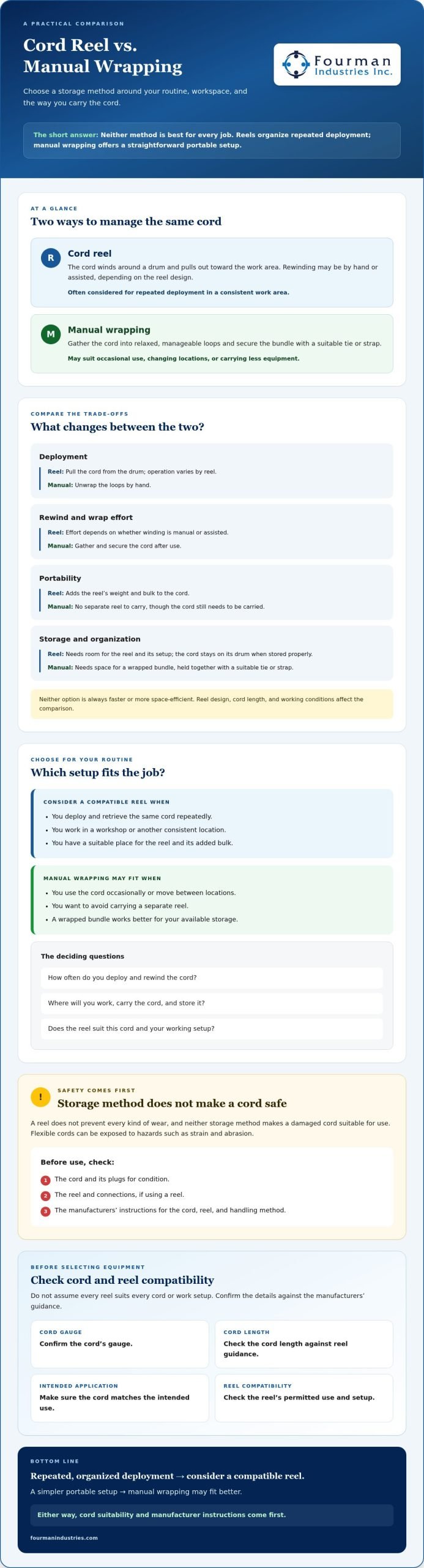
The practical difference comes down to where the cord lives and how often you handle it. A reel can organize repeated deployment, especially in a consistent work area. Manual wrapping avoids carrying a separate reel, but you’ll gather and secure the cord by hand after use. Neither option is always faster or takes up less space. Reel design, cord length, and work conditions all affect the comparison.
| Factor | Cord reel | Manual wrapping |
|---|---|---|
| Deployment | Pull cord from the drum; operation varies by reel. | Unwrap the loops by hand. |
| Rewind or wrap effort | Depends on whether winding is manual or assisted. | Gather and secure the cord after use. |
| Portability | Adds reel weight and bulk to the cord. | No separate reel, though the cord still needs to be carried. |
| Storage footprint | Requires room for the reel and its setup. | Needs room for a wrapped bundle; actual space varies. |
| Organization | Keeps cord arranged on its drum when stored properly. | Stays together with a suitable tie or strap. |
Consider cord condition as well as convenience. OSHA describes hazards to flexible cords, including damage from strain and abrasion. A reel doesn’t prevent every kind of wear, so inspect the cord and follow its handling instructions. Review OSHA safety standards for more information about flexible-cord hazards.
When is a cord reel the more practical option?
A reel may suit a workshop or another fixed location where the same cord is deployed and retrieved often. Before choosing one, consider whether there’s a suitable place for it and whether its added bulk fits the workspace. Check the reel manufacturer’s compatibility guidance for your particular cord, including its length and gauge. Don’t assume a reel will suit every cord or work setup.
When is manual wrapping the simpler choice?
Manual wrapping may fit occasional jobs, changing work locations, or situations where you want to carry less equipment. It requires no separate reel, but winding the cord by hand still takes time. Compare the storage space available. A wrapped bundle may fit your storage area better, or a reel may keep things more orderly. Neither method guarantees a smaller footprint.
Quick guide: For frequent use in one place, consider a compatible reel. For mobile work or occasional use, manual wrapping may be easier to transport. If you use the cord in several settings, weigh both storage and handling needs. Whichever method you choose, match cord gauge, length, and intended use to the job. If you’re comparing cord options, explore custom and personalized extension cords as one possible next step.
Does a reel or manual wrapping protect an extension cord better?
A reel can keep cord gathered and make handling more orderly. Careful manual wrapping can also help prevent loose loops from dragging or catching. But a reel isn’t a safety guarantee. Either method can leave a cord vulnerable to damage if it’s pulled, pinched, crushed, or stored poorly. OSHA outlines hazards from flexible cords, including physical damage and strain, in its guide to the dangers of improper cord use.
Storage method does not replace inspection or the cord’s and reel’s rated-use instructions. Before use, check the cord jacket, plug, connections, and reel for visible damage. Don’t use damaged equipment. Also consider the cord’s gauge, length, and intended application. A tidy storage setup can’t make an unsuitable cord right for the job.
Can a cord stay on the reel while it is powering equipment?
There’s no universal yes or no. Whether a cord can power equipment while wound depends on the specific cord and reel, the electrical load, and the manufacturers’ directions. Check the documentation for heat guidance and whether the cord must be fully extended before use. If the instructions are unclear, don’t guess. Confirm the permitted setup with the manufacturer before connecting equipment.
How should you inspect and store a wrapped extension cord?
Look over the full cord, including its jacket, plug, and connections, before use. Watch for cuts, exposed conductors, loose parts, or other visible damage. For storage, make relaxed loops and avoid tight knots, sharp bends, or pressure from heavy objects. Keep the cord away from conditions that could damage it, and use its manufacturer’s care guidance to determine suitable handling and storage.
Both reel storage and manual wrapping depend on consistent handling. A reel may keep cord organized on its drum, but rough pulling, poor placement, or use outside its ratings can still cause damage. A hand-wrapped cord can be stored neatly, but tight loops or crushing can cause problems too. Inspect the reel, its connections, and the cord before use, and stop if anything looks damaged.
For the extension cord reel vs manual wrapping decision, treat convenience as one factor, not the safety test. Follow the instructions for the exact cord and reel you’re using, especially where heat, load, or full extension is concerned. If your work conditions or equipment change, check that the cord remains suitable for the application.
How to choose between an extension cord reel and manual wrapping
Choose a storage method around the work, then confirm your cord and equipment are a match. Use this checklist to narrow the extension cord reel vs manual wrapping choice:
- Frequency: Do you deploy and retrieve the cord repeatedly, or only now and then?
- Distance: Does the cord reach the work area without stretching across a route that creates handling problems?
- Portability: Will you carry the cord between locations, or leave it set up in one workspace?
- Workspace: Is there room for a reel and its mounting or handling arrangement?
- Storage: Does a reel or a tied bundle fit your available storage space better?
For repeated use in a consistent work area, a compatible reel may suit the routine. For occasional jobs or changing locations, manual wrapping may keep the kit simpler. These are starting points, not rules. Before choosing, verify the cord’s gauge, length, and intended application, along with its compatibility with any reel. If gauge is a key question, consult the published guide to choosing a 12-gauge extension cord for more detail.
What should you check before using a cord reel?
Read the reel documentation before pairing it with a cord. Confirm the supported cord type and length, intended use, and instructions for operation, loading, and storage. Then assess the setup itself. The mounting point, reel placement, and room to handle the cord should all work for the space. If compatibility or operating guidance is unclear, check with the reel manufacturer rather than guessing.
What is a simple manual-wrapping routine?
Follow the product instructions and disconnect equipment and power before gathering the cord. Make relaxed, even loops without twisting, tight bends, or pulling the cord under strain. Secure the bundle with a suitable tie or strap, but don’t cinch it so tightly that it pinches or crushes the jacket. Check the cord’s care guidance for handling recommendations specific to its construction.
Use the method that fits how you work, but let cord suitability lead the decision. A reel can’t make an unsuitable cord right for an application, and a neat hand-wrapped bundle doesn’t change the cord’s ratings. Compare confirmed options, including extension cords for your work, and check the relevant manufacturer instructions before use.
Choose a storage method, and an extension cord, that fits the job
For repeated, organized deployment in one work area, a compatible reel may suit your routine. For simple portability and occasional use, manual wrapping avoids carrying a separate reel. Either way, storage convenience comes second to choosing a cord that fits the work and following the cord and equipment manufacturers’ instructions.
Before making your choice, pin down the requirements: how far the cord must reach, what equipment it will power, and what connections the job calls for. Check the cord’s length, gauge, and intended application. If you’re considering a reel, verify compatibility with the specific cord rather than assuming it will fit or operate as needed on any reel.
Match extension-cord details to your work
Gauge matters because it relates to the electrical load a cord is suited to carry. Fourman Industries offers confirmed cord categories that include 10 Gauge ECONO and 12 Gauge SJTW Triple Tap extension cords. Neither is automatically right for every job or compatible with every reel, so compare the specifications with your equipment and the manufacturer’s instructions. For identification or crew organization, read the custom-printed extension-cord guide before deciding whether printed identification would be useful.
Make the next step straightforward
Write down your requirements first: length, gauge, application, and connection needs. Then compare them with the cord’s documented specifications. Fourman Industries also sells custom-printed and personalized extension cords, along with pink and purple extension cords. These are cord options, not reels. Confirm the right fit for your work before selecting a storage method.
The practical answer to extension cord reel vs manual wrapping is simple: pick the handling method that suits your routine, then let cord suitability guide the final choice. Review Fourman Industries’ extension-cord offerings to find a cord category to consider for your job.
Set up your next job with the right cord and storage method
Choose a reel if you regularly deploy and retrieve a cord in an organized work area. Manual wrapping can be a simpler fit for occasional use or carrying a cord between locations. Either way, storage convenience comes second to the cord’s gauge, length, intended application, and the manufacturers’ instructions.
That’s the practical takeaway from the extension cord reel vs manual wrapping comparison: match the storage method to your routine, and make sure the cord itself suits the work. Inspect it before use and check reel compatibility rather than assuming every cord fits every setup.
Need a cord for your next project? Fourman Industries was founded in 1997 and offers custom-printed and personalized extension cords. Explore Fourman Industries’ extension cords and compare the available options with your job requirements.
Make the choice that fits your work, follow the product guidance, and you’ll be ready to get started with confidence.
Frequently Asked Questions
Is an extension cord reel better than manual wrapping?
It depends on how often you deploy the cord and where you work. A reel may help organize repeated use in a consistent workspace, while manual wrapping avoids carrying a separate device and may suit occasional or mobile tasks. In the extension cord reel vs manual wrapping comparison, consider your work pattern, available storage, and equipment instructions. Neither method is automatically best for every cord or job.
Can you use an extension cord while it is still wound on a reel?
Don’t assume every cord and reel can be used while the cord is wound. Requirements vary by product, load, and reel design. Check the manufacturers’ instructions for whether the cord must be fully extended and for any operating limits. If the documentation doesn’t clearly answer your question, contact the manufacturer before use rather than relying on a general rule that may not apply to your setup.
Does an extension cord reel prevent tangles?
A reel can help organize a cord during storage and deployment, but it can’t guarantee tangle-free use. Twisting, incorrect winding, rough handling, or an incompatible cord can still cause problems. Follow the reel’s instructions and inspect the cord regularly. Manual wrapping can also keep a cord manageable: form relaxed, even loops and secure them without pinching the jacket. Handle either setup carefully to reduce avoidable tangles.
How do you manually wrap an extension cord without damaging it?
Disconnect the cord and follow its manufacturer’s handling instructions before wrapping. Gather it into relaxed, consistent loops rather than tight coils, knots, or sharp bends. Secure the bundle with a suitable tie, but don’t tighten it enough to crush or pinch the jacket. Keep heavy objects off the stored cord. Before using it again, inspect the full length, plugs, and connections for visible damage.
What should I check before buying a cord reel?
Confirm that the reel is intended for your cord’s type, length, and application. Read its operating and storage instructions, including any directions about using the cord while wound. Consider how frequently you’ll deploy it, whether the workspace can accommodate its mounting or handling arrangement, and where you’ll store it. Appearance alone doesn’t confirm compatibility, so check the reel documentation against the exact cord you plan to use.
Is manual wrapping safe for heavy-duty extension cords?
Manual wrapping is a storage method, not a safety rating. Follow the cord manufacturer’s handling instructions, avoid tight bends and crushing, and inspect the cord for visible damage before use. For heavy-duty work, verify that the cord’s gauge, length, and rating suit the equipment and application. If you can’t determine whether the cord is suitable, consult the manufacturer or another qualified source before connecting it.
Which extension cord storage method is best for a jobsite?
Choose based on how often the cord moves, how frequently it’s deployed, and the storage available. A compatible reel may fit repeated use in a consistent work area; manual wrapping may be more portable for changing tasks. Jobsite conditions and requirements can vary, so check workplace guidance and the cord and reel manufacturers’ instructions. Make sure the cord suits the equipment and application, regardless of how you store it.




