

An ETL mark isn’t a safety downgrade from a UL mark. For buyers comparing UL vs ETL certification for extension cords, both marks can indicate that a product was tested and certified by an OSHA-recognized laboratory to applicable safety standards. The important questions are what the certification covers and whether the cord suits the job.
It’s reasonable to want a clear answer before you buy. The logos look different, and a mark on a plug or wire can leave you wondering whether the complete extension cord was evaluated. Neither mark means a cord is right for every application, and neither removes the need to check its ratings and intended use.
This guide explains what UL and ETL marks establish, how to verify a cord’s listing, and what to look for on its label. You’ll also learn how to distinguish certification for a complete cord set from markings on individual components, then compare gauge, length, construction, and use environment with your needs. That’s a more dependable way to choose than relying on a familiar logo alone.
Key Takeaways
- UL and ETL marks can both indicate independent testing, but the certification scope matters as much as the logo.
- For UL vs ETL certification for extension cords, compare the listing details and verify they match the complete cord you’re considering.
- Check the cord’s gauge, length, amp rating, jacket type, and intended environment against the demands of your worksite, workshop, or home.
- A mark on a component alone may not establish that the complete cord set is certified. Check what the listing actually covers.
- Custom printing and cord color can help with identification, but they don’t establish electrical certification or application suitability.
UL vs. ETL Certification for Extension Cords: What the Marks Mean
What practical difference does a UL or ETL mark make when you’re buying an extension cord? It identifies the organization responsible for certifying the product, but the logo alone doesn’t tell you whether the cord fits your job.
Product certification means an organization has evaluated a product against applicable safety requirements within a defined scope. That scope may cover a complete cord set, a particular component, or a specific product type. UL and ETL identify different certification organizations, not different cord functions. Both are recognized as Nationally Recognized Testing Laboratories (NRTLs). See this overview of the Nationally Recognized Testing Laboratory (NRTL) concept and OSHA’s role in NRTL recognition.
A certification mark speaks to the product and scope covered by its listing. It doesn’t, by itself, establish that the cord is suitable for every application. The cord’s ratings, construction, and intended environment still need to match the work.
What does a UL mark on an extension cord indicate?
UL is a testing and certification organization. A genuine UL Listed mark indicates that the product identified in UL’s certification records has been evaluated within the stated scope. It’s more than a manufacturer’s general claim that a cord is “safe” or “tested.” Look at the full mark and product label, not just the letters “UL” printed on packaging or a component.
Marks can apply to different product types or scopes. A mark on an individual plug or wire shouldn’t automatically be read as certification of the complete extension cord. To check the specific product, use UL’s current Product iQ resources and compare the listing details with the cord’s label.
What does an ETL mark on an extension cord indicate?
ETL certification is provided by Intertek. An ETL Listed mark identifies a product certified by Intertek within the scope shown in its records. A listed mark refers to a certified product, not simply a sample that was tested once. As with UL, check which product and construction the certification covers before concluding that it applies to the complete cord set.
Read the ETL mark and product label together. Then use Intertek’s current product directory to verify the exact model or product identifier and confirm that the record matches the cord you’re considering. The certifier’s name may differ, but the scope and the cord’s own specifications remain central to a sound buying decision.
Are UL and ETL Extension Cord Certifications Equivalent?
For buyers, the short answer is that a UL mark and an ETL mark can provide a comparable kind of assurance when each certifies the relevant extension cord to the same applicable safety standard and within a suitable scope. The marks come from different organizations, though, so compare the certification record rather than treating the logos as interchangeable by default.
When comparing UL vs ETL certification for extension cords, look at five details: who certified the product, what mark appears, which standard applies, what the certification scope covers, and whether the exact product can be verified in the certifier’s directory. A shared standard is a useful point of comparison, but it doesn’t prove that two products have identical construction, ratings, or certification scope.
How OSHA-recognized testing laboratories fit into the comparison
A Nationally Recognized Testing Laboratory, or NRTL, is an organization OSHA recognizes to test and certify products within specific areas of scope. OSHA recognizes both UL and Intertek, which issues ETL certifications. Recognition applies to defined scopes, so check the current OSHA’s NRTL Program information and listing when confirming an organization’s status and scope.
That recognition isn’t an OSHA endorsement of a particular brand or every cord carrying a mark. OSHA recognizes qualified laboratories for specified testing and certification work. The product’s own certification record still needs to match the cord being considered.
Why the applicable standard and certification scope matter
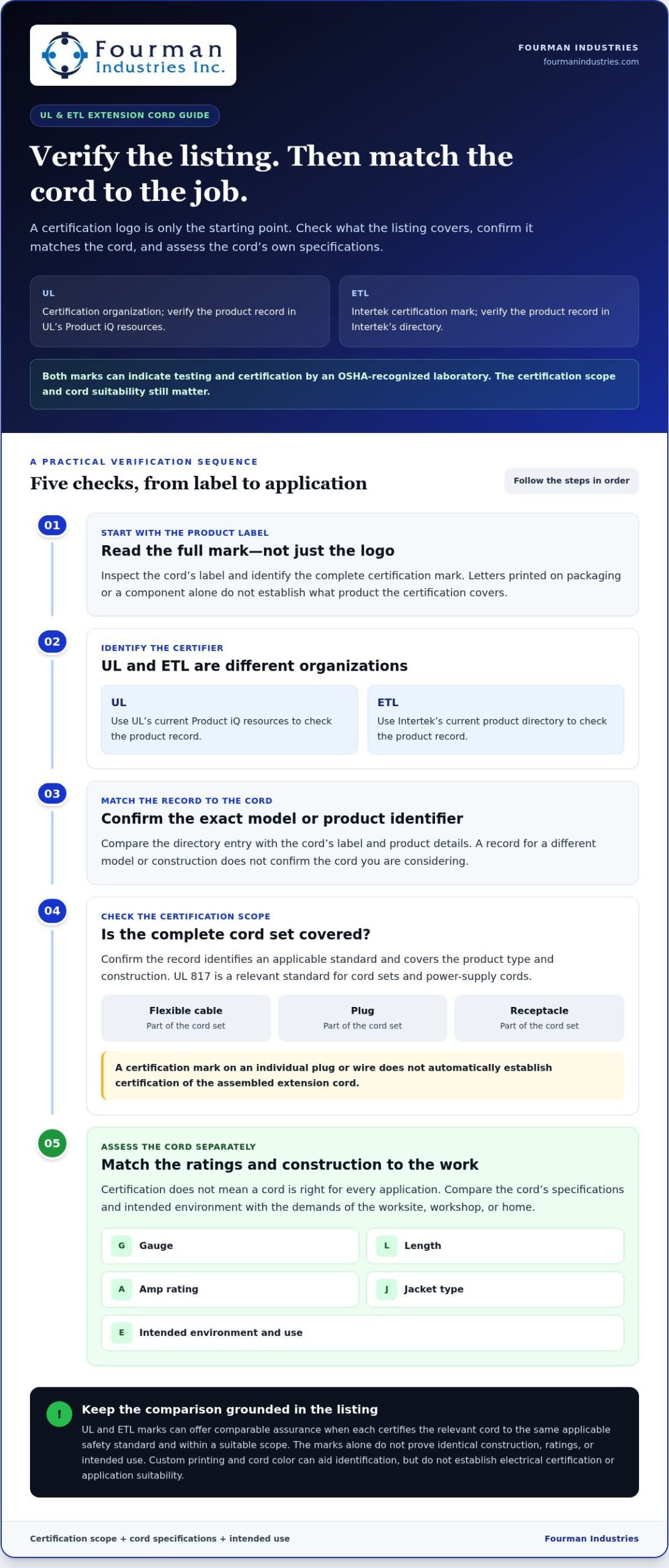
UL 817 is a relevant standard for cord sets and power-supply cords. For a particular extension cord, confirm that the certification record identifies an applicable standard and covers the product type and construction in question. A cord set may include the flexible cable, plug, and receptacle as an assembly. Certification for a component alone doesn’t automatically establish certification for the assembled cord.
A recognized certification mark shows that a product was evaluated within a defined scope. It isn’t a blanket safety guarantee or proof that the cord fits every job. Two cords certified by different NRTLs may meet the same applicable standard, but don’t assume their listings cover identical models or intended uses. Check those details in the certifier’s current records before comparing products.
Once certification scope is clear, assess the cord’s ratings and intended application separately. For a practical starting point, browse extension cord options and compare each cord’s stated specifications with the demands of your worksite, workshop, or home.
How to Verify UL or ETL Certification on an Extension Cord
A logo is a starting point, not the whole check. Inspect the cord’s label, identify the certification mark, and compare the product details with the certifier’s current directory record. This helps you confirm whether the listing applies to the cord in your hands, rather than relying on a product photo or a general safety claim.
Which details should you check on the cord and packaging?
Look for a legible UL or ETL mark on the cord, plug, or product label, along with information that identifies the product. Packaging can help you find the model or manufacturer, but it may be separate from the cord or reused across variations. A seller’s statement or logo image alone doesn’t establish that the exact cord is listed.
- Note the certification mark and any file or control number shown.
- Record the manufacturer, model, or other product identifier.
- Identify the cord type and compare its description with the certification record.
Read the cord’s electrical ratings and use markings separately. Certification doesn’t replace checking specifications such as voltage, amperage, gauge, or intended use. The listing and label answer different questions: whether the product is covered by a certification, and whether its stated specifications suit your application.
How do you check a certification directory entry?
For a UL mark, look for the file number, often beginning with “E,” and search UL’s Product iQ database. For an ETL mark, locate the control number near the logo and search Intertek’s Product Directory. Search tools can change, so follow the certifier’s current directory instructions. OSHA’s Nationally Recognized Testing Laboratory (NRTL) Program page is also a reference for checking the laboratories and scopes OSHA recognizes.
Compare the directory entry with the cord itself. Check that the manufacturer, model or product identifier, and cord type align. Then confirm that the entry’s scope describes the product you’re evaluating, not only an individual component. A similar name or matching logo isn’t enough if key identifiers differ.
If the directory record and product details don’t match, pause before relying on that listing. It may reflect a different model, an incomplete search, or another discrepancy. The mismatch alone doesn’t prove the cord is counterfeit or unsafe. Don’t treat the certification claim as verified until the certifier or manufacturer can clarify which record applies. This careful check is a practical step in comparing UL vs ETL certification for extension cords.
Which Certified Extension Cord Fits Your Application?
A UL or ETL mark can help you assess certification, but choosing between the marks alone won’t tell you whether a cord is right for the job. A cord for a short indoor task may not be suited to a longer run, outdoor conditions, or demanding worksite use. Compare the cord’s specifications with the equipment and environment first.
What should you compare beyond the certification mark?
Start with the connected equipment’s requirements and the cord’s label. Check gauge, length, amp rating, and jacket markings together. Gauge and length work together: a longer cord can increase voltage drop, and a thicker conductor can help manage it. Don’t rely on a universal rule of thumb. Follow the equipment manufacturer’s instructions and the cord’s stated ratings.
Next, consider where and how the cord will be used. Indoor, outdoor, temporary, and jobsite applications can call for different construction and environmental ratings. A jacket marking helps identify the conditions a cord is designed for, but it must match the actual exposure and handling. For more detail on gauge and capacity, see this 12 Gauge Extension Cord guide.
Does a certified cord automatically suit every job?
No. Certification doesn’t override the cord’s ratings, the equipment instructions, its condition, or its intended use. Don’t use a cord with cuts, exposed conductors, damaged plugs, or other visible damage. Avoid overloading circuits and unsuitable connections, too. If the cord or connected equipment’s requirements are unclear, pause and get authoritative guidance before use.
The same practical checks matter whether a listing carries a UL or ETL mark. Match the cord’s rating and construction to the task, then use it as directed. For added background on certification marks and safe selection, read this UL-certified extension cord safety guide. The right choice in the UL vs ETL certification for extension cords comparison is the cord whose verified scope and specifications align with your application.
Ready to compare cords by intended use and specifications? Explore extension cord options and use the label details to guide your selection.
Choose an Extension Cord with Verified Certification and the Right Specs
A good buying decision checks more than the logo. Confirm the mark and its scope, then match the cord’s specifications to the equipment and conditions where you’ll use it. In the UL vs ETL certification for extension cords comparison, neither mark replaces this application check.
A practical checklist before you buy
- Match the certification record. Compare the exact cord model or product identifier and cord type with the certifier’s current listing.
- Check ratings and length. Review gauge, length, and electrical ratings alongside the connected equipment’s instructions.
- Review construction and environment. Confirm the jacket and cord type are suited to the intended location and conditions.
- Inspect before use. Read the product instructions and look for damage to the cord, plug, or connections.
These checks work together. A listing can help establish what product was certified, while the label and instructions help you determine how it’s rated and meant to be used. Don’t treat a familiar mark as a substitute for checking the complete cord and its intended application.
Ready to compare options against your project’s needs? Explore extension cord options and use each cord’s listed specifications to guide your choice.
When custom printing helps identify cords
Custom printing can make cords easier to distinguish in a shared shop, at a worksite, or among several similar cords. Fourman Industries offers custom-printed extension cords as an identification option. Printing can help show ownership or make a cord easier to recognize, but it doesn’t establish electrical performance, certification, or suitability for a particular job.
Keep those purposes separate: use the certification record to verify certification, the product label and instructions to assess ratings and intended use, and printing or color to support identification. For ideas on how printed markings can help organize cords, read the custom printed extension cord guide.
Make Your Next Cord Choice with Confidence
In the UL vs ETL certification for extension cords comparison, the logo is only one part of the decision. UL and ETL marks can indicate certification by different recognized organizations, but the exact listing scope matters. Verify that the record matches the cord, then check its gauge, length, ratings, construction, and intended use.
Choose for the job, not the mark alone. A certified cord still needs to suit the equipment and environment, while custom printing or color can help identify it without establishing certification.
Fourman Industries has specialized in electrical accessories since 1997, including custom-printed and personalized extension cords. Explore Fourman Industries extension cords and compare the specifications with your application.
Take a moment to verify the details, and you’ll be better prepared to choose a cord that fits the work ahead.
Frequently Asked Questions
Is ETL certification as good as UL certification for extension cords?
Yes, ETL certification can provide comparable assurance to UL certification when the relevant product is certified to the same applicable standard and within a suitable scope. UL and Intertek, which issues ETL marks, are OSHA-recognized testing laboratories for specific scopes. Don’t judge by logo alone. Verify the exact cord and certification record, then check that its ratings and construction suit your application.
What is the difference between UL Listed and ETL Listed extension cords?
The main difference is the certifying organization and the mark displayed. UL Listed products are certified by UL; ETL Listed products are certified by Intertek. Either mark can indicate evaluation to an applicable safety standard, but the certification scope may vary by product. Check the listing details to see whether they cover the complete extension cord or only a component, and confirm the model matches.
How can I verify that an extension cord is UL or ETL certified?
Find the mark and identifying details on the cord or its label, then search the certifier’s current directory. For UL, use the file number, often beginning with “E,” in Product iQ. For ETL, search Intertek’s Product Directory using the control number near the mark. Compare the record’s manufacturer, model or product identifier, and cord type with the item in hand.
Does an ETL mark mean an extension cord meets UL standards?
Not automatically. An ETL mark means Intertek certified the product within a stated scope. The product may be certified to a UL standard when that standard applies, but confirm the exact standard and product coverage in Intertek’s current directory. A familiar mark alone doesn’t show which requirements were evaluated, whether the complete cord set is covered, or whether the cord suits your intended use.
Can I use an extension cord without a UL or ETL mark?
An absent mark doesn’t, by itself, prove that a cord is unsafe or unlawful to use. Requirements can depend on the product, workplace rules, and applicable safety requirements. Don’t rely on appearance alone. Check the product documentation and applicable requirements for your setting. If certification can’t be verified or the cord’s identity and ratings are unclear, choose a cord with verifiable product information instead.
Does certification mean an extension cord is safe for outdoor use?
No. Certification doesn’t automatically make a cord suitable for outdoor conditions. Check the cord’s jacket markings, product instructions, and stated environmental rating to confirm it’s intended for the conditions where you’ll use it. Also consider exposure to moisture, temperature, abrasion, and other demanding conditions. A certified indoor cord may not be appropriate outdoors, so match the product to the environment.
What should I check besides certification when buying an extension cord?
Compare the cord’s gauge, length, amp rating, jacket type, and intended environment with the connected equipment’s requirements. Check the manufacturer’s instructions and the cord’s label, and inspect it for damage before use. These details matter whether you’re considering UL vs ETL certification for extension cords: certification identifies an evaluation within a scope, while the cord’s specifications help determine whether it fits the job.




