

Joining two extension cords may solve a reach problem, but it adds a connection that can overheat or become a fire hazard. If you’re wondering how to safely connect two extension cords, the safest starting point is to avoid joining them and use one cord rated for the job instead.
It’s understandable to reach for a second cord when an outlet is just out of range. But cord length, wire gauge, equipment load, and the condition of every plug and connection all affect safety. A check of the connection can’t make an unsuitable setup safe. Don’t use a joined pair as permanent wiring or when the device’s requirements aren’t clear.
This guide explains why cord-to-cord connections are discouraged, what to inspect if a temporary connection is unavoidable, and how to choose a safer alternative. You’ll learn how to compare cord ratings with your equipment and working conditions, spot damage that means a cord should be taken out of service, and decide when a single, appropriately rated cord is the better fix.
Key Takeaways
- When considering how to safely connect two extension cords, first check whether one correctly rated cord can reach.
- A lower AWG number means a thicker conductor, but cord length and equipment demand still matter when comparing ratings.
- If a temporary connection can’t be avoided, follow both cord manufacturers’ instructions and the equipment requirements. These checks reduce risk but don’t make every setup suitable.
- Choose a cord by matching the equipment load, environment, and required reach to its verified specifications.
- Fourman Industries sells several extension cord options. Compare their specifications with your equipment before choosing one.
Can you safely connect two extension cords? Start with the safer answer
The safer choice is to avoid joining extension cords when one correctly rated cord can reach the outlet. Every added plug-and-receptacle connection creates another point that can loosen, become damaged, or be exposed to moisture and strain. A snug fit is a basic check, but it doesn’t confirm that the cords suit the equipment or conditions.
A temporary cord connection is not a recommended permanent setup. Extension cords are intended for temporary use, not as a substitute for fixed wiring. If a cord needs to stay in place, choose another arrangement rather than relying on a joined pair. For background on cord construction and common safety concerns, see these extension cord basics.
If you’re asking how to safely connect two extension cords, first consider whether one cord selected for the equipment, distance, and environment can replace the junction. If you can’t confidently confirm that a temporary setup meets both cord manufacturers’ instructions and the connected equipment’s requirements, don’t use it. A connection that appears secure can still be unsuitable for the load.
Why an extension-cord connection can become a weak point
The junction deserves close attention. A loose plug, cracked insulation, bent prong, or damaged receptacle can compromise the connection. Dirt or moisture may affect it, and pulling, twisting, or placing strain on the cords can loosen or damage it over time. These conditions don’t mean every joined setup will fail, but they make careful inspection and suitable placement essential.
Keep cords and connections away from water, and don’t leave them where people, doors, or equipment can pull, crush, or trip over them. A tight fit alone doesn’t make a setup safe.
When to stop and choose another arrangement
Stop if either cord, plug, or receptacle is damaged or unusually warm. Don’t keep using a connection exposed to water or likely to be crossed by foot traffic or equipment. Choose a single suitable cord or another arrangement that avoids those conditions.
Check the cord labels and instructions alongside the equipment requirements. If the ratings or intended use aren’t clear, don’t guess. Consult the manufacturers’ guidance or ask a qualified electrician to help determine an appropriate setup.
How cord gauge, length, and equipment load affect a connected setup
Gauge, length, and equipment demand work together. AWG, or American Wire Gauge, describes conductor thickness: a lower gauge number means thicker conductors. Thicker wire may be able to carry more current, but the number alone doesn’t tell you whether a particular cord or joined setup suits your equipment.
Length matters, too. As a cord run gets longer, voltage drop can become a concern, especially when equipment draws substantial power. If cords are joined, assess the full path from outlet to device, not just the length or label of each cord in isolation. The equipment and cord instructions determine suitability.
| What to verify | Why it matters | Where to check |
|---|---|---|
| Gauge and cord rating | Shows the conductor size and the cord’s stated limits or intended use. | Cord jacket, product label, or manufacturer instructions. |
| Total cord length | The full run can affect performance. A longer path may require closer attention to cord and equipment specifications. | Measure the complete route from outlet to device and check both cord labels. |
| Equipment demand | The device’s electrical requirements must be compatible with the cord specifications. | Equipment label and user manual. |
| Use environment | Indoor and outdoor cords may be designed for different conditions. | Cord markings and manufacturer guidance. |
How to check gauge and cord ratings before use
Look for gauge, rating, and use markings printed on the cord jacket or listed on its product label. Check the manuals for both cords and the connected equipment. Don’t assume that cords with similar-looking plugs share the same specifications. If a marking is unreadable or you can’t confirm the requirements, don’t guess at a safe load. Choose a suitable single cord or ask a qualified electrician.
Why outdoor ratings and GFCI protection matter
Use a cord marked for the conditions where it will be used. An indoor cord isn’t automatically suitable outdoors, where moisture and other environmental exposure can create added risks. An outdoor rating doesn’t mean a cord can be submerged or used contrary to its instructions.
Ground-fault circuit interrupter (GFCI) protection can reduce the risk of electric shock in situations where it’s required or recommended, including damp or wet work areas. It’s an added safeguard, not permission to exceed cord ratings or ignore damage. Follow the cord and equipment instructions, along with applicable safety guidance, before choosing a setup.
As you compare specifications, review Fourman Industries’ extension cord options and match the verified details to your equipment, reach, and working conditions.
Would one longer extension cord be safer than connecting two?
Often, a single cord correctly rated for the equipment and conditions is the simpler choice. It avoids an extra plug-to-receptacle junction that must be checked and protected. But extra length alone doesn’t make a cord safer. A cord that reaches the device may still be unsuitable if its specifications don’t match the equipment’s demand or the work environment.
Before choosing a longer cord, compare its rating and intended use with the equipment instructions. Consider the full distance from outlet to device, including the route the cord must follow. Avoid stretching a cord tight or choosing an unnecessarily long one that can bunch up or create a trip hazard. For more background on selection factors, see this 12 gauge extension cord guide. Use it for selection context, but always check the actual cord and equipment instructions for your setup.
What to look for in one replacement cord
Start with the equipment’s requirements, then check the cord’s gauge, rating, and intended use on its label or in the manufacturer’s instructions. Match the cord type to the environment, too. Choose enough length to reach without tension, pinching, or unnecessary excess. Don’t judge suitability by color, a rugged appearance, or a “heavy-duty” description alone. Verify the specifications. A single cord is a better alternative only when its documented ratings fit the job.
Fourman Industries sells extension cords, including 10 Gauge ECONO and 12 Gauge SJTW Triple Tap options. Those product names alone don’t establish that a cord is right for a particular device or distance. Check current product specifications and intended-use guidance before selecting one. The right choice depends on your equipment and conditions.
When repositioning equipment is the better fix
Sometimes the safest practical solution is to change the layout. Check whether you can move the equipment closer to an appropriately located outlet or reposition the work so the cord follows a clear, protected route. Keep cords away from doorways, sharp edges, heat sources, and moving equipment. Don’t run them where doors can pinch them or wheels can crush them.
Keep the cord visible and accessible for inspection. Don’t conceal it under rugs, behind fixed surfaces, or in places where damage or heat buildup could go unnoticed. If neither repositioning nor a suitably rated single cord solves the reach problem, pause and consult the equipment and cord manufacturers’ instructions or a qualified electrician. That’s better than choosing a longer cord by guesswork or relying on a joined setup.
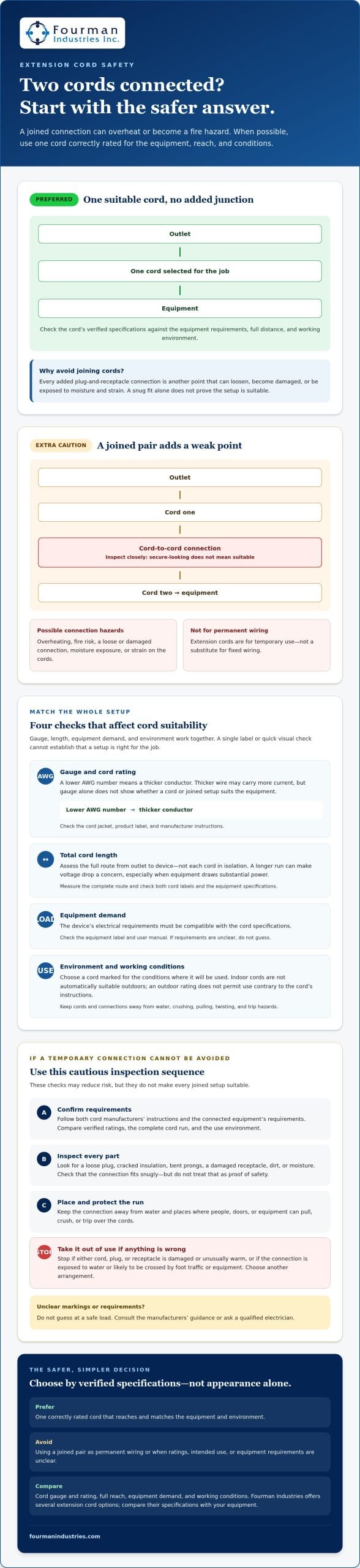
If connecting two extension cords is unavoidable, use this cautious checklist
Joining cords is generally best avoided. These checks are for risk reduction during temporary use, not approval of every cord combination. If you can’t confirm that both cords and the connected equipment are compatible, stop and choose another arrangement. Follow the instructions for both cords and the equipment throughout.
Inspect both cords, confirm their ratings, and keep the junction protected. Work through the checklist in order. If any check fails, don’t connect or use the cords.
- Read the instructions. Check the cord manufacturers’ guidance and the equipment’s electrical requirements. If the instructions prohibit the setup or leave compatibility unclear, stop.
- Inspect both cords and connectors. Look for cuts, cracked insulation, crushed sections, exposed conductors, bent prongs, loose fittings, or other damage. Don’t use a damaged cord or connector.
- Confirm ratings and compatibility. Compare the markings on both cords with the equipment requirements and the conditions of use. Don’t assume matching plugs or similar appearances mean the cords are compatible.
- Check the connection. The cord ends must be designed to fit together. Don’t force a plug, modify a connector, or use an adapter to make an unsuitable connection work.
- Plan the route and protection. Keep the junction dry, visible, and away from traffic, heat, sharp edges, and anything that could pull or crush it. Use GFCI protection where required or appropriate for the location and equipment.
- Monitor during temporary use. If the plug loosens, becomes warm, or shows damage, disconnect power and stop using the setup. Don’t leave the connection unattended or in place as a permanent solution.
Inspect, match, and connect only compatible cord ends
Check the entire length of each cord, not just the plug ends. A small cut, crushed spot, or exposed conductor is reason to take that cord out of use. Then compare cord labels and instructions to verify the ratings and intended use. If you can’t confirm that the connection and ratings are compatible, don’t try to make them fit.
Protect the junction and monitor the equipment
Keep the connection where you can see and inspect it. Protect it from moisture and physical strain, but don’t cover or conceal it in a way that hides damage or warmth. GFCI protection adds a safeguard in suitable circumstances; it doesn’t override cord ratings or manufacturer instructions. Stop promptly if anything changes or seems abnormal.
If you need a simpler alternative, compare Fourman Industries’ extension cord options against your equipment requirements and working conditions. Check the current specifications before choosing a cord, and don’t treat a product listing as confirmation that a joined setup is suitable.
Choose a properly rated extension cord for a safer, simpler setup
A safer setup starts with the job, not a guess at which cord looks sturdy. Identify the equipment’s electrical requirements, where you’ll use it, and how far the outlet is from the work area. Then compare those details with the cord’s marked specifications and manufacturer instructions. Aim for one suitable cord that reaches without strain, not simply the longest option available.
This decision path also helps answer how to safely connect two extension cords: first see whether a properly selected single cord or a different equipment location can eliminate the extra connection. No cord removes every hazard, and no product is automatically suitable for every tool, distance, or setting. Confirm the actual specifications before use.
Use product specifications to narrow your options
Fourman Industries sells extension cords, including 10 Gauge ECONO Extension Cords and 12 Gauge SJTW Triple Tap Extension Cords. These are product names, not a guarantee that either option fits a particular load. Check the current specifications and intended-use guidance for the cord you’re considering, then compare them with the equipment label or manual and the conditions where you’ll use it.
For a specific job, work through these checks before choosing:
- Load: Confirm the equipment’s electrical requirements and compare them with the cord’s verified rating.
- Environment: Check that the cord is intended for the location and conditions, including any outdoor use.
- Reach: Choose a length that follows a safe route without tension, pinching, or unnecessary excess.
- Instructions: Follow the cord and equipment manufacturers’ directions. If a rating or marking is unclear, don’t assume.
A custom extension cord buying guide can provide additional selection context. Still, use the product’s current specifications to determine whether it suits your particular task.
Know when to get qualified help
If you’re unsure whether the outlet or electrical setup can support the equipment, pause and consult a qualified electrician. Choosing a different cord won’t resolve uncertainty about the outlet itself. Fourman Industries sells equipment, including extension cords, but doesn’t provide electrical repair services.
Once you know the load, location, and required reach, compare the available cord options and read each product’s specifications before deciding. Verify the fit for your job rather than relying on appearance or joining cords to make a setup reach.
Make the safer choice before you plug in
The best way to approach how to safely connect two extension cords is to look for an alternative first. One correctly rated cord can avoid an extra connection, but added length alone doesn’t make a cord suitable. Match its specifications to the equipment, the full reach, and the conditions where you’ll use it.
If a temporary connection still seems necessary, follow both cord manufacturers’ instructions and the equipment requirements. Inspect every cord and connector, and stop if anything is damaged, loose, or unusually warm. If you’re unsure whether the outlet or setup can handle the equipment, ask a qualified electrician rather than guessing.
Fourman Industries sells 10 Gauge ECONO extension cords and 12 Gauge SJTW Triple Tap extension cords. Their names don’t guarantee suitability for a particular job, so check current specifications and intended-use guidance before choosing.
Compare extension cord options and check their specifications to make an informed choice. Verify that the cord fits your equipment and working conditions before use.
Frequently Asked Questions
Is it safe to connect two extension cords?
Generally, use one properly rated cord that’s long enough instead. Every joined connection adds another point that can loosen, become damaged, or get wet. If temporary use can’t be avoided, check both cords’ ratings and instructions, inspect them for damage, and keep the junction dry and protected. Monitor it during use. Stop and disconnect power safely if the connection becomes warm, loose, or damaged. These checks reduce risk, but don’t make every setup suitable.
Can I connect two extension cords of different gauges?
Don’t assume two cords with different gauges are suitable together just because their plugs fit. Gauge, total cord length, equipment demand, and each cord’s rating all affect whether the setup is appropriate. Check both manufacturers’ instructions and the equipment requirements before use. If any rating or requirement is unclear, avoid joining the cords. Choose one cord specified for the application or ask a qualified electrician for guidance.
What happens if an extension cord connection gets wet?
A wet connection can increase the risk of electric shock and may damage equipment. Don’t touch a wet plug or connection. Disconnect power only if you can do so safely, without handling wet electrical parts. Keep cords and connections out of wet areas unless their instructions specifically permit those conditions. Don’t use equipment that appears damaged. If you’re unsure how to isolate the power safely, stay clear and contact a qualified electrician.
Can I use two extension cords outdoors?
Outdoor use depends on the ratings of both cords, the equipment, and the conditions. Connecting an indoor-rated cord to an outdoor-rated one doesn’t make the first cord suitable for outdoor exposure. Prefer one cord rated for the environment and equipment requirements. Follow the product instructions, keep the connection protected, and use GFCI protection where required or appropriate. If you can’t confirm the ratings or intended use, don’t use the joined setup.
How do I know what gauge extension cord I need?
Start with the equipment’s electrical requirements and the cord manufacturer’s rating guidance. Check gauge and cord length together, and read the markings on the cord rather than judging by appearance. A lower AWG number generally means thicker conductors, but gauge alone doesn’t establish that a cord suits the equipment. If the label is missing or the load requirements aren’t clear, check with the manufacturer or a qualified electrician.
Is it safe to connect extension cords to a power strip?
Don’t assume that combining an extension cord and power strip is safe. Each has specific ratings and instructions, and the combined arrangement may be overloaded or unsuitable for the equipment. Check the manufacturers’ guidance and the requirements of every connected device. If you need more reach or outlets, use only a setup specifically permitted by the manufacturers. If the instructions don’t make that clear, ask a qualified electrician instead of guessing.
Should I replace a warm or damaged extension cord?
Stop using the cord and disconnect it safely. Unusual warmth, cracked insulation, exposed wires, crushed sections, or loose connectors can signal a problem. Don’t tape over damage or keep using the cord to finish the task. Replace a damaged cord with one selected for the equipment and conditions. If an outlet seems warm or damaged, don’t use it; have a qualified electrician assess the outlet and electrical setup.




