
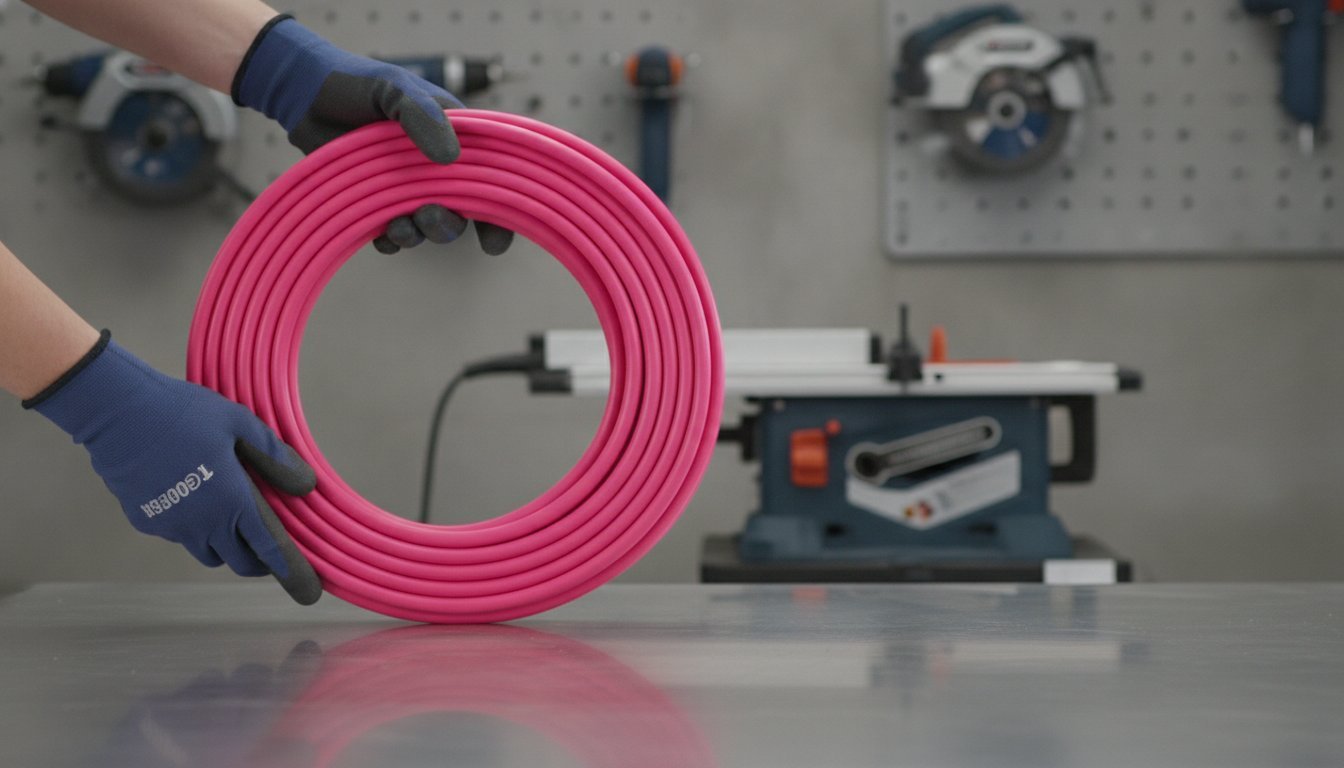
Your power tools are only as reliable as the copper feeding them. If you’re still using standard vinyl cords on a professional job site, you’re essentially waiting for a motor burnout or a cold-weather crack to stall your progress. Most pros have felt the sting of a tool losing power because a generic sjtw extension cord couldn’t handle the amperage. It’s a common frustration that costs both time and money when you’re on a deadline.
You need gear that stands up to the grit of a real workshop and stays flexible even when the temperature hits -40°C. This guide helps you master technical specifications so you can choose a durable, weather-resistant power solution that actually lasts. We’ll break down the SJTW rating, explain why 12-gauge remains the industry standard for 2026, and ensure your setup meets OSHA 1926.405(a)(2) safety requirements. You’ll learn how to correctly match cord gauge to your tool’s draw and why a thermoplastic jacket is the “Goldilocks” choice for outdoor durability and cost-efficiency on any modern job site.
Key Takeaways
- Decode the UL acronym to identify cords that handle moisture and 300-volt junior service loads without failing on the job.
- See why a 12 gauge sjtw extension cord is the essential standard for preventing voltage drop in high-demand power tools like table saws.
- Compare SJTW against SJOOW and STW jackets to choose the right balance of thermoplastic durability and cost-efficiency for your crew.
- Learn how to use high-visibility colors and custom imprinting to stop cord theft and keep your equipment organized on busy sites.
What is an SJTW Extension Cord? Decoding the UL Rating
Every professional has looked at the side of a cable and seen that string of letters. It isn’t just industry jargon; it’s the technical DNA of your power supply. An sjtw extension cord follows a specific naming convention defined by the UL 62 standard for extension cords. This ensures every manufacturer plays by the same rules for safety and performance.
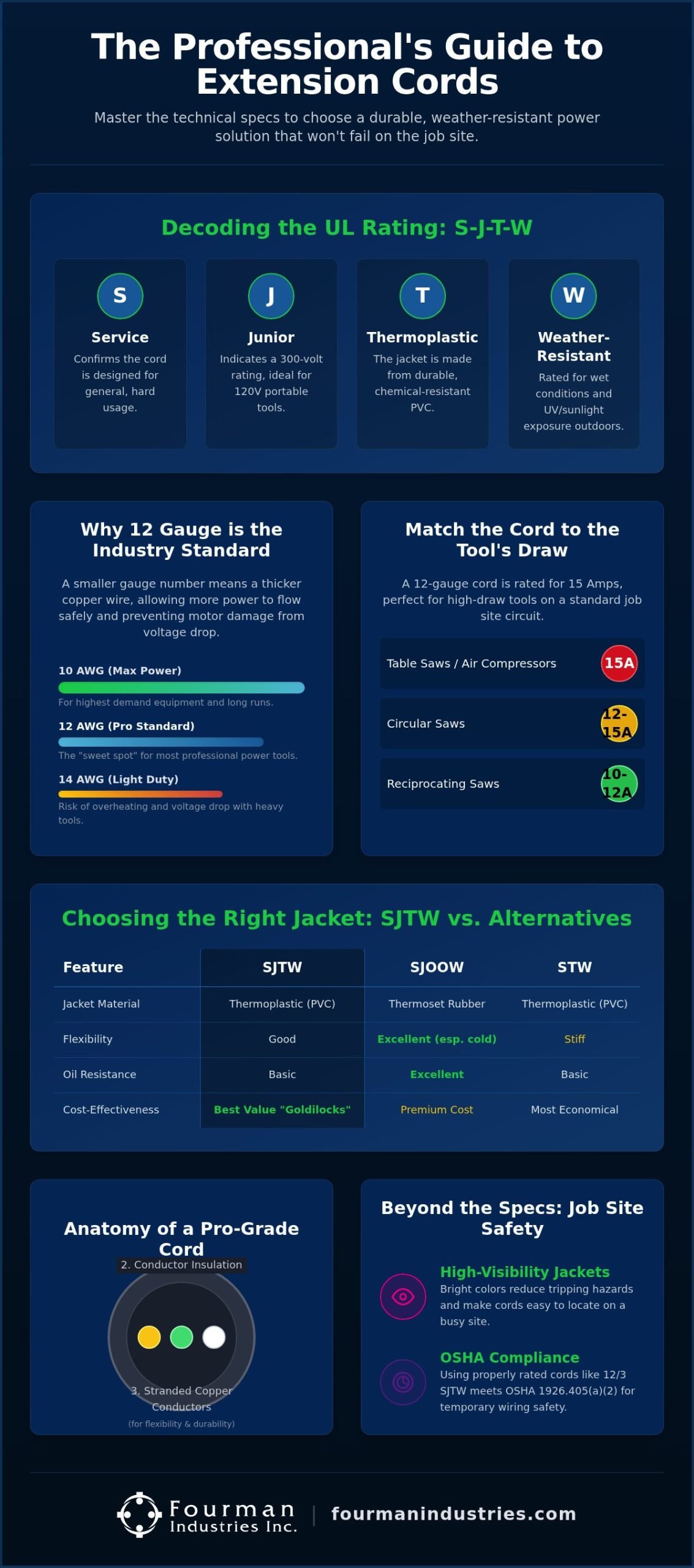
- S (Service): This confirms the cord is designed for general use.
- J (Junior): This indicates a 300-volt rating. While “Junior” sounds small, it’s the ideal standard for portable power tools that run on 120V circuits.
- T (Thermoplastic): The jacket is made from a durable PVC material that resists chemicals and abrasions.
- W (Weather-Resistant): This is the most critical letter for outdoor crews, signaling the cord is rated for wet conditions and sunlight.
Safety starts with the UL or ETL mark. These certifications prove the cord has passed rigorous testing for heat resistance and electrical load. Without these marks, you’re risking a fire or a ruined tool motor on your job site. It’s the only way to guarantee the product meets OSHA requirements for temporary wiring.
The Anatomy of an SJTW Cable
Inside that jacket, you’ll find high-quality copper stranding. Unlike solid wire found in your walls, extension cords use many tiny strands of copper twisted together. This design allows the cord to bend and coil repeatedly without the metal fatigue that leads to internal breaks. Each copper conductor is wrapped in its own layer of color-coded insulation before being bundled inside the outer jacket. The thermoplastic (PVC) outer layer provides a tough, smooth finish that slides easily over concrete or through grass. An sjtw extension cord is the industry standard for outdoor-rated, medium-duty power delivery.
Why the “W” Rating Matters for Outdoor Use
The “W” rating is your insurance policy against the elements. It specifically means the jacket material is treated to handle moisture without absorbing it. This prevents short circuits when the cord is sitting in damp morning grass or during a light rain shower. Beyond water, the “W” rating includes UV stabilization. Standard indoor cords become brittle and crack after a few days in the sun; a “W” rated cord stays flexible and intact. Just remember that weather-resistant doesn’t mean submersible. You can use these in the rain, but don’t let them sit in standing puddles or submerged in a trench. Proper drainage on your site is still essential for electrical safety.
Technical Specifications: Why 12 Gauge SJTW is the Industry Standard
Choosing the right wire gauge is the difference between a tool that hums and a tool that smokes. In the world of electrical gear, the American Wire Gauge (AWG) system works in reverse. A smaller number means thicker copper and a higher capacity for power. For most pros, a 12 gauge sjtw extension cord is the sweet spot. It provides enough copper to feed hungry motors without being too heavy to haul around the site. According to OSHA guidelines for job site extension cords, these are classified as junior hard service cords. This makes them a legal and safe choice for hard usage in construction environments.
High-draw tools like circular saws or miter saws pull a lot of juice the moment you pull the trigger. If your wire is too thin, the tool won’t get the amperage it needs. This leads to sluggish performance and eventual motor failure. A 12/3 SJTW cord is designed to handle these surges. It also allows for the popular Triple Tap configuration. This setup lets you run three tools from a single drop, which boosts your crew’s efficiency and keeps the workspace organized. If you need a reliable connection for your crew, our 12 Gauge SJTW Triple Tap extension cords are built for this exact demand.
Amperage and Performance Limits
Matching your cord to your tool isn’t a suggestion; it’s a requirement for safety. A standard 12 gauge SJTW cord is rated for 15 amps. This perfectly matches the limit of a standard US household or job site outlet. Here is a quick look at what typical tools require:
- Circular Saws: 12 to 15 Amps
- Table Saws: 15 Amps
- Air Compressors: 14 to 15 Amps
- Reciprocating Saws: 10 to 12 Amps
While 12 gauge covers most needs, some massive equipment or long-term industrial setups need even more. For those high-demand scenarios, we offer 10 Gauge ECONO cords that provide an extra buffer of safety and power delivery. If you want a deeper understanding of how gauge affects amperage capacity and tool protection, our complete guide to 12 gauge extension cords covers the full relationship between wire thickness and peak performance.
Voltage Drop: The Silent Tool Killer
Voltage drop is a hidden enemy on the job site. As electricity travels through a wire, it faces resistance. The longer the wire, the higher the resistance. This causes the voltage to drop by the time it reaches your saw. When voltage goes down, the heat inside your tool’s motor goes up. This heat ruins the windings and kills the tool. A 12/3 sjtw extension cord maintains steady power much better than thinner 14 or 16 gauge alternatives. At 50 feet, a 12 gauge cord handles a full 15-amp load with minimal loss. For workshop tasks where you only need a short run to your bench tools, a 12 gauge extension cord 25 ft delivers a zero-compromise connection with virtually no voltage drop. When you push beyond that mark, you have to be careful. Check out our guide on how to use a 12 gauge extension cord 100 ft for specific safety thresholds and performance tips.
SJTW vs. SJOOW and STW: Choosing the Right Jacket
Don’t let the alphabet soup on a cable jacket confuse you. Choosing between SJTW and SJOOW comes down to one question: what’s on your floor? A standard sjtw extension cord features a thermoplastic PVC jacket. It’s built for the grit of a construction site; it’s lightweight, resists abrasions, and stands up to the sun. SJOOW cords use a thermoset rubber jacket. Rubber is incredibly flexible, but it’s also heavier and more expensive. For most crews, the thermoplastic jacket of an SJTW cord provides the ruggedness you need without the extra weight or cost.
The “J” in SJTW is another key detail you need to understand. It stands for Junior service, which carries a 300-volt rating. Compare this to an STW cord, which lacks the “J” and carries a heavy-duty 600-volt rating. While 600V sounds more powerful, it’s usually overkill for standard 120V or 240V power tools. The 300V rating of a junior service cord is the professional standard for portable tools. It allows the cord to stay thinner and more manageable while providing total safety for your saws, drills, and compressors.
When to Upgrade to Oil-Resistant Jackets
If your work environment involves a lot of chemicals, you might need an upgrade. Thermoplastic jackets are excellent for water and mud, but they can break down when soaked in motor oil or gasoline. In a mechanic’s bay or an industrial shop where spills are common, look for the “OO” designation found in SJOOW. This indicates that both the outer jacket and the internal wire insulation are oil-resistant. If you aren’t worried about oil spills, sticking with an sjtw extension cord is the smarter, more cost-effective move for outdoor framing, roofing, or landscaping projects. It handles 90% of professional tasks without the added expense of specialty rubber.
Temperature Ratings and Flexibility
Flexibility is the biggest concern when the temperature drops. High-quality SJTW cords are rated to stay functional from -40°C up to 60°C. Because PVC is a plastic, it can develop a “memory” if it’s stored poorly. If you wrap it tight around your arm, it will stay kinked when you try to use it. Use a proper over-under coil to keep the jacket supple and ready for work. This is a massive step up from standard indoor SPT cords. Those thin, flat cords are meant for lamps, not job sites. They lack the jacket thickness and weatherproofing that keep a professional cord from cracking under the sun or shorting out in the rain.
Practical Applications: From Job Sites to Home Workshops
A professional sjtw extension cord is the backbone of any productive site. It feeds the high-draw machinery that keeps a project moving, from heavy-duty table saws to high-pressure air compressors. These tools require a steady, uninterrupted flow of current to maintain blade speed and motor health. Using a lower-rated cord often leads to tripped breakers or, worse, internal tool damage. Beyond the woodshop, these cords are the gold standard for outdoor events. Festivals, weddings, and sound stages rely on the “W” rating to keep expensive lighting rigs and sound systems safe from morning dew and unpredictable weather. Lighted ends are a simple but effective tool for troubleshooting; they provide instant visual confirmation that your circuit is live without a trip back to the generator.
Before you plug in for the day, run a quick safety check on your equipment. A few seconds of inspection can prevent a fire or a blown tool. Follow this checklist for every cord in your kit:
- Inspect the entire length of the jacket for deep nicks, cuts, or exposed copper.
- Verify the ground prong is present, straight, and secure in the plug.
- Check both plug ends for any signs of melting, discoloration, or scorch marks.
- Test the lighted female end to ensure power is reaching the end of the run.
Construction and Professional Use
Concrete floors and gravel paths act like sandpaper on inferior jackets. The thermoplastic PVC on an sjtw extension cord is specifically engineered to resist this abrasion, ensuring the internal insulation remains protected. High-visibility colors like pink and purple serve a dual purpose on a busy site. They act as a clear safety marker to help prevent trips and make it impossible for another crew to “accidentally” walk off with your gear. To take your site security even further, read the ultimate guide to custom printed extension cords to see how branding keeps your inventory where it belongs.
Residential and Seasonal Power
Don’t trust thin “green” holiday cords for high-wattage displays. Those basic cables often lack the 12-gauge copper necessary for large LED arrays or inflatable decorations that run for hours. An SJTW cord provides a safe, weather-resistant buffer for winter weather and heavy rain. When working in tighter spaces where a shorter run is all you need, a heavy-duty 12 gauge extension cord 25 ft keeps your setup clean and eliminates the excess coiling that degrades cord life over time. When the season ends, proper storage is key to extending the life of the thermoplastic jacket. Avoid coiling your cords tightly around your elbow. Instead, use a loose over-under coil and store them in a dry bin. This prevents the PVC from developing a permanent “memory” or crimping the internal copper strands over time. For gear that handles the elements without breaking a sweat, browse our 12 Gauge SJTW Triple Tap extension cords today.
Beyond the Specs: Customizing Your SJTW Cords for Security
Your job site is a high-traffic environment where equipment often grows legs and walks away. Even the most durable sjtw extension cord is useless to your crew if it disappears into someone else’s truck at the end of the shift. Cord theft is the number one logistical headache for project managers in 2026. It isn’t just the cost of the copper; it’s the downtime caused by a missing power drop. At Fourman Industries, we use the professional-grade SJTW jacket as the foundation for a security system that protects your investment.
Customization creates a powerful psychological deterrent. Most job site theft happens because gear looks identical. When your company name is printed directly onto the thermoplastic jacket, “accidental” pickups stop immediately. We take this further by offering high-visibility colors like pink and purple. These aren’t just style choices. They stand out against mud, concrete, and standard yellow cords. It makes your gear instantly recognizable from across the site, ensuring your inventory stays where it belongs. It’s an authoritative way to claim your workspace without saying a word.
The Power of Personalized Gear
The thermoplastic jacket on an sjtw extension cord is the perfect surface for our custom printing process. This ink bonds with the PVC to ensure your name doesn’t rub off after a week of being dragged across a floor. Many of our clients use color-coding to organize their workflow. You might assign pink cords to the framing crew and purple to the electricians. This level of organization prevents outlet crowding and clarifies who is responsible for which line. If you want to see how these bright options look in action, check out the best pink extension cords for 2026 for high-visibility examples.
Investing in Durability and Identity
A 12 gauge SJTW cord is a long-term asset for your business. Moving away from disposable, generic cords saves money over several seasons. You aren’t just buying copper and plastic; you are buying a reliable partner for your power tools. When you combine the technical 300V weather-resistant rating with a personalized identity, you get a tool that works as hard as you do. Stop replacing stolen gear and start building a professional inventory that lasts. Shop Fourman Industries for custom 12 Gauge SJTW Triple Tap cords and secure your power today.
Secure Your Power and Your Inventory
Your tools are the lifeblood of your business. Protecting them starts with feeding them the right current. Choosing a 12 gauge sjtw extension cord ensures your high-draw motors stay cool and your crew stays productive in any weather. Take the technical knowledge you’ve gained and put it into practice. Don’t settle for generic gear that cracks in the cold or disappears into a competitor’s truck.
Professional success is built on reliable equipment and smart organization. Using heavy-duty copper protects your saws, while high-visibility pink and purple jackets keep your site safe. When you add custom printing to the mix, you turn a simple utility into a permanent asset that stays in your inventory where it belongs. It’s time to build a power kit that reflects the quality of your work.
Upgrade to Custom Printed 12 Gauge SJTW Cords at Fourman Industries and take total control of your job site gear. Let’s get to work with equipment you can actually trust.
Frequently Asked Questions
Can I use an SJTW extension cord in the rain?
Yes, you can use an sjtw extension cord in the rain because the “W” rating specifically designates weather and water resistance. The thermoplastic jacket is engineered to prevent moisture from reaching the internal copper conductors. While it handles rain and damp grass easily, it is not submersible. Avoid letting the plug connections sit in standing puddles to prevent short circuits and potential shocks.
What is the difference between SJTW and SJOOW?
The main difference is the jacket material and its resistance to chemicals and oil. SJTW uses a thermoplastic (PVC) jacket that is lightweight and cost-effective for general construction and outdoor use. SJOOW uses a thermoset rubber jacket that is oil-resistant and remains more flexible in extreme cold. Choose SJOOW for automotive shops with frequent oil spills, but stick with SJTW for standard outdoor job sites.
Is an SJTW cord safe for a space heater or air conditioner?
It is only safe if the cord’s gauge matches the appliance’s amperage requirements. Most space heaters and air conditioners pull 12 to 15 amps, which requires a 12 gauge cord to prevent overheating. Using a thinner 14 or 16 gauge cord for these high-draw appliances creates a fire hazard and can damage the motor. Always check the nameplate on your device before choosing your power cord.
What does the 300V rating on an SJTW cord actually mean?
The 300V rating indicates the cord is a “Junior” service cable designed for standard portable power applications. It means the internal insulation is tested to safely handle electrical loads up to 300 volts. Since most North American tools run on 120V or 240V circuits, this rating is the professional standard. It provides a thinner, more manageable cable compared to 600V heavy-duty service cords.
Why is my SJTW cord stiff in cold weather?
Thermoplastic jackets naturally become more rigid as temperatures drop toward their lower operating limit of -40°C. Unlike rubber, PVC is a plastic that hardens in the cold, which can make it difficult to uncoil or wrap. To maintain better flexibility, store your cords in a heated space or a warm truck cab before use. Once the cord is carrying a load, the internal current will slightly warm the jacket.
How can I tell if my cord is 12 gauge or 14 gauge?
Look at the technical text printed or embossed directly onto the outer jacket of the cord. You’ll see a sequence like “12/3” or “14/3” near the UL listing information. The first number represents the wire gauge, and the second is the number of conductors. If the printing has worn off, 12 gauge cords are noticeably thicker and heavier than 14 gauge versions because they contain more copper.
Does the color of an SJTW cord change its electrical rating?
No, the color of the jacket is purely for visibility, safety, and organization. A pink, purple, or yellow sjtw extension cord all carry the same electrical specifications if their gauge and UL ratings are identical. We use high-visibility colors like pink and purple to help you identify your gear on a crowded site and deter theft, but the copper inside remains the same professional grade.
Can SJTW cords be used for permanent outdoor wiring?
No, SJTW cords are strictly for temporary power according to OSHA standard 1926.405(a)(2). They are not a legal or safe substitute for permanent structure wiring or burial. The thermoplastic jacket will eventually degrade if left exposed to the elements for years without maintenance. Always remove your extension cords once the specific task or project is finished to remain compliant with local safety regulations.




