
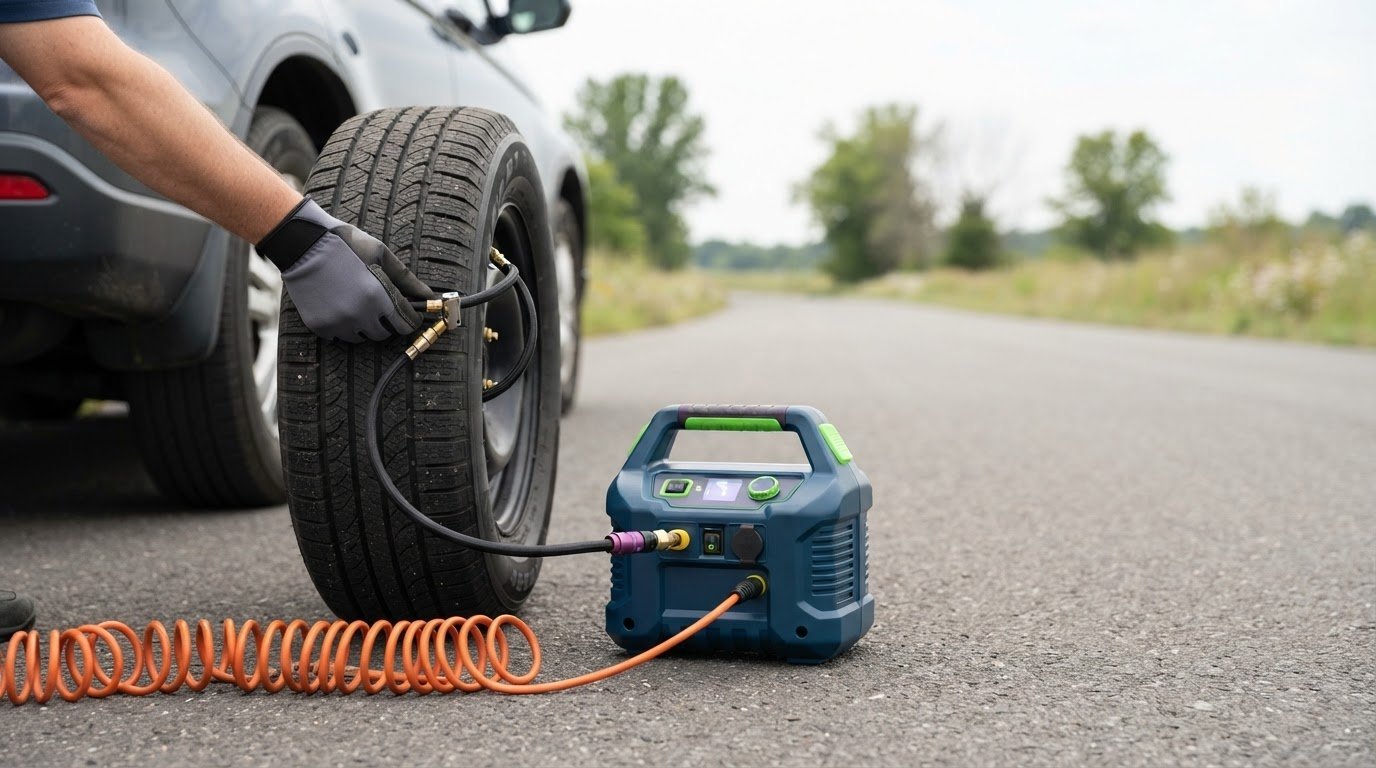
A tire that’s only a few PSI low may be ready in under a minute, while a larger pressure increase can take several minutes. So, how long does it take to inflate a tire with a portable compressor? There’s no single answer: tire size, starting pressure, target pressure, and compressor airflow all affect the time.
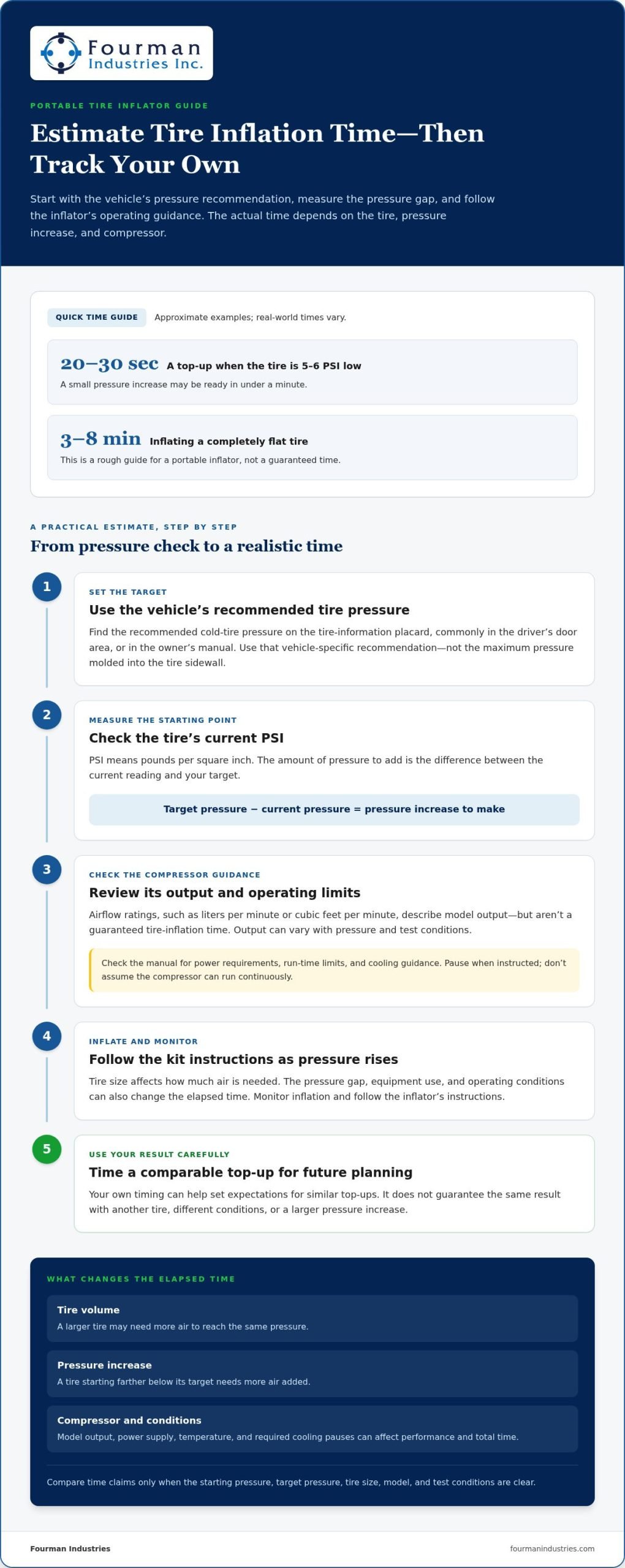
It’s reasonable to want an estimate before you’re stopped roadside. As a guide, topping off a tire that’s 5 to 6 PSI low may take about 20 to 30 seconds, while inflating a completely flat tire can take roughly 3 to 8 minutes with a portable inflator. Actual times vary, and an advertised rating alone won’t tell you how a compressor will perform with your tire.
This guide explains what affects inflation time and how to estimate it for your tire and pressure increase. You’ll also learn how to choose the right target pressure, why the vehicle’s door-jamb sticker matters, and when to pause so the compressor can cool. Fourman Industries’ Portable 12v Tire Inflator Kit is an option for your roadside equipment. Follow the kit’s operating instructions whenever you use it.
Key Takeaways
- There’s no universal answer to how long does it take to inflate a tire with a portable compressor; pressure increase, tire size, and compressor output all matter.
- Compare inflation-time claims only when the starting pressure, target pressure, and tire size are clear.
- For a useful estimate, check the tire’s recommended pressure, measure its current PSI, and track how quickly your compressor raises it.
- Choose a compressor that fits your expected use, and follow its operating instructions while monitoring inflation.
- A Portable 12v Tire Inflator Kit can be part of a practical roadside-equipment setup.
How long does it take to inflate a tire with a portable compressor?
There’s no reliable time that applies to every portable compressor, tire, and starting pressure. A small top-up is a different job from bringing a very low tire back to its recommended pressure. The answer to how long does it take to inflate a tire with a portable compressor depends on how much air the tire needs and how the particular inflator performs under the conditions you’re using it in.
Compressor ratings can help you compare models, but they don’t guarantee a specific real-world inflation time. Tire size, the pressure increase, inflator output, and operating limits all play a part. Treat advertised times as results for a particular model and test setup, not as a promise for every tire.
Why a quick top-up takes less time than a low tire
PSI means pounds per square inch, the unit used for a tire pressure reading. The amount of pressure you need to add matters as much as the final target. Reaching a target from just below it takes less work than reaching that same target from a much lower pressure.
Hypothetical example, not a product test: Imagine two identical tires with the same target pressure. One is only a few PSI below that target; the other is much farther below it. The first needs a smaller pressure increase, so it will generally take less time to inflate.
Why portable compressor times vary
Inflator output affects how quickly air moves into the tire, while tire volume affects how much air is needed. Starting and target pressures determine the size of the pressure increase. Operating conditions, including how the equipment is used and whether cooling pauses are required, can also affect the total time.
That’s why two inflators can produce different results on the same vehicle. Even one inflator can take different amounts of time across tires or uses when the starting pressure, conditions, or required pressure increase change. A time claim is useful only when you know the model and test conditions behind it. Without a like-for-like comparison, a general minute range can create the wrong expectation.
To estimate the job, find your vehicle’s recommended tire pressure and measure the tire’s current PSI. The difference tells you how much pressure you need to add. Then check the inflator’s manual for operating guidance and any limits on how long it should run before you pause. Follow those instructions rather than assuming it can run continuously.
Timing an inflation on your own tire can help you plan for similar top-ups, but it doesn’t guarantee the same result on another tire or with a larger pressure increase. Fourman Industries’ Portable 12v Tire Inflator Kit is an option for a roadside-equipment setup. Use the manual, your vehicle’s pressure recommendation, and the conditions you expect to encounter to set a realistic expectation.
What determines portable tire compressor inflation time?
Several variables work together, so an inflator’s advertised output alone can’t tell you exactly how quickly it will inflate a tire. Tire size affects the amount of air needed, the pressure increase sets the task, and operating conditions can affect how consistently the compressor runs. Considering all of these factors helps you judge whether a model suits routine top-ups or a more demanding roadside situation.
Tire size, starting pressure, and target PSI
A larger tire generally has more internal volume than a smaller one, so bringing it up by the same pressure amount can require more air. The starting and target readings matter too: their difference is the pressure increase the compressor needs to deliver. A tire that starts closer to its target needs less added air than one that starts farther below it.
Find the recommended cold-tire pressure on the vehicle’s tire-information placard, commonly located on the driver’s door area, or in the owner’s manual. Use that vehicle-specific recommendation as your target, not the maximum pressure molded into the tire sidewall. The NHTSA Tire Safety Guidelines also explain why proper inflation is part of tire safety and maintenance.
Compressor output and operating conditions
Airflow describes how much air an inflator can move over time. It may be shown in units such as liters per minute or cubic feet per minute, but figures aren’t directly comparable unless they’re measured under similar conditions. Output can also vary at different pressures. Treat an airflow rating as a model specification, not a guaranteed inflation time for every tire.
Power supply and conditions during use can affect performance. Temperature can influence pressure readings, and an inflator may need to pause and cool during a longer job. Check the specific model’s instructions for power requirements, operating limits, and cooling guidance. Don’t assume every portable compressor operates the same way.
- Tire volume: Larger tires may require more air to reach the same pressure.
- Pressure increase: A lower starting PSI means more air must be added to reach the target.
- Airflow and use: Model output, its power supply, temperature, and required pauses can all affect elapsed time.
For a useful estimate, consider the tire size, the gap between current PSI and the vehicle’s recommended pressure, and the inflator’s instructions. Fourman Industries’ Portable 12v Tire Inflator Kit is one option for a roadside-equipment setup. Compare the kit’s product information and operating guidance with the tires and situations you expect to handle.
How to compare inflation times without misleading estimates
A timing claim helps only if you know what was being inflated and under what conditions. A quick top-up and a larger pressure recovery are different jobs, so comparing their times directly can make a compressor seem faster or slower than it is. To judge how long does it take to inflate a tire with a portable compressor, look for a like-for-like test or measure the same setup yourself.
What a useful timing comparison includes
Record the tire size, starting PSI, target PSI, compressor model, and elapsed time. Note relevant conditions, such as the power source and whether the compressor paused to cool. Keep small top-ups separate from recovery after a substantial pressure loss. Without these details, it’s difficult to apply a reported time to your own tire.
| Inflation scenario | What to compare | Time |
|---|---|---|
| Small pressure top-up | Same tire size and small starting-to-target PSI increase | Record a timed test for the specific model |
| Larger pressure recovery | Same tire size and larger starting-to-target PSI increase | Record a timed test for the specific model |
The table gives no generic minutes because an inflation time applies only to the compressor and test setup used. Record the time from your own test, or use a published result when its test details are available. Either way, treat the result as specific to that model and setup, not as a guaranteed performance for every portable compressor.
How to read advertised or anecdotal times
A short demonstration may show one compressor inflating one tire from one starting pressure under particular conditions. Check whether the source identifies the tire, starting and target PSI, model, power supply, and any cooling pauses. If important details are missing, the time offers limited guidance. An airflow rating alone can’t be converted into promised minutes without a comparable test.
Even the same compressor may take a different amount of time on another vehicle. Tire size changes the air volume involved, and a different pressure increase changes how much air must be added. Power supply and operating conditions can also affect results. A time recorded on a smaller tire, for example, shouldn’t be treated as a forecast for a larger one.
For the fairest comparison, match as many test details as possible, especially tire size and pressure change. Set aside published claims that don’t provide enough information to reproduce the setup. For your own planning, time a top-up and a larger recovery separately, following the compressor’s operating instructions during both tests.
How to estimate and monitor your own tire inflation time
A timed test on your own tire gives you a more useful planning estimate than a generic claim. You’ll be using the same tire, compressor, and setup you’re likely to use again. It won’t predict every situation, but it can show how your equipment performs for a similar pressure increase.
A practical way to time a pressure top-up
Work in order: confirm the vehicle’s recommended pressure, measure the tire’s starting PSI with a reliable gauge, and connect the inflator according to its manual. Start timing when inflation begins. Stay with the tire, monitor pressure as you go, and stop at the recommended target. Don’t estimate pressure by the tire’s appearance.
- Check the target. Use the vehicle’s placard or owner’s manual for the recommended cold-tire pressure.
- Record the starting point. Measure and note the current PSI before connecting the inflator.
- Inflate and monitor. Follow the compressor instructions and check pressure at sensible intervals, rather than waiting until the end to see whether you’ve reached the target.
- Note the result. Record elapsed time, starting pressure, final pressure, tire size, and compressor model.
Those notes help you estimate future top-ups with the same setup. Keep readings and times from different tires or pressure increases separate; a test on one tire doesn’t establish a universal inflation time. The answer to how long does it take to inflate a tire with a portable compressor is most useful when it reflects your own measured conditions.
When timing is not the main concern
If a tire looks damaged, loses pressure repeatedly, or won’t hold air, inflation time isn’t the main problem. A compressor adds air; it doesn’t repair a puncture or damaged tire. Arrange appropriate tire service, and don’t keep driving on a tire that may be unsafe.
Stay with the inflator while it runs. Check its manual for operating limits and required cooling breaks, and pause as directed. If the pressure reading behaves unexpectedly, stop and review the vehicle and compressor instructions rather than continuing by guesswork. Recheck the reading with a reliable gauge if needed, and don’t exceed the vehicle’s recommended pressure.
For repeatable results, use the same gauge and note the conditions each time. Small differences in setup or starting pressure can change the time, so treat your record as a practical reference, not a promise. If you’re adding roadside equipment, explore the Portable 12v Tire Inflator Kit.
Choosing a portable compressor for realistic roadside expectations
The right inflator depends on the job you expect it to handle. If you mainly check and top up passenger-car tires, focus on a model suited to that routine. If you’re preparing for several vehicles or larger tires, compare the manufacturer’s stated capabilities and operating limits with those needs. A portable compressor is one part of roadside preparation, not a substitute for equipment designed for every tire or emergency.
Match the compressor to your everyday needs
Start with the vehicles and tire types you’ll use it for. Then compare product specifications, including airflow or pressure information where provided, power requirements, and any run-time or cooling guidance. Don’t assume two models with similar-looking ratings perform the same way. Consider where you’ll store the compressor and whether its instructions are clear enough to follow during a roadside stop.
Think through your likely use before choosing:
- Occasional top-ups: Prioritize a model whose stated capabilities suit your vehicle’s tires and whose operation you can follow confidently.
- Broader roadside preparation: Consider how the inflator fits alongside other equipment you may need, and whether its instructions and operating limits make sense for your intended use.
Inflation-time claims are useful only when the test setup resembles yours. Tire size, pressure increase, power supply, and operating conditions can all change the result. If you’re asking how long does it take to inflate a tire with a portable compressor, compare timing for a similar tire and pressure change rather than choosing by the quickest advertised claim.
Keep expectations grounded in the actual product
Fourman Industries offers a Portable 12v Tire Inflator Kit as part of its automotive emergency equipment selection. Use the product information and kit instructions to understand its intended use. Base your roadside expectations on the actual equipment, rather than assuming its airflow, pressure range, duty cycle, or inflation time from another model.
An inflator also works best as part of a considered vehicle kit. For ideas on building one, explore these guides to emergency car kit essentials and choosing a truck and car battery jump starter. These resources can help you think beyond tire pressure and plan for other roadside needs.
If a portable tire inflator belongs in your vehicle setup, consider Fourman Industries’ Portable 12v Tire Inflator Kit and its product information.
Make roadside preparation part of your routine
Before your next drive, make sure your tire inflator is easy to reach and that you know how to use it. Read its instructions before you need them, and keep a pressure gauge with your roadside equipment. Familiarity with the equipment can make a roadside stop feel more manageable.
If you’re still wondering how long does it take to inflate a tire with a portable compressor, the best estimate comes from the exact tire and inflator you’ll use. A timed test during a routine pressure check can give you a practical baseline without relying on a broad advertising claim.
Fourman Industries offers a Portable 12v Tire Inflator Kit among its automotive accessories. Explore the kit and its product information to see how it fits your vehicle’s roadside setup: Explore Fourman Industries’ Portable 12v Tire Inflator Kit.
Prepare at your own pace, follow the equipment instructions, and head out with more confidence.
Frequently Asked Questions
Can a portable compressor inflate a completely flat tire?
A portable compressor may add air, but a completely flat tire can point to a puncture, damage, or a bead that has come away from the rim. Don’t assume inflation makes it safe to drive. Look for visible damage and follow your vehicle’s roadside guidance. If the tire won’t hold pressure or appears damaged, arrange appropriate tire service instead of relying on the compressor to get you back on the road.
Can I run a portable tire compressor with the car turned off?
It depends on the compressor and vehicle, so check both manuals before connecting or operating the unit. Some inflators may draw enough power to affect the vehicle battery, and vehicle outlets can have their own limits. Use only the power connection and method specified for your equipment. Stay with the compressor while it runs, and stop if you notice a power issue or the equipment behaves unexpectedly.
Why does a portable tire compressor stop before the tire reaches its target pressure?
The cause can vary by model. A stop may relate to an operating limit, interrupted power, a protection feature, or a loose connection. Check the display and connections, then consult the manual before restarting. Don’t keep cycling the compressor beyond its instructions. If the pressure reading seems abnormal or the tire loses air while you inflate it, stop and inspect the tire rather than continuing to run the unit.
Should I inflate a tire to the pressure printed on its sidewall?
Usually, no. The sidewall marking generally indicates a tire limit, not the vehicle’s recommended pressure. Find the correct cold-tire pressure on the vehicle placard or in the owner’s manual, then use that as your reference. Check the reading with a gauge. If your vehicle is carrying a different load than usual, consult its instructions for the appropriate pressure rather than guessing from the sidewall.
Does cold weather make a portable compressor take longer to inflate a tire?
Cold conditions can affect tire pressure readings and compressor operation, though the exact effect depends on the equipment and situation. The answer to “how long does it take to inflate a tire with a portable compressor?” can therefore vary in colder weather. Measure the tire when it’s cold and use the vehicle’s recommended cold-tire pressure. Follow the compressor’s instructions for operating conditions, and don’t compare a warm-tire reading directly with a cold one.
Can I use a portable tire compressor to repair a puncture?
No. A compressor supplies air; it doesn’t repair a puncture, damaged sidewall, or other tire failure. Even if the tire accepts air, it may lose pressure again. If you suspect damage, follow your vehicle maker’s roadside guidance and arrange appropriate tire service. Use the inflator to address air pressure only, not as a substitute for a proper tire repair or an assessment of whether the tire is safe.




