
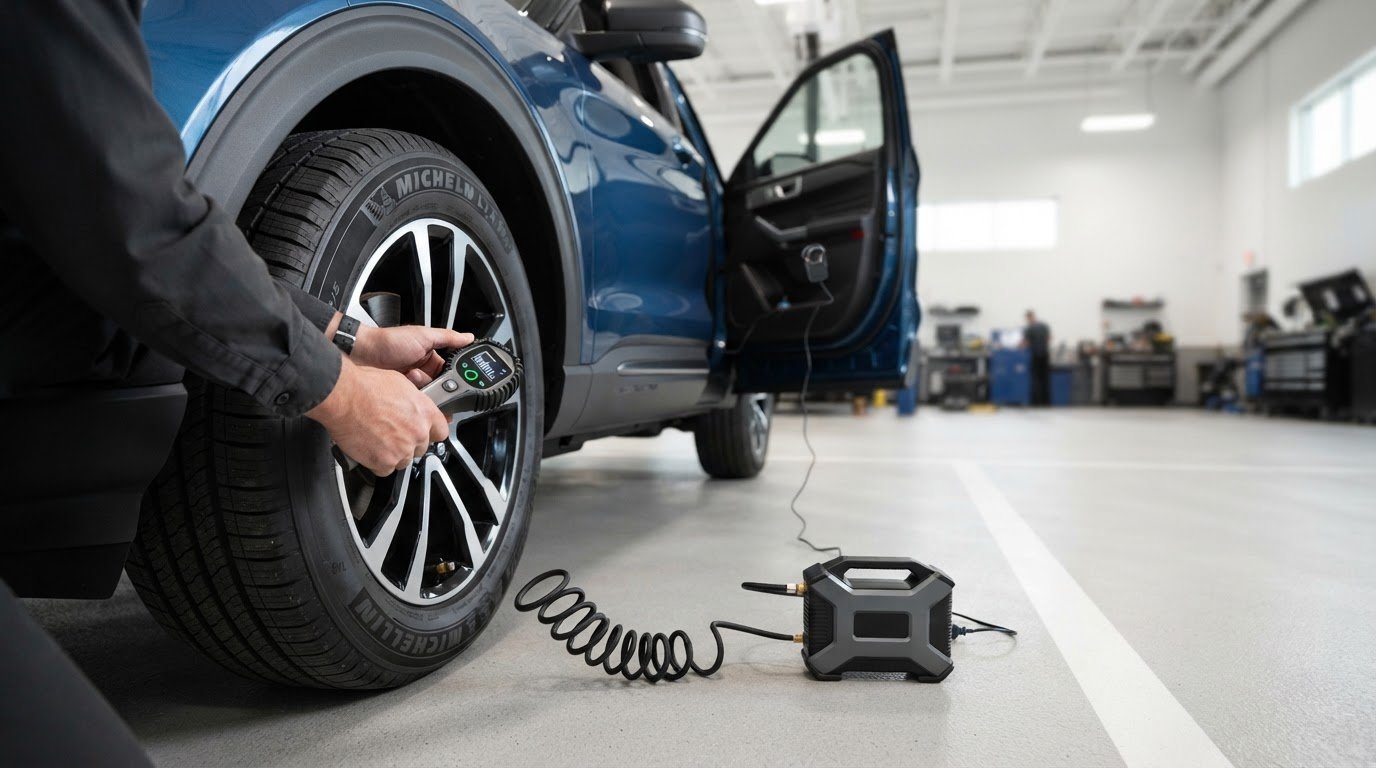
The PSI printed on your tire’s sidewall isn’t the pressure you should use. It’s the tire’s maximum, and relying on it instead of your vehicle’s recommendation can leave you guessing. If you’ve wondered, “what is the correct tire pressure for my car,” start with the vehicle maker’s guidance, not the number on the tire.
It’s easy to feel unsure when the front and rear tires call for different pressures, temperatures drop, or the TPMS warning comes on. Checking your tires doesn’t take special expertise. You need the right PSI for your vehicle and a reliable pressure reading.
This guide explains where to find your car’s recommended pressure, how to measure it accurately when tires are cold, and what to do if a reading is too high or low. You’ll also learn how vehicle load and temperature can affect pressure, and how to respond to a TPMS warning. A portable 12V tire inflator kit can help you add air after checking, at home or on the road.
Key Takeaways
- To answer “what is the correct tire pressure for my car,” use the vehicle’s recommended cold-tire PSI, not the maximum pressure printed on the tire.
- Check pressure with a compatible gauge when tires are cold for a more accurate reading.
- Read the vehicle placard for different front, rear, spare, or heavier-load pressure recommendations.
- If the TPMS warning appears, verify pressure with a gauge and follow your vehicle manual before adjusting or resetting the system.
- After measuring, a portable 12V tire inflator kit can help you add air when needed.
What Is the Correct Tire Pressure for Your Car?
Use the cold-tire PSI specified by your vehicle’s manufacturer. There’s no single pressure that suits every car. If you’re asking, “what is the correct tire pressure for my car,” check the vehicle’s tire-information placard first, then follow the value listed for each tire position and load condition.
The recommended pressure is specific to your vehicle, not just the tire. Front and rear tires may have different targets, and some placards list a separate setting for a full passenger load or heavy cargo. Use the instructions that match how your vehicle is equipped and loaded. A dashboard Tire-pressure monitoring system (TPMS) can alert you to a pressure drop, but it doesn’t replace the manufacturer’s PSI recommendation.
Where to Find Your Car’s Recommended PSI
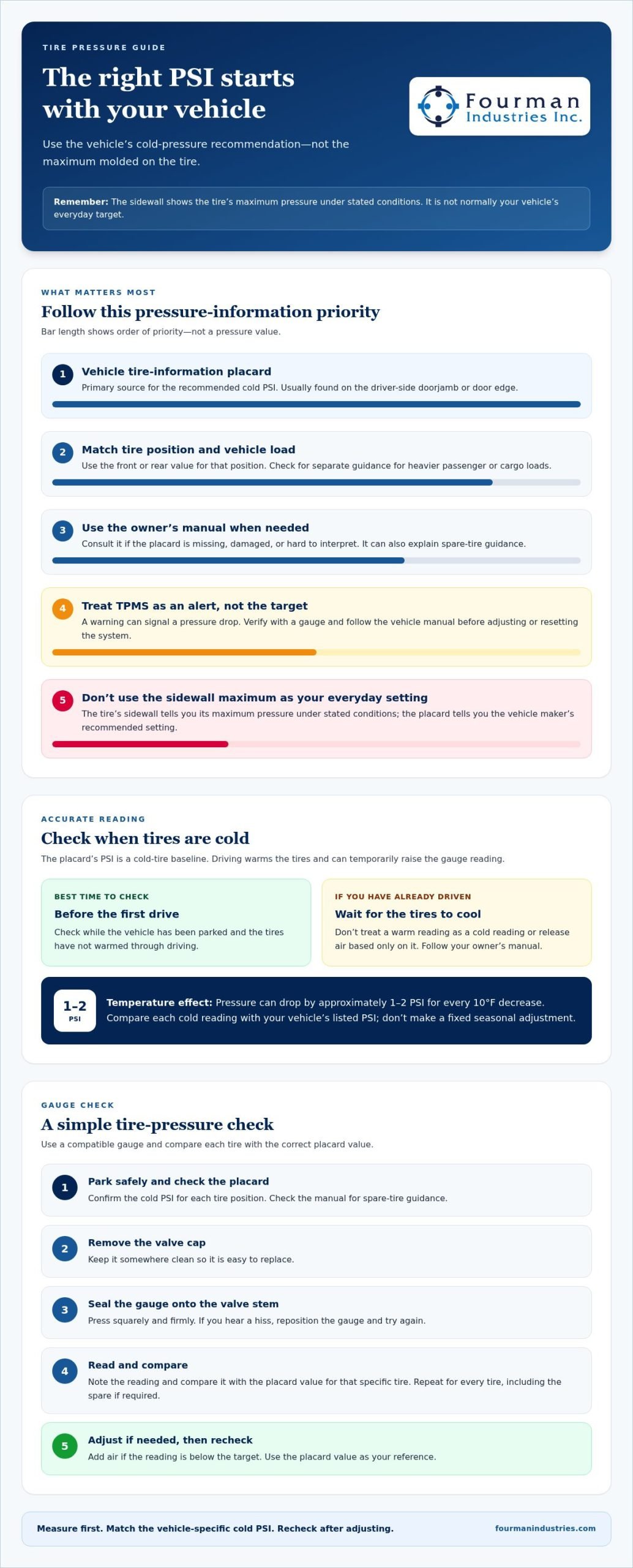
Start with the tire-information placard, usually attached to the driver-side doorjamb or door edge. It lists the vehicle’s recommended cold inflation pressure, often in PSI, and may show separate values for the front and rear tires.
Read the whole label. If it gives different pressures by position, use the front value for the front tires and the rear value for the rear tires. Look for additional guidance for heavier passenger or cargo loads. Don’t assume one number applies to every tire or driving condition.
If the placard is missing, damaged, or hard to interpret, consult the owner’s manual. Check the section on tires or vehicle specifications. The manual can explain how to read the placard and which pressure applies to your vehicle’s setup.
Why Tire Sidewall Pressure Is Not the Target
The number molded into a tire’s sidewall identifies the tire’s maximum pressure under the conditions stated on the tire. It isn’t normally the vehicle maker’s everyday recommended setting. The sidewall tells you about the tire; the placard tells you how the vehicle manufacturer specifies it should be inflated on your car.
That difference matters. Inflating every tire to its sidewall maximum could put it above the vehicle’s recommended pressure. For the correct cold PSI, rely on the vehicle placard or owner’s manual, not the sidewall number. If the placard lists more than one value, match the pressure to the tire position and load before adding or releasing air.
Why Tire Pressure Must Be Checked When Tires Are Cold
For an accurate comparison with your vehicle’s recommended PSI, measure the tires when they’re cold. The vehicle placard specifies tire pressure for cold tires. That’s the baseline the manufacturer uses, so a reading taken after driving may not show whether the pressure is on target.
As tires roll, they flex and generate heat. The air inside warms and expands, temporarily raising the gauge reading. A recently driven tire may therefore appear to be at the recommended pressure even if its cold pressure is lower. Don’t release air based only on a warm reading. Let the tires cool, then check again under the conditions described in your owner’s manual.
How to Tell Whether Tires Are Cold Enough to Check
The easiest approach is to check before your first drive of the day, while the car has been parked and the tires haven’t warmed through driving. This gives you a more representative reading against the cold PSI on the vehicle placard. Follow your owner’s manual for the exact measurement guidance for your vehicle.
Already driven? Don’t treat a warm reading as a cold-tire reading. Wait until the tires have had time to cool. The suitable wait depends on how far and how long you drove and the surrounding conditions. If you’re unsure, follow the manual rather than relying on a fixed wait time that may not fit every situation.
How Weather Changes Can Affect Tire-Pressure Readings
Ambient temperature affects tire pressure, too. As a general guide, pressure can drop by approximately 1-2 PSI for every 10°F decrease in temperature. A cold snap may bring a lower reading even when the tire hasn’t lost air through a puncture or leak. Warmer weather can also shift the reading upward.
Check your tires regularly as the weather changes, and compare each reading with the vehicle’s listed cold PSI. Don’t add or remove a set amount of air just because the season changed. The right pressure is still the vehicle-specific cold setting, not a seasonal adjustment. If a cold check shows low pressure, a suitable inflator can help you add air. A portable 12V tire inflator kit is a practical option to keep for home or roadside maintenance.
Keep a pressure gauge and portable 12V tire inflator kit within reach. Measure first, add air as needed, then recheck against the placard value.
How to Check Tire Pressure and Read the Gauge Correctly
Use a tire-pressure gauge that fits the valve and can read the pressure range specified for your vehicle. Before you start, have the placard’s cold PSI in front of you so you can compare each reading with the correct target. If you’re wondering “what is the correct tire pressure for my car,” the answer is the vehicle-specific value, checked one tire at a time.
A Step-by-Step Tire-Pressure Check
- Park safely and check the placard. Confirm the recommended cold PSI for each tire position. Check the manual to see whether your spare should also be measured.
- Remove the valve cap. Keep it somewhere clean so it’s easy to replace.
- Press the gauge onto the valve stem. Hold it squarely and firmly enough to form a seal. If you hear a hiss, air is escaping, so reposition the gauge and try again.
- Read and note the result. Compare the gauge reading with the placard value for that specific tire. Repeat for every tire, including the spare if the vehicle guidance calls for it.
- Adjust and recheck. Add air if the reading is below the target. If it’s above, release a small amount, then measure again. Repeat until the cold reading matches the listed pressure.
- Replace the valve caps. Note any tire that repeatedly loses pressure so you can track the change.
Check cold, compare with the placard, adjust, then recheck. This sequence helps prevent guesswork and confirms the pressure after each adjustment.
What to Do When a Tire Reads Too Low or Too High
If a tire is a little below its recommended pressure, add air in short increments and check the gauge again. A portable 12V tire inflator kit can help you add air after measuring. Don’t rely on how a tire looks to judge its exact PSI.
If the reading is too high, briefly press the gauge or valve tool to release a small amount of air. Measure again before releasing more. Small adjustments make it easier to reach the vehicle’s target without overshooting.
Stop before driving if a tire looks damaged, is losing air quickly, or is severely underinflated. Don’t treat it as a routine pressure adjustment or continue driving on it as usual. Follow your vehicle manual and prioritize a safe response rather than trying to correct a serious problem at the roadside.
Is the Correct Tire Pressure Different for Front, Rear, or Loaded Tires?
Yes. Your vehicle’s placard may list different cold-pressure recommendations for the front and rear tires, and it may give another setting for a heavier passenger or cargo load. Use the entry that matches the tire position and load condition. Don’t average different values or assume one pressure applies to all four tires.
When Front and Rear Tire Pressures Do Not Match
Vehicle manufacturers may specify different pressures to account for a vehicle’s design and weight distribution. If the placard lists one value for the front axle and another for the rear, follow each value as written. For example, use the listed front PSI for both front tires and the listed rear PSI for both rear tires. Check the placard or manual before rotating tires or changing their positions so you can follow the correct guidance for the new position.
| Tire position or condition | Which value to use |
|---|---|
| Front tires | Placard’s cold PSI for the front |
| Rear tires | Placard’s cold PSI for the rear |
| Spare tire | Manual or placard instructions for the spare |
| Heavier passenger or cargo load | Alternate pressure only if specified by the vehicle maker |
Pressure Guidance for Passengers, Cargo, and Spare Tires
Check the full placard for separate instructions labeled for a full passenger load, heavy cargo, or another loading condition. Use that alternate recommendation only when it applies to your trip. Don’t assume carrying extra weight always calls for the same pressure increase across vehicles. The correct setting comes from your own placard or manual.
Spare tires may have different inflation instructions from the tires fitted to the car. Follow the owner’s manual for the spare’s pressure and any temporary-use limits, such as restrictions on how it should be used. If the placard or manual gives no clear direction for your setup, don’t guess. Tire-size changes can also affect the required guidance, so use vehicle-specific instructions rather than transferring a pressure value from a different tire size.
Once you’ve identified the right setting, a portable 12V tire inflator kit can help you add air after checking pressure. Match the adjustment to the correct front, rear, or load-specific recommendation.
Handling Low-Pressure Warnings or Repeated Drops
A TPMS warning is a prompt to check the tires, not a pressure reading. Use a gauge to measure each tire and compare it with the vehicle’s recommended cold PSI. Under the current federal TPMS standard, a warning is required when pressure is 25% or more below the manufacturer’s recommended level. Don’t wait for the dashboard light to check your tires regularly.
How to Respond to a TPMS Warning
When it’s safe to do so, inspect the tires and check their pressure with a gauge. If a tire is low and appears intact, add air to the vehicle’s placard recommendation when conditions permit. Follow your owner’s manual for the correct procedure, including how to check whether the warning has cleared. Reset steps vary by vehicle, so don’t rely on a generic button sequence.
If a tire looks damaged, loses air quickly, or is severely underinflated, stop somewhere safe and assess the situation. Don’t keep driving on a tire that may be unsafe. A portable inflator can add air, but it can’t identify the cause of a leak or repair tire damage.
If the warning remains after you’ve checked and corrected the pressure, consult the manual for the next steps. The system may need time or a specific reset procedure. If you’re unsure what is safe, get qualified tire service rather than treating the warning light as the problem itself.
Keep a Gauge and Inflator Ready
Keep a suitable tire-pressure gauge in your vehicle or garage so you can verify a warning and make routine checks. Fourman Industries offers a portable 12V tire inflator kit for adding air after you’ve measured the pressure. Use the gauge to confirm the result, and follow the vehicle’s cold-pressure recommendation.
One low reading may call for an adjustment. A tire that repeatedly loses pressure needs more attention. Note which tire drops and how often, inspect it for visible damage when safe, and arrange qualified tire service to identify the cause. Adding air may help you reach the recommended pressure, but repeated loss can point to a problem that inflation alone won’t solve.
If you’re asking “what is the correct tire pressure for my car” after a warning, use the placard or manual as your reference, then measure with a gauge. A dashboard alert is a useful signal, but a direct reading tells you what each tire needs.
Keep Your Tires Ready for the Road
If you’ve asked, “what is the correct tire pressure for my car,” use the vehicle maker’s cold-pressure recommendation on the placard or in the owner’s manual. Check each tire with a gauge, follow any different front, rear, or load-specific values, and recheck after adjusting. The number printed on the tire sidewall is a maximum, not the everyday target.
Make pressure checks part of your regular vehicle routine, especially as temperatures change. If the TPMS warning appears or one tire keeps losing pressure, measure it directly and follow your manual. Adding air can bring pressure back to the recommended level, but repeated loss or visible damage needs further attention.
A portable inflator can be a practical addition to your home or roadside kit. Fourman Industries offers a portable 12V tire inflator kit to help add air after a pressure check. Explore Fourman Industries’ portable 12V tire inflator kit, and make your next tire check simple and confident.
Frequently Asked Questions
What is the correct tire pressure for my car?
The correct pressure is the vehicle manufacturer’s recommended cold-tire PSI, found on the driver-side doorjamb placard or in the owner’s manual. Use the value for each tire position, since front and rear recommendations can differ. The placard may also list an alternate setting for a heavier passenger or cargo load. Check the tires when cold and follow the instructions that match your vehicle and load.
Is the PSI on the tire sidewall the correct pressure for my car?
No. The sidewall pressure identifies the tire’s maximum pressure under the conditions stated on the tire; it isn’t normally the carmaker’s recommended everyday setting. Use the vehicle’s placard or owner’s manual for the recommended cold PSI. For example, if the tire sidewall shows a higher number than the placard, don’t inflate to the sidewall maximum just because it’s printed on the tire.
Can I check tire pressure after driving?
You can measure it, but the reading may be higher than the cold pressure because driving warms the tires and the air inside. For a cold reading, check before driving when possible. A commonly used guideline defines a cold tire as one on a vehicle parked for at least three hours and driven less than a mile. Follow your owner’s manual for the measurement guidance that applies to your vehicle.
How often should I check my car’s tire pressure?
Check tire pressure at least once a month and before a long trip. Check more often if a tire looks low, the TPMS warning appears, or you notice repeated pressure loss. Weather changes can also affect readings, so make regular checks as temperatures shift. Use a gauge and compare each cold tire with the vehicle’s placard value rather than relying only on appearance or the dashboard warning.
What should I do if my tire pressure warning light comes on?
When it’s safe, check each tire with a pressure gauge and compare the readings with the vehicle’s cold-pressure recommendations. Add air to the placard pressure when conditions permit, then follow the owner’s manual for any warning-light reset steps. If a tire looks damaged or loses air quickly, stop safely and don’t continue driving on it. A portable inflator can add air, but it won’t diagnose a leak.
Should front and rear tires have the same pressure?
Not always. Some vehicles specify different cold pressures for the front and rear tires. Follow the position-specific numbers on the placard or in the owner’s manual, rather than averaging them or using one value for all four tires. Check those instructions if you rotate tires or change their positions. The vehicle maker’s recommendations account for the particular vehicle and its tire setup.
What happens if I drive with tire pressure that is too low?
Driving on underinflated tires can cause excess heat and uneven or accelerated tire wear, and it may affect handling. A severely underinflated tire can be unsafe to drive on. If a tire looks unusually low, damaged, or is losing air quickly, stop somewhere safe and assess it rather than continuing your trip. Use a gauge to confirm pressure, and follow your vehicle manual for next steps.




