
A jump starter that worked last season may not be ready for your next roadside emergency. So, how long does a portable jump starter hold a charge? It depends on the model, battery condition, and storage conditions. Even when unused, a rechargeable battery gradually loses charge, and temperature extremes can affect its performance.
There isn’t one schedule that fits every jump starter. Lithium-ion models may retain charge for several months, while lead-acid models may need attention sooner. Check the manual for guidance specific to your unit, including its recommended check and recharge intervals.
This article explains how heat, cold, storage habits, and battery age affect charge retention. You’ll also learn how to store your unit, check its charge before you need it, and distinguish routine recharging from signs of possible battery wear. A simple check-and-recharge routine can help keep your truck or car jump starter ready.
Key Takeaways
- There’s no universal answer to how long does a portable jump starter hold a charge. Follow the guidance for your model.
- Storage temperature, battery age, incomplete charging, and accessory use can all affect readiness.
- One low charge indicator reading doesn’t automatically mean the battery is worn out. Check whether it holds usable charge over time.
- Build a simple readiness routine: follow the manual, use an approved charger, store the unit properly, and check it regularly.
- Choose a jump starter based on your vehicle’s requirements and the product’s stated output, charging method, and indicators.
How long does a portable jump starter hold a charge when unused?
There’s no dependable duration that applies to every unit. How long a portable jump starter holds a charge depends on its model, battery condition, storage environment, and any power the unit uses while idle. Check the manufacturer’s manual for guidance specific to your device. A published standby claim, if available, applies to that model and its stated test conditions, not to every jump starter.
Charge retention is the amount of stored energy that remains available after a device sits unused. Batteries gradually lose charge through self-discharge, even when they aren’t connected to a vehicle. Depending on the design, built-in electronics may also draw power during storage.
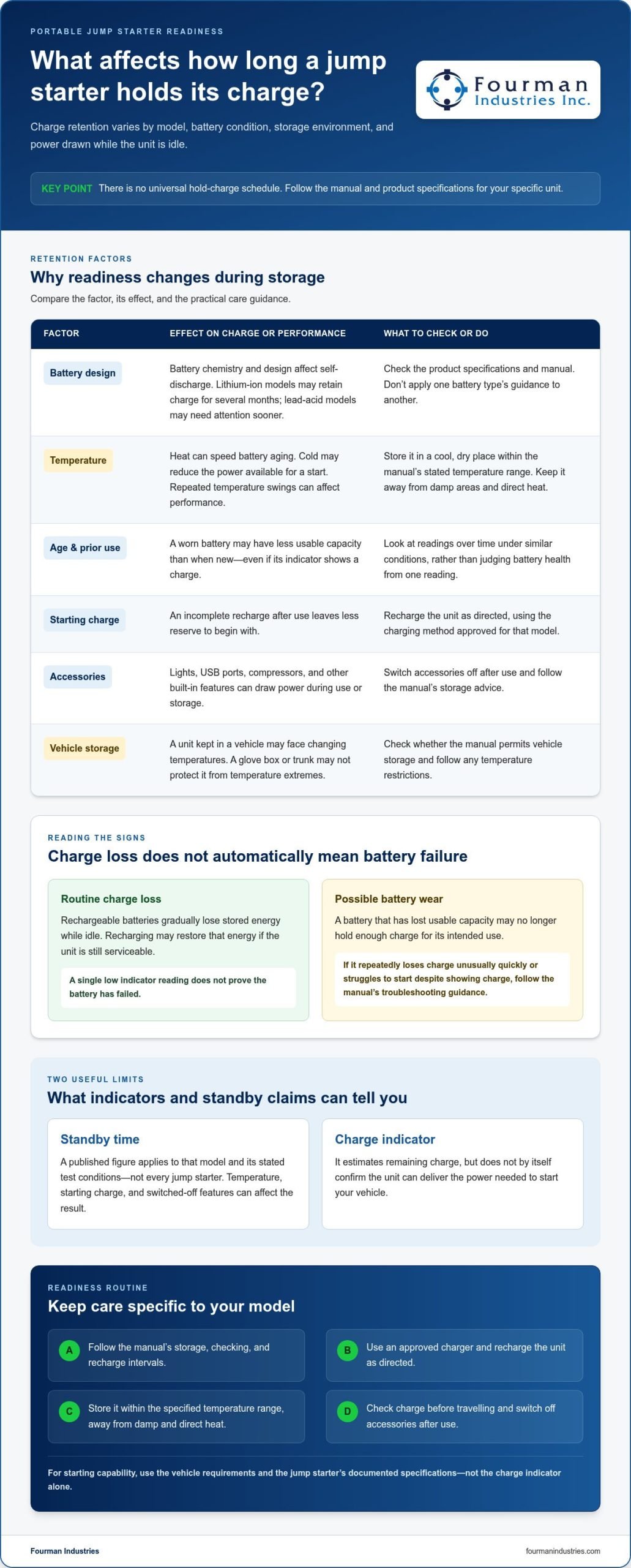
In short, charge retention varies with battery design, age, prior use, storage conditions, and the power drawn by built-in features.
Why one jump starter may hold charge longer than another
Battery chemistry and design affect charge loss, but compare them only when the product specifications identify the battery type. Age and previous use matter, too. A battery with reduced usable capacity may show a charge after recharging but still have less energy available than it did when new. Built-in lights, USB ports, and other accessories can also draw energy. Switch them off after use and follow the manual’s storage advice.
Storage conditions matter as well. Hot or very cold surroundings can affect battery performance, and a unit kept in a vehicle may face changing temperatures. Don’t assume two jump starters will retain charge equally, even if both were fully charged before storage.
What a published standby time can and cannot tell you
A standby figure can help you understand how long a particular model may retain charge under the manufacturer’s stated conditions and testing method. Check the details: temperature, starting charge, and whether features are switched off can affect the result. Treat the figure as model-specific guidance, not a guarantee of how long your own unit will stay ready.
Standby time also isn’t the same as starting capability. A charge indicator may show remaining power, but it doesn’t confirm by itself that the unit can start your vehicle. Required starting capability depends on the vehicle and the jump starter’s documented specifications. Check the charge before travelling, and follow the manufacturer’s instructions to decide when to recharge.
What affects how long a portable jump starter holds its charge?
Storage conditions are only part of the picture. Battery age, previous wear, how fully the unit was charged, and power drawn by built-in features all affect how much energy remains available. These factors explain why two fully charged jump starters may show different readings after sitting unused.
Temperature, battery age and condition, initial charge, accessory use, and battery design all influence charge retention. Follow the storage and charging instructions for your specific model.
How temperature and storage conditions affect charge
Very hot or cold conditions can affect battery performance. Heat can speed battery aging, while cold may reduce the power available for a start. A cool, dry location within the temperature range specified in the manual is a better choice than a spot exposed to repeated temperature swings.
Some units are designed to travel in a vehicle, but that doesn’t mean every model should be stored there all the time. If your manual prohibits certain temperatures or vehicle-storage conditions, follow that guidance. Keep the jump starter away from damp areas and direct heat. A closed glove box or trunk may not protect it from temperature extremes.
Battery age, accessories, and self-discharge
All rechargeable batteries gradually lose stored energy while idle, a process called self-discharge. Battery chemistry and design affect how quickly this happens, so don’t apply one battery type’s guidance to another. Check the product specifications and manual rather than relying on a general rule.
Age and use count, too. A battery with prior wear may have less usable capacity, even if its indicator shows a charge. An incomplete recharge after use leaves less reserve to begin with. Lights, USB ports, compressors, and other features can draw power as well. Turn accessories off when you’re finished and recharge the unit as directed.
The charge indicator is useful, but it tells only part of the story. It estimates remaining charge; it doesn’t necessarily show whether the battery can deliver the burst of power needed to start a vehicle. If a unit repeatedly loses charge unusually quickly or struggles to perform a start despite showing charge, follow the manual’s troubleshooting guidance. One reading alone doesn’t prove the battery has failed.
For roadside preparation, match a jump starter to your vehicle’s requirements and follow its model-specific care instructions. Fourman Industries offers truck and car battery jump starters as a practical addition to your emergency gear.
Does losing charge mean a portable jump starter is worn out?
Not necessarily. A jump starter can lose stored energy while sitting unused, and recharging may restore that energy if the unit is still serviceable. That differs from a battery that has lost usable capacity and can no longer hold enough charge for its intended use. One low indicator reading on its own doesn’t prove the battery has failed.
If you’re wondering how long does a portable jump starter hold a charge, remember that charge loss alone doesn’t tell you everything about battery health. Look for a pattern instead. Compare readings over time under similar conditions, and follow the manual’s instructions for charging and checking the unit.
Signs that call for a closer check
A charge indicator can help you monitor changes, but it may not show how much starting power remains. Note the reading after charging, then check it again later under similar storage conditions. Use the same process each time and follow the manufacturer’s guidance, since indicators and testing procedures vary by model.
Investigate if the unit repeatedly drains faster than expected, shuts down unexpectedly, or won’t maintain a charge after you’ve charged it as directed. These signs don’t confirm a specific fault, but they are a reason to consult the manual or manufacturer support before relying on the jump starter in an emergency.
Stop using the unit if its case is swollen, damaged, or leaking, or if it becomes unusually hot. Don’t try to troubleshoot physical damage by repeatedly charging or using the device. Follow the manufacturer’s safety instructions for next steps.
When recharging may solve the problem, and when it may not
After storage or use, recharging may bring a serviceable jump starter back to its normal charge level. Use only the charging method specified by the manufacturer, then check the indicator as directed. If the unit holds its charge again, the earlier low reading may have reflected ordinary energy loss rather than a sign of failure.
Recharging can’t reverse battery wear or repair physical damage. If the jump starter continues to lose charge quickly, won’t maintain a charge, or behaves differently from the manual’s instructions, follow the model-specific troubleshooting steps or contact the manufacturer for guidance. Don’t judge battery health from one reading or dispose of a unit based on a single unexplained symptom.
How should you store and check a portable jump starter?
A reliable readiness routine can be simple: follow the instructions for your model, check the unit periodically, and record when you last did so. Storage and charging recommendations vary, so don’t assume every jump starter needs the same schedule. To understand how long does a portable jump starter hold a charge, start with its manual rather than a one-size-fits-all rule.
A simple readiness check before an emergency
Use this routine when you add a jump starter to your vehicle or emergency kit, then repeat checks at the interval its manufacturer recommends:
- Read the manual. Note the required charge level, approved charging method, inspection steps, and recommended check or recharge interval.
- Charge as directed. Use the supplied charger or a method approved by the manufacturer. Don’t substitute a charger based only on its appearance or connector fit.
- Inspect the unit. Check the indicator and casing according to the manual. Look over the clamps, cables, ports, and included accessories for dirt or visible damage.
- Record the check date. Write it on a label or add a calendar reminder so the jump starter doesn’t get forgotten in the emergency kit.
Recharge when the manufacturer’s instructions call for it, including after use. A fixed monthly or seasonal schedule may not suit every model. For help choosing equipment that matches your vehicle, read this jump starter buying guide.
Where and how to store the unit
Choose a dry, protected location where the jump starter won’t be crushed, knocked around, or switched on accidentally. Follow the manual’s specified storage temperature, charge level, and recharge intervals. Don’t leave the unit in a vehicle if its instructions prohibit those conditions. After checking it, put the cables and accessories back neatly so they’re ready when needed.
Keep the instructions with the device or save a copy somewhere easy to find. That makes it simpler to confirm the right storage and charging steps later instead of relying on memory. For ideas on how a jump starter fits into a broader roadside kit, see these emergency car kit essentials.
A truck and car battery jump starter can be part of your roadside setup. Follow its manual to maintain it between trips.
Choose a jump starter you can keep ready for the road
A jump starter is useful only if it suits your vehicle and is ready when you need it. Compare the unit’s documented specifications with your vehicle’s requirements, then consider how you’ll charge it, check its status, and maintain it in storage. The answer to “how long does a portable jump starter hold a charge” matters, but charge retention is only one part of choosing roadside equipment.
Match documented specifications to your vehicle
Start with your vehicle’s manual. Check its required voltage and starting requirements, then compare them with the jump starter’s documented output and intended applications. Required starting capability depends on both the vehicle and the product specifications, so don’t assume a unit suited to one car will work for every vehicle.
Peak-current labels alone don’t establish compatibility or real-world suitability. Review the complete specifications and follow the instructions for both the vehicle and jump starter before purchase or use. Consider practical details, too: Does the charging method fit your routine? Is the charge indicator easy to read? Does the manual explain storage, recharging, and readiness checks clearly? These details affect how easily you can maintain the unit, not just select it.
Make charge maintenance part of your roadside routine
Include the jump starter in your regular emergency-kit checks. Inspect its indicator and condition according to the manual, recharge it as directed, including after use, and record the check date so the next inspection doesn’t depend on memory. Pairing these checks with other kit maintenance makes it less likely you’ll discover a depleted unit during a roadside problem.
Keep the manual with your emergency gear or save it on your phone. That way, you can quickly confirm the correct charging and storage steps for your model. A jump starter is one part of being prepared, alongside other equipment suited to your vehicle and travel needs.
Fourman Industries offers truck and car battery jump starters. Explore Fourman Industries’ jump starters and compare the product specifications with your vehicle’s documented requirements before choosing.
Make roadside readiness part of your routine
How long does a portable jump starter hold a charge? There’s no single answer for every unit. Model design, storage conditions, battery age, and accessory use all play a part. A low charge reading after storage doesn’t automatically mean the battery is worn out, but repeated rapid drain or trouble maintaining charge deserves a closer look.
Use the manufacturer’s instructions to charge and store your jump starter, inspect it periodically, and note when you last checked it. Before choosing a unit, compare its documented starting capability with your vehicle’s requirements. A few simple habits can help you feel more prepared when a roadside problem catches you off guard.
Fourman Industries offers truck and car battery jump starters, along with portable 12V tire inflator kits for your roadside gear. Explore Fourman Industries’ truck and car battery jump starters and take a practical step toward a more prepared drive.
Frequently Asked Questions
How long does a portable jump starter hold a charge?
There’s no dependable duration that applies to every jump starter. As a general guide, lithium-ion models may retain charge for several months, while lead-acid models may need recharging sooner. Actual charge retention depends on the model, battery condition, storage environment, and power drawn by built-in features. Check the manual for the manufacturer’s standby guidance and recommended recharge interval. Treat any published standby time as model-specific, not a guarantee.
Do portable jump starters lose charge when not in use?
Yes. Rechargeable batteries gradually lose stored energy through self-discharge, even when the jump starter is switched off and disconnected. Depending on the design, built-in electronics may also use a small amount of power during storage. Accessories such as lights or USB ports can drain the unit if left on. Check the charge indicator according to the manual and recharge using the approved method when instructed.
How often should I recharge a portable jump starter?
Follow the recharge interval in your model’s manual, since battery chemistry and design affect maintenance guidance. As a general routine, check the charge monthly and recharge an unused unit about every three months, unless its manufacturer specifies otherwise. Recharge after each use as directed. Use the supplied charger or a manufacturer-approved method, and note when you last checked the unit so it doesn’t get overlooked in your emergency kit.
Can cold or hot weather drain a jump starter?
Temperature extremes can affect battery performance and the amount of usable power available. Cold can temporarily reduce a unit’s ability to deliver starting power, while heat can speed battery wear over time. Store the jump starter in a dry location within the temperature range specified in its manual. Avoid leaving it in a vehicle if the manufacturer’s instructions prohibit those conditions, and don’t assume an indicator reading tells the whole story about starting capability.
How can I tell if my jump starter is fully charged?
Check the charge indicator and the manual’s instructions for interpreting it. Depending on the model, a full charge may be shown by a display, indicator lights, or another signal. Don’t assume the same light pattern or charging time applies to every unit. Use the supplied or manufacturer-approved charger and follow the manual to confirm when charging is complete. A full indicator reading doesn’t necessarily prove the battery can still deliver adequate starting power.
What should I do if my jump starter loses charge quickly?
Recharge it as directed, switch off accessories, and check the indicator again using the manufacturer’s procedure. If it continues to lose charge unusually quickly, shuts down unexpectedly, or won’t maintain a charge, follow the manual’s troubleshooting steps or contact the manufacturer for model-specific guidance. One low reading alone doesn’t establish battery failure. Stop using the unit if its case is swollen, damaged, leaking, or unusually hot.
Can I leave a portable jump starter in my car?
Only if the jump starter’s manual allows vehicle storage under the conditions it may encounter. A car can experience temperature swings that affect battery performance, so follow the stated storage range and instructions. Keep the unit dry, protected from damage, and secured against accidental activation. If the manual advises against leaving it in a vehicle, store it elsewhere and include a reminder to check its charge before trips.




