
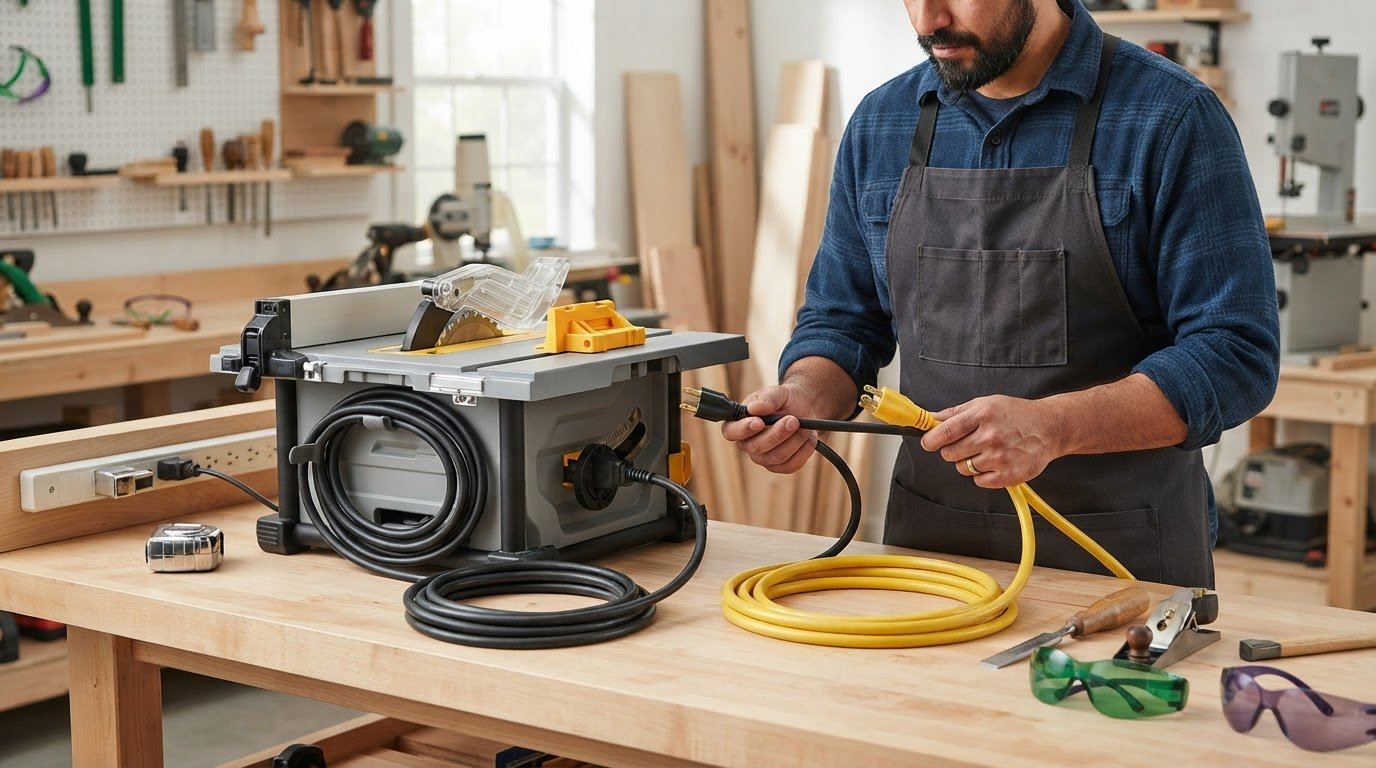
The heaviest-looking extension cord isn’t automatically the right choice for your table saw. A power cord for table saw use must match the saw’s requirements and electrical supply. If you use an extension cord, its ratings, length, and construction must also suit the setup. An unsuitable cord can cause voltage drop and affect motor performance.
It’s easy to confuse the cord attached to the saw with a separate extension cord, but they do different jobs and their ratings aren’t interchangeable. Start with the saw’s manual and the markings on its supplied lead. Then check the circuit and any extension cord label before plugging in.
This guide explains how to identify your saw’s voltage, amperage, plug, and cord requirements, then compare extension-cord gauge, length, and jacket ratings. You’ll learn when to use the supplied lead by itself, what to verify before adding an extension, and when to ask a qualified electrician about an uncertain setup.
Key Takeaways
- Distinguish the saw’s attached power lead from an extension cord, and check that each connects to a suitable supply.
- Choose a power cord for table saw use by checking the exact model’s manual, electrical ratings, required run length, and permitted cord setup.
- Compare printed cord specifications. A lower AWG number means a thicker conductor, but no single gauge suits every saw and setup.
- Compare using the supplied lead with using a permitted extension cord or positioning the saw within reach of the supply.
- Before ordering, check the product specifications and intended use against the saw’s manual. Inspect the cord’s condition and plan its route through the workshop.
Power cord for a table saw: understand the saw’s requirements first
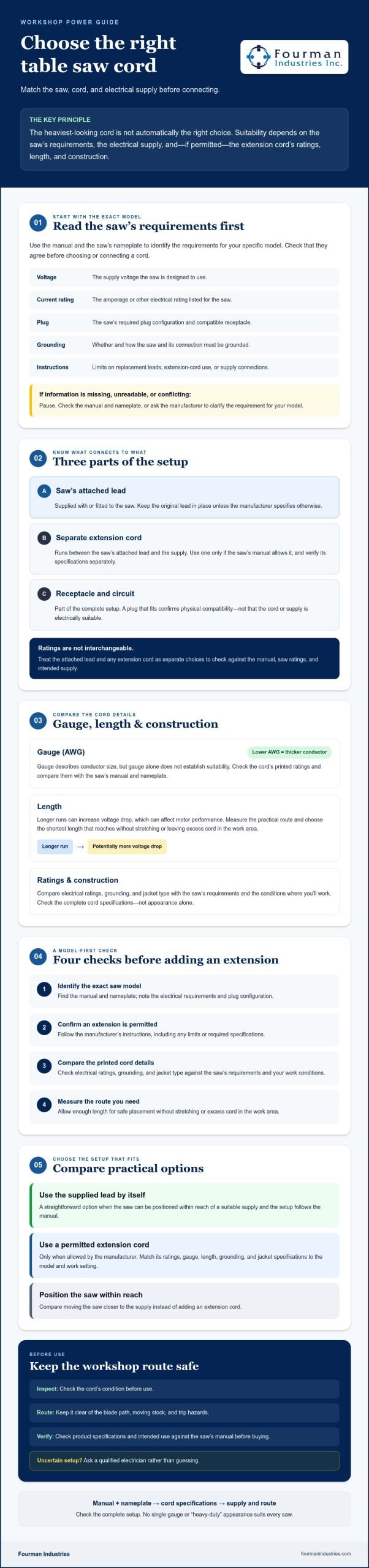
A table-saw power setup includes the saw’s attached lead and its connection to a suitable electrical supply. The attached lead is not the same as an extension cord. The manual and nameplate for your exact model determine which supply and cord arrangements are appropriate.
Before choosing a power cord for table saw use, find the model number and check these details:
- Voltage: The supply voltage the saw is designed to use.
- Current rating: The amperage or other electrical rating listed for the saw.
- Plug: The plug configuration required by the saw and compatible receptacle.
- Grounding: Whether and how the saw and its connection must be grounded.
- Manufacturer instructions: Any limits on replacement leads, extension-cord use, or supply connections.
If a rating is missing, hard to read, or conflicts with another instruction, pause before buying or connecting a cord. Check the manual and nameplate, or ask the manufacturer’s support team to clarify the requirement for your model.
Where to find your table saw’s electrical requirements
Start with the manual, then compare its guidance with the saw’s nameplate, usually attached to the housing. Voltage describes the supply the saw is designed for, amperage indicates its current requirement, and the plug shows the specified connection. These details vary between models. If the manual and nameplate appear to disagree, verify the information with the manufacturer rather than guessing.
Power cord, extension cord, and supply: what is different?
The attached lead is supplied with or fitted to the saw. An extension cord is a separate cord between that lead and the supply. Use one only if the manual allows it. The receptacle and circuit are also part of the setup. A plug that fits confirms physical compatibility, not that the cord or supply is electrically suitable.
When comparing cord labels, look beyond appearance. Portable cords are made from conductors and an outer jacket. Portable cord construction offers background on conductor size and jacket materials. That information can help explain what a cord is made of, but it doesn’t replace the saw manufacturer’s instructions or confirm that a specific cord is suitable for your model.
Keep the original lead in place unless the manufacturer specifies otherwise. Treat any replacement or extension as a separate choice to verify against the manual, the saw’s ratings, and the intended supply. This model-first check gives you a sound basis for comparing cord options.
How to choose a table saw extension cord by rating, gauge, and length
Gauge, length, and load work together. A cord that looks heavy-duty may still be unsuitable if its ratings or construction don’t match the saw, the manual, and the work environment.
- Identify the exact saw model. Find its manual and nameplate, and note the electrical requirements and plug configuration.
- Check whether an extension cord is permitted. Follow the manufacturer’s instructions, including any limits or required specifications.
- Compare the cord’s printed ratings and construction. Check its electrical ratings, grounding, and jacket type against the saw’s requirements and the conditions where you’ll work. Don’t assume a plug fitting proves suitability.
- Confirm the length you need. Measure the practical route from the supply to the saw. Allow enough length for safe placement, without leaving excess cord in the work area.
This process helps narrow down a power cord for table saw use without treating a general gauge chart as a substitute for model-specific guidance.
What cord gauge does a table saw need?
AWG, or American Wire Gauge, describes conductor size. A lower AWG number means a thicker conductor. Gauge alone doesn’t establish suitability, so check the cord’s printed ratings and compare them with the saw’s manual and nameplate. Verify any gauge-to-load recommendation against the manufacturer’s instructions and the cord’s complete specifications.
How cord length and construction affect the choice
Longer runs can increase voltage drop. Choose the shortest practical length that reaches without stretching or crossing an unsafe path. Check the cord jacket’s usage and environmental ratings, along with its grounding, against the work setting and the manufacturer’s guidance. A complete guide to 12 gauge extension cords can offer broader gauge context, but it can’t establish compatibility with a particular saw.
Keep the cord clear of the blade path, moving stock, and trip hazards. OSHA’s Power tool safety tips provide additional guidance on safe cord handling. Fourman Industries lists extension-cord options, including 10 Gauge ECONO and 12 Gauge SJTW Triple Tap cords. Check their printed specifications against your saw’s manual before considering them for your setup.
You can review extension-cord options and check each cord’s specifications and intended use before ordering.
Compare table-saw power setups before buying a cord
Compare the complete setup, not just the plug. An extension cord isn’t automatically appropriate because it fits the saw’s plug. Follow the manual, and don’t use an extension cord if the manufacturer prohibits it.
| Setup | Manual compatibility | Run length | Cord handling | Practicality |
|---|---|---|---|---|
| Supplied power lead | Use according to the saw’s instructions. | Reaches only as far as the attached lead allows. | Inspect the lead for damage and route it clear of the blade and work area. | Usually the simplest setup when a suitable supply is within reach. |
| Extension cord | Use only if the manual permits it and its specifications match the saw’s requirements. | Can extend reach, but its rating and length must suit the setup. | Keep it clear of stock, the blade path, and trip hazards. | Useful only when the manufacturer allows it and a suitable cord and supply are available. |
| No-extension alternative | Keep the saw connected as instructed, without adding an extension cord. | Position the saw where the supplied lead reaches the suitable supply. | Plan the saw’s position so the lead stays clear of the work and walkways. | May require rearranging the workspace, but avoids adding a cord to the setup. |
Start with the saw’s supplied power lead
The supplied lead is your first reference for the saw’s intended connection. Check it for cuts, damaged insulation, loose connections, or other visible problems, and follow the manual for plugging in and setup. Using the supplied lead doesn’t make an unsuitable circuit or receptacle suitable. If you have concerns about the supply or circuit, ask a qualified electrician to assess them.
Add an extension cord only when permitted
If the manual allows an extension, compare its rating, conductor gauge, length, grounding, and intended-use marking with the saw’s requirements and work environment. A matching plug alone isn’t enough. Keep the cord’s printed information visible and legible. Custom printed extension cords may help with identification, but their markings don’t establish compatibility. For general precautions on overload and cord selection, consult these extension cord safety standards.
Fourman Industries offers extension cords to evaluate against the manual. Don’t assume a listed option suits a particular saw without checking its specifications. You can browse extension-cord options and verify the details before choosing a power cord for table saw use.
Use a table saw power cord safely in the workshop
A sound cord and a clear work area are basic parts of a safe setup. Before switching on, check the saw’s instructions, inspect every cord and connection, and make sure the supply matches the saw’s requirements. Follow the saw manufacturer’s instructions and remove damaged cords from service.
Workshop cord checks before switching on
With the saw switched off and disconnected as directed by its manual, inspect the attached lead and any permitted extension cord. Check the jacket, plug, and connectors closely. Don’t use a cord with cuts, exposed conductors, crushed sections, loose parts, or other visible damage. If a connection looks damaged or feels loose, stop and have it assessed by a qualified professional.
- Confirm the cord and supply match the saw’s instructions.
- Keep plugs and connectors clear of sawdust buildup and moisture.
- Route cords away from the blade path, moving stock, hot surfaces, and walkways.
- Check that cords won’t snag as you feed or remove material.
Keep the cutting area open. A cord crossing the work path can snag, become damaged, or create a trip hazard while you’re handling stock—especially when processing large slabs or lumber sourced from custom sawmills like Bourbon Bigfoot Woodworking. Arrange the saw and cord before starting, not while a cut is underway.
Common extension-cord mistakes to avoid
Don’t choose by color, plug fit, or a vague “heavy-duty” description alone. Read the printed specifications and compare them with the manual. Never modify a plug or defeat grounding to make a cord fit. If the manufacturer doesn’t permit extension-cord use, don’t use one.
Don’t improvise a fix for a damaged lead or an uncertain supply. Electrical repairs and questions about the circuit or receptacle belong with a qualified professional. Follow the saw and cord instructions for routing, coiling, and storage. Avoid arrangements that could trap, crush, or damage the cord.
Before buying a power cord for table saw use, verify its printed ratings and intended use against your saw manual. Fourman Industries offers extension-cord options to review, but suitability for a particular saw must be confirmed using the product specifications and manufacturer guidance. Review extension-cord options with those details in hand.
Choose and buy the right power cord for your table saw
Before ordering, use the exact saw model and its manual to decide whether you need a replacement lead or a separate extension cord. They aren’t interchangeable. Confirm that the manufacturer permits the setup you’re considering, then compare the cord’s printed specifications with the saw’s requirements and your workshop conditions.
A table-saw cord buying checklist
Gather the details before you shop. If a rating is unclear or the manual and nameplate don’t appear to match, pause and verify instead of guessing.
- Identify the saw: Record the exact model number and consult its manual and nameplate.
- Check the requirements: Note the manufacturer’s guidance, voltage, current rating, plug configuration, and grounding requirements.
- Confirm extension-cord use: Make sure the manual permits an extension cord and follow any restrictions it gives.
- Compare cord specifications: Check gauge, length, electrical ratings, grounding, construction, and usage markings against the saw instructions and intended environment.
- Check the listing: Confirm the specific product’s specifications and availability before ordering. A matching plug or general “heavy-duty” label doesn’t prove suitability.
- Get help if needed: Contact the saw manufacturer about model requirements. Ask a qualified electrician about uncertain supply or circuit conditions.
This checklist helps you assess a power cord for table saw use against the requirements for your particular machine, rather than relying on a one-size-fits-all recommendation.
When to browse Fourman Industries’ extension cords
Fourman Industries lists custom printed and personalized extension cords, pink and purple extension cords, 10 Gauge ECONO extension cords, and 12 Gauge SJTW Triple Tap extension cords. These are product categories to evaluate, not confirmed matches for every table saw. Check each listing for specifications and intended use, then compare them with your manual before selecting a cord.
Once you’ve confirmed what your saw requires, browse Fourman Industries to review available extension-cord options and product details.
Make your cord choice with confidence
The right power cord for table saw setup starts with your exact saw model, not a one-size-fits-all gauge rule. Check the manual and nameplate, confirm whether an extension cord is allowed, then compare its printed ratings, length, grounding, and intended use with the saw’s requirements.
Keep safety in the decision. Inspect cords before use, route them clear of the blade and work area, and stop if a lead or connection is damaged or the supply requirements are unclear. Verify every product specification before ordering. A cord’s plug fitting the saw doesn’t prove it’s suitable.
Fourman Industries lists custom cords and extension-cord categories in specified gauges. These give you options to assess, not an automatic compatibility match. Check product details against your saw’s manual before selecting a cord.
Ready to compare? Browse Fourman Industries’ extension-cord options, then make your choice with the specifications in hand.
Frequently Asked Questions
What gauge extension cord do I need for a table saw?
Use the gauge specified by the saw manufacturer for your exact model and cord length. There isn’t one gauge that fits every table saw or setup. Check the manual and nameplate, then compare their requirements with the cord’s printed gauge and electrical ratings. AWG numbers run in reverse: a lower number means a thicker conductor. If the guidance is unclear, ask the manufacturer before choosing a power cord for table saw use.
Can you use an extension cord with a table saw?
Yes, but only if the manufacturer permits an extension cord and the cord matches the saw’s requirements. Check its gauge, length, electrical rating, grounding, and intended-use marking against the manual and work environment. A plug that fits doesn’t prove the cord is suitable. If the manual prohibits extension-cord use, don’t use one. If you’re unsure about the supply or circuit, consult a qualified electrician.
How long can an extension cord be for a table saw?
Follow the maximum length, if specified, in your saw’s manual. There’s no single length that applies to all table saws, because suitability depends on the saw’s requirements and the cord’s specifications. Choose the shortest practical run that reaches safely, and check the cord rating for that length. Longer runs can increase voltage drop. Don’t use a longer cord unless the manufacturer’s guidance and cord ratings support your setup.
What happens if a table-saw extension cord is too small?
An undersized cord can contribute to voltage drop, especially over a long run. The saw may not perform as intended, and the cord or motor may heat up. Don’t treat these symptoms as harmless or keep working to see if they pass. Switch off and disconnect the saw as instructed, then check the manual and cord ratings. Replace an unsuitable cord with one that meets the manufacturer’s requirements.
Can I plug a table saw into a regular outlet?
Only if the outlet and circuit meet the saw manufacturer’s requirements. Check the manual and nameplate for the required voltage, current, plug configuration, and grounding, then confirm that the supply is suitable. “Regular outlet” can mean different things, so don’t rely on appearance or plug fit alone. If you can’t confirm that the circuit and receptacle match the saw, ask a qualified electrician before connecting it.
Should a table saw power cord be replaced if it is damaged?
Yes. Stop using a damaged cord and remove it from service. Cuts, exposed conductors, cracked insulation, loose plugs, or damaged connectors can make the setup unsafe. Don’t tape over damage, modify the plug, or defeat grounding. Follow the saw manufacturer’s instructions for replacement, and use only a lead approved for that model. If the damage involves the saw’s wiring or you’re unsure what needs replacing, seek qualified help.




