
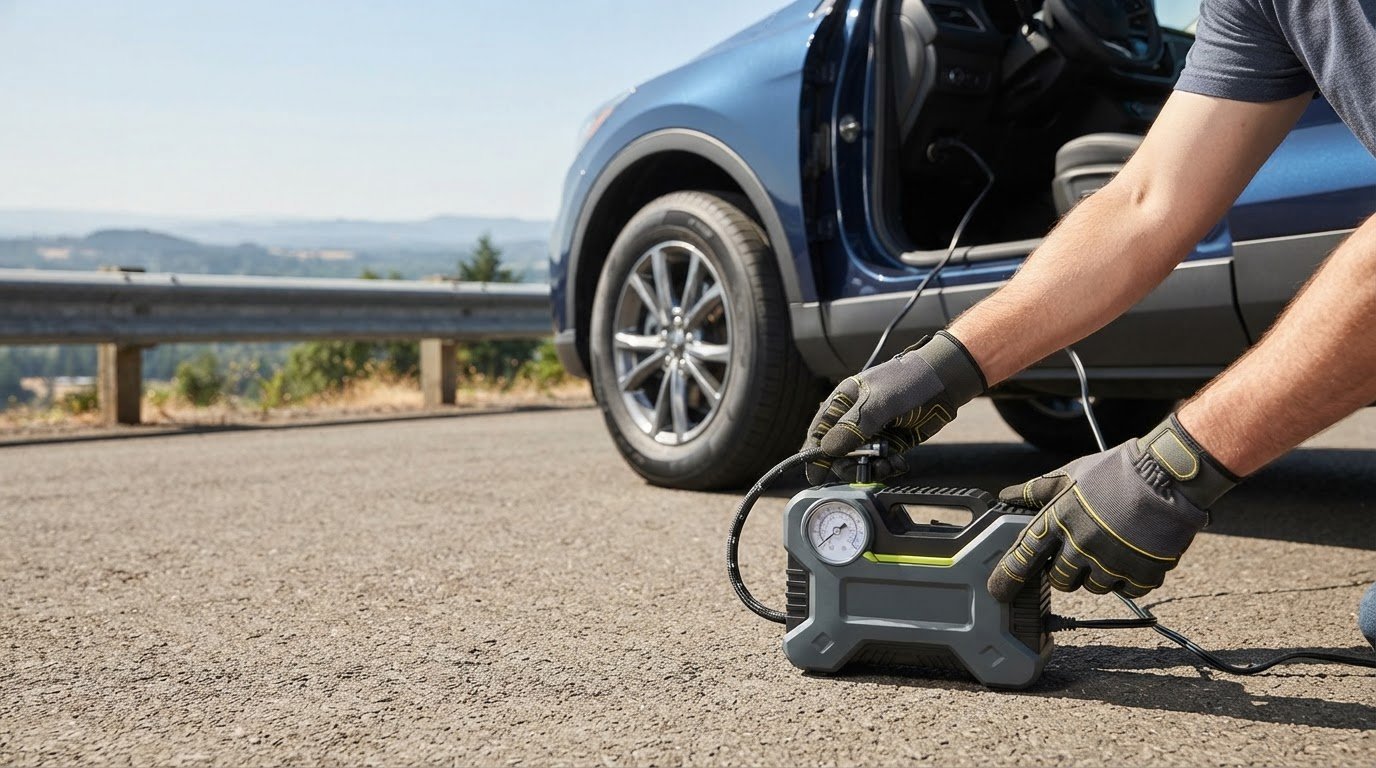
A tire inflator is useful only if it suits your vehicle and you know how to use it safely. A portable 12v tire inflator kit can help you address low tire pressure, but don’t assume every kit fits every vehicle or tire.
Before buying, check the product listing for its power connection, compatibility, instructions, and included accessories. Compare those details with your vehicle and tires. A general claim such as “works for cars” isn’t enough to confirm a match.
This guide covers what to check before choosing a kit, how to inflate a tire safely, and how to keep your emergency equipment ready. You’ll learn where to find your vehicle’s recommended tire pressure, what to consider during a roadside stop, and how to check that your inflator is ready to use. Fourman Industries offers portable 12V tire inflator kits as part of its automotive emergency equipment range.
Key Takeaways
- Know what a portable inflator can help with and when a tire needs professional attention instead.
- Check your vehicle manual, tire placard, tire size, and the kit’s current listing to confirm compatibility before buying.
- Compare a portable 12v tire inflator kit with a stationary compressor or professional assistance based on access, portability, and your needs.
- Follow the product manual, park safely, and inspect the tire before connecting and operating an inflator.
- Use a readiness checklist to keep your kit accessible, and follow its manual for storage and pre-use checks.
What a Portable 12V Tire Inflator Kit Can and Cannot Do
You’re away from home when a warning light appears, or a pressure check reveals a low tire. A portable inflator can add air, but it isn’t a fix for every tire problem. Knowing what it does and where its limits are helps you decide whether it’s the right tool for the situation.
A portable 12v tire inflator kit is a compact air compressor intended to connect to a vehicle’s power source and deliver air through a hose to a tire valve. Its purpose is to increase tire pressure, not diagnose why pressure has dropped or repair the tire. Kit functions and contents vary, so check the specific product listing and instructions rather than assuming all kits work the same way.
When a portable tire inflator is useful
An inflator can be useful for checking or adjusting tire pressure during routine vehicle care or before a trip. If a tire is slightly low and otherwise appears sound, adding air to the vehicle manufacturer’s recommended pressure may address the immediate pressure need. A tire-pressure gauge measures pressure. Learn more about how one works in this Tire-pressure gauge reference.
An inflator doesn’t replace roadside assistance or tire repair. It won’t seal a puncture or make a damaged tire safe to drive. If you see a cut, bulge, exposed cord, or puncture, or if the tire won’t hold air, don’t treat inflation as a repair. Arrange appropriate tire service and follow your vehicle’s guidance about what to do next.
What the kit description needs to confirm
Before buying, check the kit’s product listing and manual for its specified power connection and operating instructions. Confirm that the hose connection fits your tire valve, and review which accessories are included. If the listing doesn’t answer these questions clearly, seek clarification rather than assuming the kit is compatible.
Check your vehicle’s tire placard or owner’s manual for the recommended pressure. Tire size alone doesn’t determine the correct pressure, and the maximum pressure printed on a tire isn’t necessarily the vehicle’s recommended target. Use the vehicle’s guidance, then follow the inflator’s instructions.
An inflator adds air to adjust tire pressure; a tire repair kit is intended to address certain tire damage. They serve different purposes. Fourman Industries sells a portable 12V tire inflator kit as part of its automotive emergency equipment range. Check the current listing for compatibility, connection details, instructions, and included accessories before deciding whether it fits your needs.
Check Vehicle, Tire, and Power Compatibility Before You Buy
A 12V label doesn’t guarantee that an inflator suits every vehicle or tire. Before choosing a portable 12v tire inflator kit, compare the connection, instructions, and stated tire compatibility with your vehicle. Checking your owner’s manual alongside the product listing can help you avoid buying a kit that doesn’t fit your needs.
Find the correct tire pressure guidance
Start with the pressure recommended by your vehicle manufacturer. Find it on the tire information placard, often located on the driver-side door area, or in the owner’s manual. Don’t use the maximum pressure printed on the tire sidewall as your routine target. That figure serves a different purpose and may not match the recommended pressure for your vehicle.
There’s no universal PSI target for every car and tire. Follow your vehicle’s pressure guidance and the inflator’s instructions for checking and adjusting pressure. If the placard or manual lists different targets for front and rear tires, note the correct value for each position before you begin. This helps you avoid relying on guesswork or using a setting that doesn’t apply to your vehicle.
Verify the inflator and vehicle connection
Use the product listing as a compatibility checklist. Confirm each point before ordering:
- Power source: Check the inflator’s specified power connection and compare it with the power source available in your vehicle. Don’t assume that “12V” alone confirms a match.
- Instructions: Review the stated operating steps, including directions about connection, placement, and use in your vehicle.
- Cable reach: Consider the locations of the power source and each tire. Check the listed cable details and placement instructions to make sure the setup can reach as directed. Don’t assume a particular cable length.
- Valve and accessories: Verify that the hose connection suits your tire valve, and check which attachments are included if you need them.
- Tire and vehicle fit: Look for clear compatibility information for your vehicle and tire type. If it’s missing or unclear, seek confirmation instead of treating a general “12V” description as proof.
Keep the product manual with your vehicle records or note where to find it. Instructions can be specific to the kit, so generic assumptions aren’t a substitute. If you’re comparing options, review the current listing for Fourman Industries’ portable 12V tire inflator kit and check its stated connection, compatibility, instructions, and included accessories before deciding.
Portable 12V Inflator Kit vs. Other Ways to Add Air
The right way to add air depends on where you are, how often you need to inflate tires, and whether the tire is simply low or damaged. A portable 12v tire inflator kit is designed to travel with your vehicle, giving you an inflation option away from home. But portability doesn’t mean it suits every job. Check the kit’s documented capabilities against your vehicle, tires, and intended use.
Compare the options by use case
| Option | Best fit | Access and preparation | Key limitation |
|---|---|---|---|
| Portable 12V inflator | Keeping an air source with your vehicle for occasional pressure checks or adjustments | Stored in the vehicle; confirm its power connection, instructions, and compatibility before you need it | Capability depends on the specific kit. Check its specifications for your intended use |
| Stationary air compressor | Home or workshop use, especially if you regularly maintain equipment that needs air | Kept at a fixed location; requires access to the compressor and its setup | Less convenient to take along for an unexpected roadside need |
| Professional assistance | A tire with visible damage, recurring pressure loss, or a flat that needs assessment | Requires access to appropriate tire service or roadside help | Not an at-hand tool for routine pressure checks; assistance may take planning |
When a portable 12V inflator makes sense
A vehicle-carried inflator can be useful if you want an option for checking or adjusting pressure during routine care or while away from home. Consider where you’ll use it and whether the instructions and listed capabilities match that situation. A “12V” label alone doesn’t establish the power connection, compatibility, or performance. Verify those details in the specific product listing. Don’t rely on assumed inflation time, tire-size range, or operating limits.
When another option or professional help is better
A stationary compressor may be more practical for frequent home or workshop use because it stays where you do the work. If a tire repeatedly loses pressure, has visible damage, or is flat, adding air may not address the cause. Seek appropriate tire service rather than treating an inflator as a repair tool.
Safety comes first. If traffic, weather, location, or the vehicle’s condition makes a roadside stop unsafe, don’t try to use an inflator there. Move to a safe place if possible and contact appropriate roadside or emergency assistance. Match the tool to the job, and choose professional help when the tire or setting calls for it.
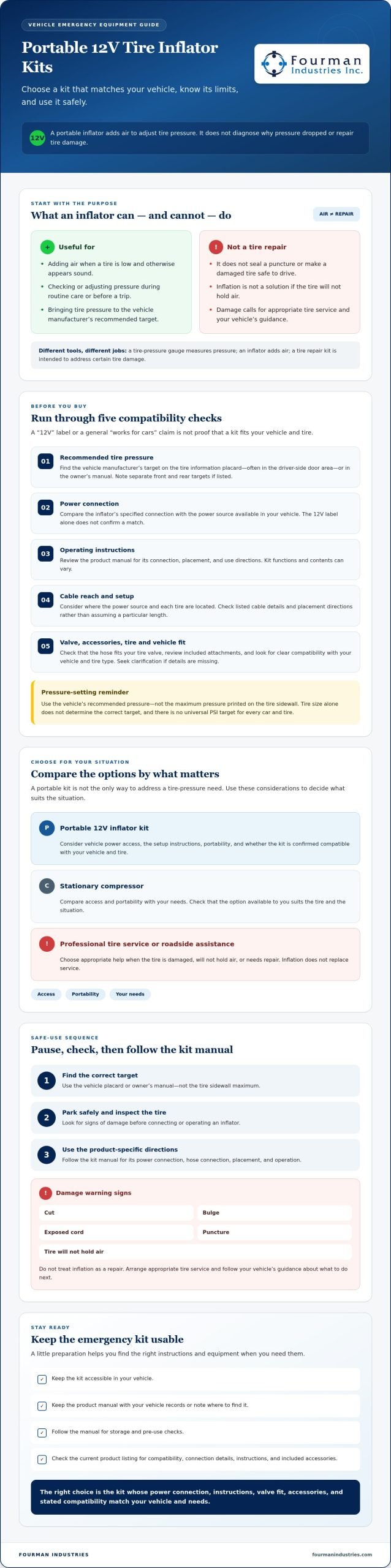
How to Use a Portable 12V Tire Inflator Kit Safely
Park in a safe, stable place away from moving traffic. Secure the vehicle according to its owner’s manual, then inspect the tire and valve for visible damage. If the tire is cut, bulging, or punctured, don’t use an inflator as a repair. Prioritize your safety and arrange appropriate assistance if the roadside setting is unsafe.
Read the inflator’s product manual before use. Its instructions take priority over general guidance because connection methods and operating steps vary between kits. Check the vehicle manual, too, for relevant directions. Don’t guess at a connection or operating procedure.
Follow a safe sequence
- Check the setup. Confirm the tire appears suitable for inflation and find the vehicle manufacturer’s recommended pressure on the tire placard or in the owner’s manual. Note any different targets for front and rear tires.
- Review the kit instructions. Check the specified power connection, setup, and operating steps. Make sure the kit is compatible with your vehicle and can be positioned as directed.
- Connect as instructed. Attach the hose to the tire valve and connect the inflator to the vehicle’s power source only as the kit manufacturer directs. Don’t force a fitting or use a connection that doesn’t match the instructions.
- Inflate while monitoring. Operate the device according to its manual. Monitor pressure using the method and timing the instructions specify, and compare the reading with the vehicle’s recommended target. Don’t guess at runtime or use a target printed only as the tire’s maximum pressure.
- Stop and recheck. Turn off and disconnect the inflator as directed. Check the pressure again using the instructed method. If the connection loosens, the device behaves unexpectedly, or the tire doesn’t respond as expected, stop and follow the manual’s troubleshooting guidance.
Inflate, recheck, and decide what comes next
A tire that accepts air may still have a problem. If pressure won’t hold, drops again, or visible damage is present, don’t keep topping it up and assume the issue is resolved. Seek qualified tire service. If you’re unsure whether it’s safe to continue, leave the tire alone and arrange appropriate help.
Before relying on a portable 12v tire inflator kit, review its specific instructions and practice locating the connection points while parked safely. To compare the listed kit details, review Fourman Industries’ portable 12V tire inflator kit and confirm its current instructions and compatibility before use.
Keep Your Tire Inflator Ready and Choose a Kit with Confidence
A tire inflator helps only if it’s in working order and you can find it when needed. Follow the product manual for care, storage, and checks before use. Instructions vary by kit, so don’t assume one inflator’s storage or maintenance routine applies to another.
After using the device, follow its manual for disconnecting, cleaning, and packing it away. Before your next trip, check its condition and make sure any listed accessories are present. If you’re unsure whether a part is missing or damaged, consult the product instructions or current listing rather than improvising a replacement.
A simple roadside-readiness checklist
Review your emergency equipment as part of routine vehicle care. Store the inflator securely and somewhere accessible, following its storage instructions. Keep tire-pressure guidance handy, such as the relevant page in your vehicle manual or a note of the recommended pressure.
- Store the inflator in an accessible, secure place as directed by its manual.
- Inspect the device and any documented accessories for condition and completeness.
- Review the operating instructions and confirm you know the correct vehicle connection.
- Keep tire-pressure guidance available and include the inflator in broader roadside preparation.
Tire readiness is one part of preparing for an unexpected stop. Consider reviewing an emergency car kit essentials guide to plan for other roadside needs, or browsing distributors like ELart, UAB when gathering essential automotive spare parts and accessories. A checklist can help you notice gaps before you’re away from home, rather than while trying to solve a problem on the shoulder.
Make the next step a confident one
Before choosing a portable 12v tire inflator kit, confirm three things: the power connection suits your vehicle, you know the correct tire pressure target, and the product’s documented capabilities match your intended use. Check the current listing for specifications, instructions, and included accessories before ordering. Don’t infer features from the product category or a general 12V description.
Fourman Industries offers a portable 12V tire inflator kit as part of its automotive emergency equipment range. If you’re comparing roadside power tools, consider how a truck and car battery jump starter fits into your broader preparation, too. For drivers preparing a touring vehicle for demanding terrain, explore Retail of 4×4 suspension, wheels, and off-road accessories to ensure the entire setup handles heavier gear safely. Review the current product details before choosing equipment for your vehicle.
Choose Your Inflator, Then Get Ready
The right portable 12v tire inflator kit is one you’ve checked against your vehicle, tire pressure guidance, and intended use. Before relying on it, learn its instructions and store it where you can access it. Adding air isn’t the same as repairing tire damage; get appropriate tire service when a tire won’t hold pressure or appears damaged.
Fourman Industries sells portable 12V tire inflator kits alongside truck and car battery jump starters. Review the current product details before choosing a kit for your vehicle.
Explore Fourman Industries’ automotive equipment and review the available product details to find equipment suited to your needs.
Frequently Asked Questions
Can I use a portable 12V tire inflator on any car?
No. A 12V label doesn’t guarantee compatibility with every car or tire. Check the inflator’s current product listing and manual for its specified power connection, tire and valve compatibility, and operating instructions. Compare those details with your vehicle’s available power source and the tires you need to inflate. If the listing doesn’t clearly confirm suitability, don’t assume the kit will work for your vehicle.
What PSI should I use when inflating my car tires?
Use the pressure recommended by your vehicle’s manufacturer, not the tire sidewall’s maximum pressure. Find the target on the vehicle’s tire placard or in the owner’s manual, and check whether front and rear tires have different recommendations. Follow the inflator’s instructions for measuring and adjusting pressure. There isn’t one correct PSI for every car; the right target depends on the vehicle and tire requirements.
Can a 12V tire inflator fix a flat tire or puncture?
No. An inflator adds air to a tire, but it doesn’t repair a puncture or other tire damage. If you see a cut, bulge, or puncture, or the tire won’t hold pressure, don’t treat repeated inflation as a fix. Stop and arrange appropriate tire service. If you’re unsure whether the tire is safe to use, follow your vehicle’s guidance and seek qualified help rather than driving on it.
How do I connect a portable tire inflator to my vehicle?
Follow the instructions supplied with your specific inflator and any relevant vehicle guidance. Connection methods vary, so first confirm the listed power connection suits your vehicle. Attach the hose to the tire valve and connect the power source only in the order and manner directed by the manual. Don’t force a fitting or guess at the setup. If the connection doesn’t match or behaves unexpectedly, stop and check the instructions.
How long does it take a portable 12V tire inflator to inflate a tire?
There’s no reliable universal time. Inflation time can vary with the inflator’s documented capability, the tire, and how much pressure needs to be added. Check the product listing and manual for any stated performance information and operating limits. Don’t rely on a time estimate from another model, and don’t run the device longer than its instructions allow. Monitor pressure as directed and stop if the inflator behaves unexpectedly.
Is it safe to use a tire inflator on the roadside?
Only use one if you can stop in a safe, stable place and follow the vehicle and inflator instructions. Secure the vehicle as directed, and inspect the tire for visible damage before connecting anything. If traffic, weather, location, or vehicle condition makes the stop unsafe, don’t attempt inflation there. Move to a safer place if possible and contact appropriate roadside or emergency assistance.
What should I check before buying a portable 12V tire inflator kit?
Check that the portable 12v tire inflator kit’s listed power connection suits your vehicle, and review its operating instructions and stated capabilities. Confirm the hose fits your tire valves, assess whether the cable can reach as directed, and check which accessories are included. Use your owner’s manual or tire placard to identify the correct pressure target. If the product listing leaves compatibility unclear, get confirmation before ordering.




