
That bargain-bin cord powering your expensive equipment isn’t just a budget choice; it’s a potential fuse for a job site fire. When you invest in a ul certified extension cord, you’re paying for a guarantee that the product has survived rigorous engineering tests designed to prevent catastrophic failure. You need gear that stands up to the daily grind without putting your crew or your reputation at risk. High-quality power is the backbone of any professional project, and cutting corners on safety is never worth the savings.
It’s natural to feel frustrated when you’re staring at a sea of confusing labels like UL, ETL, and SJTW. You want to keep your site compliant with 2026 OSHA standards like 1926.405(a)(2), but identifying a counterfeit safety mark isn’t always easy. This guide will clarify exactly what those certifications mean for your job site safety and your bottom line. We’ll show you how to verify authentic safety marks and explain why ETL listed products are equivalent to UL under current regulations. You’ll also learn how to choose the right 10 or 12 gauge cord to prevent dangerous voltage drops and keep your equipment running cool until the job is done.
Key Takeaways
- Learn how UL labs use destructive testing to ensure your cords won’t melt or ignite when pushed to their maximum rated capacity.
- Understand the legal equivalence between UL and ETL markings to ensure your gear stays fully compliant with 2026 OSHA and NEC standards.
- Identify the security features of an authentic ul certified extension cord so you can confidently spot and reject dangerous counterfeit products.
- See how high-visibility colors and custom printing can boost job site safety and prevent theft without damaging the insulation’s integrity.
- Determine the right wire gauge and jacket ratings to protect your expensive equipment from voltage drops and harsh weather conditions.
What Does ‘UL Certified’ Actually Mean for Extension Cords?
UL stands for Underwriters Laboratories. They are a global safety science leader that has been around for over a century. When you see that mark on a ul certified extension cord, it means the product passed a battery of tests to meet strict safety requirements. Manufacturers actually pay for this voluntary process. They do it to prove their gear is high quality and won’t catch fire under a normal load. Essentially, UL certification is a third-party validation of electrical safety and fire resistance. It tells you that an independent expert has verified the manufacturer’s claims about durability and load capacity.
The Role of Underwriters Laboratories (UL)
The UL (safety organization) has been setting the bar for electrical standards since the 1890s. They don’t just guess what’s safe; they write the rules that keep your job site from becoming a hazard. UL works closely with the National Electrical Code (NEC) to ensure that everything from your wall outlet to your power tools plays by the same rules. This collaboration ensures that the standards evolve as electrical technology changes. You should also know the difference between ‘UL Listed’ and ‘UL Recognized.’ A ‘UL Listed’ cord is a complete, finished product ready for use on your site. ‘UL Recognized’ usually applies to internal components, like a specific switch or wire inside a larger machine. For your extension cords, you always want to see the ‘UL Listed’ mark on the cord set itself.
Why Safety Standards Matter on the Job Site
Safety isn’t just about avoiding shocks; it’s about staying compliant and keeping your business running smoothly. OSHA requires certified equipment in professional environments. If an inspector walks onto your site and sees uncertified power strips or flimsy cords, you’re looking at heavy fines and potential work stoppages. Using a ul certified extension cord also slashes your liability. If an accident occurs, having certified gear proves you took reasonable steps to protect your crew and follow the law. This is why we focus on heavy duty custom extension cords that meet these rigorous specs. When your gear is built to a standard, you aren’t just buying a cord; you’re buying peace of mind. It ensures your equipment gets the clean power it needs without overheating the jacket or melting the plug. High-quality cords prevent the voltage drops that kill motors and cause expensive downtime.
The Rigorous Testing Behind UL Safety Standards
UL doesn’t just inspect a cord; they attempt to destroy it in a laboratory setting. This process is what separates a professional-grade ul certified extension cord from a dangerous fire hazard. Testing ensures that the cord won’t ignite even when pushed to its maximum rated load. Engineers evaluate every component, from the insulation thickness to the flexibility of the copper strands inside. They also perform continuous factory audits. This means the 100th cord off the assembly line is just as safe as the first prototype tested in the lab. Cords that skip these steps often end up on the CPSC’s substantial product hazard list because they lack basic safety features like proper strain relief or polarized plugs.
The 4 Critical UL Safety Tests
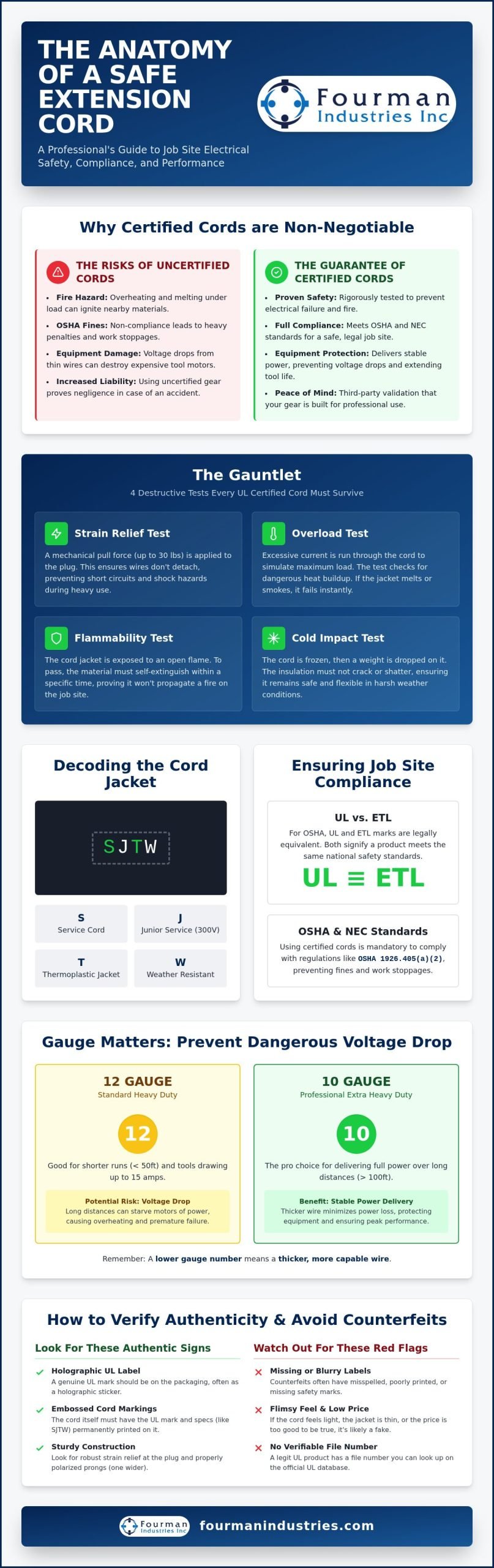
To earn a UL mark, a cord must survive several brutal scenarios. The Strain Relief Test applies a mechanical pull force of up to 30 lbs to the plug and cord connection. This ensures the wires don’t pull out and create a short circuit during heavy use. Overload Testing involves running high current through the wire to check for excessive heat buildup. If the jacket melts or smokes, it fails immediately. The Flammability Test verifies that the jacket material will self-extinguish if it’s exposed to an open flame. Finally, the Cold Impact Test involves dropping weights on a frozen cord. If the insulation cracks in freezing temperatures, it’s not fit for a professional job site.
Understanding SJTW and Jacket Ratings
You’ll see letters like SJTW printed on the jacket of a high-quality cord. These aren’t random; they tell you exactly what the cord can handle. ‘S’ stands for Service, ‘J’ for Junior (rated to 300 volts), ‘T’ for Thermoplastic, and ‘W’ for Weather and sunlight resistance. This combination is the industry gold standard for outdoor and industrial use. Our 12 Gauge SJTW Triple Tap Extension Cords are specifically designed to manage heat dissipation across multiple outlets. This prevents the cord from overheating when you’re running several power tools at once. If you need a reliable power solution that has actually been through the ringer, check out our selection of heavy-duty extension cords built for the pro.
UL Listed vs. ETL Listed: Understanding the Difference
If you’re shopping for a heavy-duty power solution, you’ll likely see both the UL circle and the ETL shield. Don’t let the different logos confuse you. Both marks prove that the product has passed the exact same safety tests. The main difference is simply which lab performed the evaluation. While UL is the most famous name in the industry, ETL is just as rigorous. Both are recognized as Nationally Recognized Testing Laboratories (NRTLs) by the federal government. This means an ETL-listed cord is legally equivalent to a ul certified extension cord in the eyes of safety inspectors and insurance adjusters.
OSHA is very clear about these requirements. According to the OSHA requirements for extension cords, any cord used in a professional workplace must be approved by a recognized NRTL. It doesn’t favor one lab over the other. Manufacturers often choose ETL because their certification process can be faster, helping them get high-quality products to market without cutting corners on safety. Whether you choose UL or ETL, you’re getting a cord that meets the highest engineering standards.
| Feature | UL Listed | ETL Listed |
|---|---|---|
| Testing Body | Underwriters Laboratories | Intertek |
| Safety Standards | ANSI/UL 817 & UL 62 | ANSI/UL 817 & UL 62 |
| OSHA Accepted | Yes | Yes |
| Legal Status | NRTL Recognized | NRTL Recognized |
The Danger of Uncertified ‘Generic’ Cords
Stay away from generic cords that only feature a ‘CE’ mark. In the United States, CE is not a substitute for a third-party NRTL certification. The CE mark is a self-declaration used primarily in Europe; it doesn’t involve the same independent lab testing required for a ul certified extension cord. Uncertified cords are a massive gamble for any contractor. They often use thin copper or copper-clad aluminum that can’t handle the rated amperage, leading to rapid overheating and fire. Brittle jackets are another common issue, as they crack and expose live wires after just a few weeks on a rough job site. If a fire starts because of uncertified equipment, your insurance provider has a valid reason to deny the claim entirely. Stick to certified gear to protect your crew and your business.
How to Verify a UL Mark and Avoid Counterfeit Cords
Online marketplaces have made it easier than ever to accidentally buy dangerous equipment. Counterfeit UL labels are a growing threat to job site safety. These fakes often hide sub-par engineering, like using 16-gauge wire in a jacket labeled as 12-gauge. This mismatch causes the cord to overheat almost immediately under a professional load. Verifying your ul certified extension cord is the only way to ensure your tools get the power they need without risking a fire. Don’t trust a low price over a verified safety mark.
When you receive a new cord, perform a quick physical inspection before putting it to work:
- Check the weight: Real copper is heavy. If the cord feels suspiciously light, the wire inside is likely undersized or made of inferior materials.
- Inspect the jacket printing: High-quality cords have the gauge, voltage rating, and temperature limits clearly embossed or printed along the length of the jacket.
- Examine the plug: Authentic plugs are molded securely to the cord. They shouldn’t feel hollow or flimsy when you grip them.
Spotting an Authentic UL Label
A genuine UL mark isn’t just a printed logo on a box. Look for the holographic ‘UL’ sticker directly on the cord’s jacket or near the plug. This sticker contains specific security features that are difficult for counterfeiters to replicate. You should also find an ‘Issue’ or ‘List’ number printed on the tag. Ensure the ‘UL’ logo is perfectly centered inside a circle with a small ‘R’ for registered trademark. If the logo looks blurry, stretched, or lacks that circle, you’re likely looking at a fake.
Using the UL Online Certifications Directory
If you’re still unsure, go straight to the source. The UL Product iQ database is a free online tool that lets you verify any certification. You can search the database by the manufacturer’s name or the file number found on the cord’s tag. This database confirms that the company is currently authorized to use the UL mark. Professional brands like Fourman Industries are completely transparent about their specs because our gear passes the test every time. Verifying that the manufacturer name on the cord matches the UL file is the ultimate way to avoid a “no-name” hazard. Don’t gamble with your crew’s safety on unverified gear. Buy a ul certified extension cord directly from a trusted partner who prioritizes industrial-grade reliability.
Choosing Safe, Custom Power Solutions for Your Job Site
Safety and organization go hand-in-hand on a busy work site. It’s not just about having the right gear; it’s about making sure your crew can identify and use that gear safely under pressure. A chaotic pile of tangled, generic cords is a recipe for disaster. Using a ul certified extension cord provides the electrical protection you need, but custom organization provides the physical protection your team deserves. These custom extension cords allow you to identify cord ratings like 10G or 12G at a glance. This simple visual cue prevents someone from accidentally plugging a high-draw tool into a cord that isn’t rated for the load. Branding your gear also maintains the integrity of your site’s safety plan while keeping your assets from walking off the job.
The Safety Benefits of High-Visibility Colors
Trip hazards are a leading cause of job site injuries. Standard yellow or orange cords often blend into sawdust, mud, or concrete. Using pink extension cords or purple options creates a high-contrast visual barrier that is hard to miss. This is especially helpful in low-light areas or during early morning shifts when visibility is low. You can also use these colors to mark specific circuits or designate power for different trades. If the framing crew uses purple and the finishing crew uses pink, you reduce clutter and ensure that no one is overloading a shared circuit. It makes your site more efficient and much easier to manage during a safety inspection. For a deeper dive into managing power and preventing voltage drop on a busy site, our professional guide to job site extension cord safety covers how to match gauge ratings to specific tool amperages. If you want to take asset protection even further, learning how to design and order personalized extension cords with your company name or color-coded markings is a proven strategy for reducing equipment theft and job site confusion.
Why Fourman Industries Prioritizes Certified Power
We don’t believe in shortcuts. Our commitment to 12 Gauge SJTW and 10 Gauge ECONO standards ensures that your equipment stays powered without the risk of overheating or voltage drops. Every ul certified extension cord we sell is built to handle the daily abuse of a professional environment. We know that customization is a tool for professional organization. Our custom printing process is designed to be permanent yet safe. We use specialized techniques that bond the text to the thermoplastic jacket without eating into the protective insulation layer. This means you get the branding and theft prevention you want without losing the safety certification you need. Your equipment is an investment; don’t let it be ruined by a sub-par power connection. Shop our UL-compliant custom printed extension cords today.
Secure Your Job Site with Certified Power
Protecting your crew and your equipment starts with knowing exactly what’s powering your tools. You now understand that UL and ETL marks are equivalent shields against fire hazards and that verifying a ul certified extension cord through official directories is the only way to beat counterfeiters. By combining these rigorous safety standards with high-visibility colors and clear gauge markings, you eliminate guesswork on a busy site. Safety isn’t just a box to check; it’s the foundation for a successful and profitable business.
Fourman Industries has been a reliable partner for professionals since 1997. We specialize in industry-standard 12 Gauge SJTW construction that stands up to the toughest environments. Our personalized printing process ensures your company name won’t peel or fade; it keeps your gear in your hands where it belongs. Don’t settle for generic cords that put your reputation at risk. Build your safe, UL-compliant custom cord at Fourman Industries and get the peace of mind that comes with professional-grade gear. Let’s get to work and keep your project running safely.
Frequently Asked Questions
Is a UL listed extension cord required by OSHA?
Yes, OSHA requires all extension cords used in professional settings to be certified by a Nationally Recognized Testing Laboratory (NRTL). This mandate covers agencies like UL or ETL. Using uncertified equipment on a job site can result in significant fines and immediate work stoppages. It’s a non-negotiable standard for maintaining a safe and legal workplace for your entire crew.
What is the difference between UL Listed and UL Recognized?
A UL Listed mark applies to a complete, finished product like a ul certified extension cord. UL Recognized is used for individual components that go inside a larger piece of machinery. You should always look for the “Listed” mark on your power cords to ensure the entire assembly is safe for standalone use. Using recognized components in a way they weren’t intended is a common safety violation.
Can a custom-printed extension cord still be UL certified?
Yes, custom printing does not void the certification if the process maintains the cord’s physical integrity. We use specialized techniques to bond text to the jacket without damaging the insulation layer. This allows you to add branding or organization cues while keeping the cord fully compliant with all safety standards. It’s the best way to prevent theft without compromising the engineering of the product.
How do I know if my extension cord is UL certified if the tag is gone?
Check the jacket of the cord for embossed or printed information. Most manufacturers also mold the UL logo directly into the plastic of the male or female plug. If you can’t find a mark on the plug or the jacket, the cord should be retired from professional use. OSHA inspectors generally require visible proof of certification during site audits to ensure the equipment is safe for the job.
Are ETL listed cords as safe as UL listed cords?
ETL listed cords are just as safe as those with a UL mark. Both laboratories are recognized by OSHA as NRTLs and test products against the exact same ANSI and UL safety standards. The only difference is the specific lab that performed the testing. An ETL shield on your cord provides the same level of legal and physical protection as a UL circle.
Why are UL certified cords more expensive than others?
Certified cords cost more because they use higher-quality materials like 100 percent pure copper rather than cheaper aluminum blends. Manufacturers also pay for rigorous lab testing and regular, unannounced factory audits to maintain the mark. These costs ensure that every ul certified extension cord you buy will actually perform at its rated capacity. It’s an investment in durability that pays off by preventing equipment failure.
What happens if I use an uncertified cord for heavy-duty tools?
Using uncertified cords with heavy-duty tools often leads to dangerous voltage drops and excessive heat buildup. This can permanently damage the motors in your expensive saws or drills, leading to costly repairs. Worse, the thin copper inside uncertified cords can melt the insulation, causing short circuits or electrical fires. Stick to certified gear to protect your equipment investment and your crew’s safety.
Does UL certification expire on an extension cord?
UL certification itself does not have an expiration date, but the physical condition of the cord definitely does. A cord that was certified years ago is no longer safe if the jacket is cracked or the ground prong is missing. Frequent inspections are necessary for compliance. If the cord shows signs of internal heat damage or external wear, it’s time to replace it regardless of the original certification mark.




