
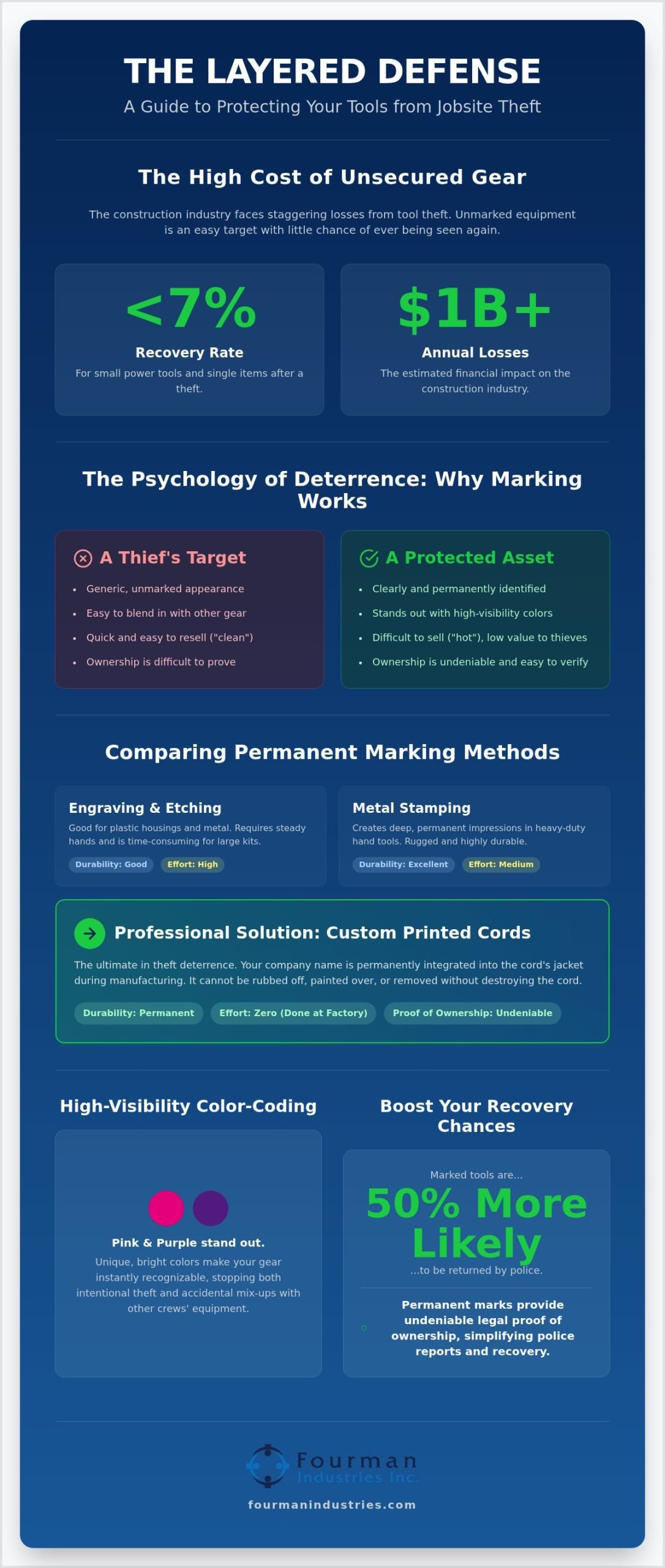
Did you know that for small power tools and single items, the recovery rate after a theft is less than 7%? It is a staggering statistic that represents up to $1 billion in annual losses for the construction industry. You have worked hard to build your kit. There is nothing worse than arriving at a shared jobsite only to find your expensive gear has “walked off” or been mixed up with another crew’s equipment. Understanding how custom printed cords prevent theft is the first step in protecting your livelihood from these common jobsite headaches.
We believe that theft prevention is a layered defense. This guide will show you how to create a foolproof identification system that ensures your gear stays in your hands. We will explore the most effective ways to mark your tools, from forensic DNA kits to high-visibility color-coding with pink or purple cords. You will learn how to make your equipment too hot to handle and significantly easier to recover if it ever leaves your sight. Let’s get your gear secured so you can focus on the work that actually pays the bills.
Key Takeaways
- Master the “layered defense” strategy to make your equipment undesirable to thieves and significantly easier for police to recover.
- Compare the durability of engraving, stamping, and etching to choose the right permanent marking method for every tool in your kit.
- Learn exactly where to place identifiers on your gear so they are nearly impossible for a thief to grind down or hide.
- Understand how custom printed cords prevent theft through permanent, factory-integrated lettering that outlasts standard surface markings.
- Implement high-visibility color-coding with pink or purple gear to stop “borrowing” and ensure your equipment is easy to spot from across the site.
Why Tool Identification is Your Best Defense Against Theft
Tool marking is the process of applying permanent, unique identifiers to your equipment to prove you own it. It is your first line of defense. When you mark your gear, you aren’t just putting a name on a box. You are stripping away the tool’s resale value. Thieves want “clean” items they can flip quickly for cash. A tool with your company name etched into the casing or a cord with your brand name integrated into the jacket is “hot.” It is undesirable. It is a liability for the person trying to sell it. Understanding how custom printed cords prevent theft is the foundation of a secure jobsite.
Standardizing this across your entire crew prevents the “accidental” theft that happens on busy sites. We have all seen it. A contractor from another company picks up a drill or an extension cord, thinking it’s theirs. Clear identification stops that confusion immediately. If a site is cleared by police after a theft, marked tools are 50% more likely to be returned to their rightful owners. You shouldn’t rely on luck to get your equipment back. You need a system that makes ownership undeniable. It is about protecting your investment and your time.
The Psychology of Theft Deterrence
Thieves are looking for the path of least resistance. They target tools that look generic and easy to hide. When a thief sees a kit full of unique branding and high-visibility gear, they see a professional who tracks their assets. It sends a signal that you are diligent. Using unique colors like pink or purple creates an immediate visual barrier. These colors are statistically less likely to be stolen because they stand out too much. Most thieves won’t touch a cord they can’t hide in a pile of standard yellow or orange cables. Professional Anti-theft systems often rely on this type of visual deterrence. High-visibility gear makes your property impossible to ignore. It forces a thief to think twice before grabbing your gear.
Legal Proof of Ownership
Serial numbers are important, but they are often difficult for police to track on the fly. A clear company name or a unique identifier simplifies the entire reporting process. In 2026, the standard for asset management involves integrating these physical marks with a digital registry. If you have to reclaim stolen property, having your name permanently manufactured into the cord jacket provides undeniable proof. Unlike a surface mark that can be rubbed off or painted over, professional-grade identification is part of the cord itself. This is a primary reason how custom printed cords prevent theft; they create a permanent record that cannot be easily altered.
This permanent manufacturing process ensures the branding stays legible through years of wear and tear. It makes your police report airtight and your recovery much faster. When you can point to a specific, unalterable mark on your gear, the legal process moves at a much higher speed. It turns a “he said, she said” situation into a factual recovery. You don’t want to spend your afternoon arguing over who owns a 12-gauge cord. You want to get back to work.
Comparing the Best Marking Tools for Permanent Identification
Picking the right marking tool depends entirely on what you are trying to protect. You can’t use a metal stamp on a power cord, and you shouldn’t use a marker on a steel wrench. A permanent mark is only permanent if it’s bonded to the material correctly. Surface-level solutions like spray paint or tape are amateur. They fail in the mud, rain, and heat of a real jobsite. To truly understand how custom printed cords prevent theft, you have to look at how the identification is applied. Factory-integrated marks are a different breed than a DIY scrawl.
Engraving Tools and Laser Marking
Handheld electric engravers are the workhorse of many shops. They are affordable and let you mark everything from plastic drill housings to aluminum ladders. However, they require a steady hand and significant time. If you have fifty tools to mark, your hand will feel it. Laser marking is the cleaner, more professional alternative. Laser marking is a high-precision, non-contact thermal process that creates a permanent color change on the material surface. It looks factory-fresh and is nearly impossible to remove without destroying the tool itself. This is the gold standard for high-end power tools and electronics.
Metal Stamps and Dot Peen
For heavy-duty hand tools like wrenches or hammers, hardened steel stamps are the standard. This “cold-working” process physically displaces the metal to leave a deep, permanent impression. It is rugged. It is honest. If you want something more automated, dot peen technology is the way to go. These systems use pneumatic hammers to create a series of dots that form durable, tamper-proof ID codes. It is the preferred method for industrial equipment because the mark remains legible even after years of hard use and abrasion. It won’t rub off, and it won’t fade.
Matching the Method to the Gear
You have to match your marking strategy to the tool’s material. Metal stamps work great for steel but will shatter plastic or slice through rubber. This is why DIY cord marking is so difficult. You can’t engrave a rubber jacket without compromising the insulation. You can’t stamp it without causing damage. This is where professional solutions take over. Understanding how custom printed cords prevent theft means recognizing that the branding is part of the manufacturing process. It isn’t a surface application; it’s built-in. If you are tired of losing gear, it might be time to upgrade your system. You can browse professional-grade tools and custom cords to see how factory-integrated marking beats DIY every time.
Your 2026 professional marking kit should include these essentials for in-house identification:
- Tungsten Carbide Scriber: For quick, manual marks on metal and glass.
- Hardened Steel Letter/Number Stamp Set: For permanent branding of hand tools.
- Electric Handheld Engraver: For plastic housings and power tool bodies.
- High-Contrast Industrial Paint Pens: For secondary, high-visibility marks.
- Digital Asset Registry: A cloud-based app to log every marked serial number.
Marking Your Tools: Step-by-Step Guide for Every Material
Consistency is your best friend when managing a large inventory. If your crew knows exactly where to look for a company mark, they can identify a tool from across the room. This speed is vital on shared jobsites where confusion leads to loss. Before you pick up an engraver or a stamp, you need a plan. Marking a tool in a random spot makes it look like an afterthought. Marking it strategically makes it a permanent part of your asset management system. Every tool in your fleet should be marked in the exact same location to ensure your identification process is foolproof.
Preparing Metal and Plastic Surfaces
Preparation is the difference between a mark that lasts and one that rubs off in a week. For metal tools, always start by cleaning the surface with a heavy-duty degreaser. This ensures your stamps or engravers don’t slip during application. If you are using paint pens on plastic housings, sand the area slightly with fine-grit sandpaper. This scuffs the surface and creates a “tooth” for the ink to grab onto. Use masking tape to layout your design before you make any permanent cuts. It allows you to visualize the final result and prevents expensive mistakes on high-end gear like a new reciprocating saw.
Strategic Placement for Maximum Deterrence
Thieves are lazy. They want tools they can “clean” quickly with a grinder. To beat them, you have to mark the “inner” surfaces that are harder to reach. Think about the inside of a battery port or the recessed area of a tool handle. These spots are difficult to sand down without damaging the tool’s functionality. However, you must avoid marking near heat vents, moving parts, or structural components. Compromising the tool’s casing can lead to safety failures or voided warranties. Never mark over the manufacturer’s serial number. You need that number for your own records and police reports.
We recommend a “Double-Mark” strategy for your most valuable assets. Place one highly visible mark to act as an immediate deterrent. Then, hide a second, smaller mark in a location only you know about. If a thief grinds off the visible ID, the hidden one still proves ownership during a police recovery. This multi-layered approach is exactly how custom printed cords prevent theft on a larger scale. While you can manually mark a drill, trying to mark a hundred feet of rubber cord is a nightmare. Factory-integrated branding puts your name every 12 inches along the entire length of the cable. It is a permanent, manufacturing-level solution that no grinder can remove. By combining strategic manual marks on your power tools with custom-branded cords, you create a security web that is nearly impossible to bypass.
- Standardize: Pick one spot for every drill, saw, and impact driver.
- Clean: Never mark over grease, dirt, or factory oils.
- Protect: Stay away from vents and serial number plates.
- Verify: Log the location of your “hidden” marks in a secure digital file.
High-Visibility Deterrents and Asset Management Strategies
Visibility is your fastest way to spot a problem before it leaves the jobsite. While engraving and stamping provide proof of ownership, high-visibility deterrents prevent the theft from happening in the first place. If you can identify your gear from fifty yards away, so can everyone else. This immediate recognition creates a psychological barrier for thieves. It also eliminates the “I thought this was mine” excuse from other contractors. Managing your assets in 2026 requires more than just a nameplate. It requires a visual system that signals your crew is organized and vigilant.
Accountability starts with your own team. Internal tool “migration” is a common issue where gear moves between trucks and never returns. By integrating a marking policy into your daily routine, you set a standard for how equipment is handled. When every member of the crew knows that missing items will be noticed during a Friday audit, they take better care of the inventory. This is another way how custom printed cords prevent theft; they make the equipment so distinct that it cannot be easily hidden in a personal vehicle or a different toolbox.
Color Coding for Crew Accountability
Using unique color palettes is one of the most effective ways to secure a shared site. We recommend using industrial-grade epoxy paints for markings on your power tools. These paints resist solvents and heavy wear much better than standard spray paint. You can assign a specific color-map to different crews or sub-contractors. If the plumbing crew uses blue and the electrical crew uses red, a red drill in a blue bin is an immediate red flag. Unique colors like pink and purple act as psychological “keep off” signs. Statistically, these colors are far less likely to be stolen because they are too difficult for a thief to resell or hide. You can secure your site today by switching to high-visibility pink and purple extension cords that stand out in any environment.
Digital Inventory Tracking in 2026
Modern asset management relies on linking physical marks to a digital database. Using QR codes or rugged asset tags allows you to scan tools in and out of the shop. These tags should be linked to a central cloud database where you store photos, purchase dates, and serial numbers. For small crews, simple spreadsheet-based apps are often enough. Larger industrial operations may require specialized software that tracks tool maintenance schedules alongside location data. Conduct a weekly “gear audit” every Friday afternoon. It only takes fifteen minutes to verify your high-value items, but it can save you thousands in replacement costs by catching missing gear before the trail goes cold.
- Assign Colors: Use distinct palettes for different crews to prevent accidental swaps.
- Audit Weekly: Catch missing inventory early before it leaves the local area.
- Go Digital: Link your physical marks to a cloud-based registry for 2026 standards.
- Be Bold: Use high-visibility colors that are “too hot to handle” for thieves.
Professional Solutions: Custom Printed Equipment for Crews
Manual marking is a reliable first step, but it is often a bottleneck for growing businesses. If you’re managing a large crew, you need a solution that doesn’t rely on someone remembering to grab the engraver before a project starts. Custom-printed extension cords are the ultimate theft deterrent for 2026 crews because they eliminate the “forgot to mark it” problem entirely. Your gear arrives on-site already secured and ready for work. This level of preparation shows clients and competitors that you run a tight ship. It’s a fundamental part of how custom printed cords prevent theft; they turn every foot of your power system into a permanent branded asset that is impossible to ignore.
The Power of Manufacturer-Integrated Branding
There is a massive difference between surface marking and integrated branding. Most DIY methods sit on top of the material. They can be sanded, scraped, or dissolved with the right chemicals. Manufacturer-integrated branding is different. At Fourman Industries, we print your company name directly onto the cord jacket during the manufacturing process. This isn’t a surface application. It is a permanent part of the cord’s construction. You cannot remove the branding without physically destroying the cord jacket itself. This makes your gear a liability for thieves and a point of pride for your crew. Showing up with custom-branded 12 Gauge SJTW Triple Tap cords instantly boosts your professional image while keeping your equipment where it belongs.
Unique Colors: The Pink and Purple Deterrent
Beyond the name, the color of your gear is a powerful deterrent. While many contractors settle for standard yellow or orange, choosing unique palettes like pink or purple creates an immediate visual lock on your inventory. Thieves avoid these colors because they are too recognizable. You can’t hide a bright pink cord in a pile of generic cables. This high visibility also serves as a critical safety feature in low-light construction zones. It reduces trip hazards and makes it impossible for another crew to “accidentally” pack your gear at the end of the day. Using these colors is a key strategy in how custom printed cords prevent theft by making your property too distinct to steal.
Investing in professional solutions means you spend less time worrying about replacement costs and more time focusing on the job. By combining permanent, manufacturer-integrated branding with high-visibility colors, you create a security system that works 24/7. It’s about more than just stopping a thief; it’s about building a brand that commands respect on every jobsite. When your gear is clearly yours, it stays yours. If you appreciate this level of performance and customization in your professional tools, you can learn more about Project Faster Inc. to see how those same standards are applied to high-performance motorcycle components.
- Integrated Branding: The identification is part of the cord, not an afterthought.
- High Visibility: Bold colors like pink and purple stop theft before it starts.
- Professional Image: Branded gear builds trust with clients and project managers.
- Zero Maintenance: No need to re-mark tools after heavy use or cleaning.
Secure Your Jobsite and Protect Your Investment
Protecting your equipment is about more than just a name tag. It’s about creating a system that makes your tools a liability for thieves and a point of pride for your crew. You’ve learned that permanent marking reduces resale value while strategic placement ensures your identifiers are nearly impossible to remove. By combining manual engraving on your power tools with high-visibility deterrents, you build a layered defense that works around the clock. Understanding how custom printed cords prevent theft is the final piece of that puzzle. It moves your security from a surface-level DIY project to a factory-integrated professional standard.
Don’t wait for a theft to happen before you take action. Our heavy-duty 10 and 12 gauge options provide the ruggedness you need for industrial work. Because our custom printing is a permanent manufacturing process, it lasts the life of the cord. Plus, our unique colors like pink and purple prevent jobsite confusion and make your gear too hot to handle. Secure your gear with Fourman Industries custom power solutions today. You’ve put in the hard work to build your kit. Now, take the final step to ensure it stays in your hands for years to come.
Frequently Asked Questions
How do I mark my tools so they don’t get stolen?
Use a combination of visible deterrents and permanent identifiers to lower the tool’s resale value. Start by choosing unique colors like pink or purple for your gear to make it stand out from generic equipment. Follow up by engraving or stamping your company name into the casing. Thieves want items they can sell quickly without being tracked. When your gear is clearly marked, it’s a liability they would rather avoid.
What is the best way to mark power tools permanently?
Laser marking or mechanical engraving are the most permanent options for power tools. These methods physically alter the tool’s surface, making the identification nearly impossible to remove without leaving behind obvious signs of tampering. Unlike stickers or paint, these marks won’t fade or peel off after a few weeks on a busy site. Always place these marks in a location that is difficult for a thief to grind down without damaging the tool.
Does engraving a power tool void the manufacturer’s warranty?
Engraving usually doesn’t void your warranty as long as you stay away from critical structural areas and motor ventilation ports. Most manufacturers understand that professional crews need to identify their equipment. Avoid engraving over the serial number plate or deep into the housing. Stick to marking the battery base or the plastic parts of the handle to maintain the tool’s integrity while keeping your warranty intact.
Should I use my name or my driver’s license number for tool identification?
Use your business name or a unique company ID for the best results. While some people used driver’s license numbers in the past, a clear business name is much easier for police and other contractors to recognize. It also builds your brand professionality while you’re on the clock. Ensure this name matches your digital inventory records and insurance paperwork to make any potential recovery process as smooth as possible.
Can thieves easily remove engraved or stamped markings?
Thieves can attempt to grind off marks, but doing so leaves a permanent scar that alerts buyers the item is likely stolen. This damage significantly drops the street value. This is exactly how custom printed cords prevent theft on a larger scale. Because the branding is manufactured into the cord jacket, a thief would have to cut out sections of the cable to remove it, rendering the cord useless and obviously tampered with.
What is the best way to mark tools with plastic housings vs metal ones?
Use a handheld electric engraver for plastic housings and hardened steel stamps for metal surfaces. Plastic requires a light touch to prevent cracking the casing, while metal needs the force of a hammer and stamp to create a lasting impression. Regardless of the material, always clean the surface first with a degreaser. This ensures your marking tool doesn’t slip and your identification remains clean and legible for years of heavy use.
Are custom-printed extension cords really more effective than spray paint?
Custom printing is far superior to spray paint because it is a permanent manufacturing process. Spray paint is a surface application that eventually chips, peels, or gets dissolved by jobsite chemicals. Factory-integrated branding is built into the cord’s jacket from the start. It won’t rub off even after being dragged across concrete or through mud. This professional approach ensures your identification stays clear for the entire life of the cord.
How do I track my marked tools if they are actually stolen?
Log every marked tool in a central digital database with photos and serial numbers. If your gear goes missing, you can immediately provide police with specific proof of ownership. Many 2026 asset management apps allow you to mark items as stolen in a shared registry. This makes it harder for pawn shops to accept the gear and increases the chances of a successful recovery if the police clear a suspect jobsite or warehouse.




