
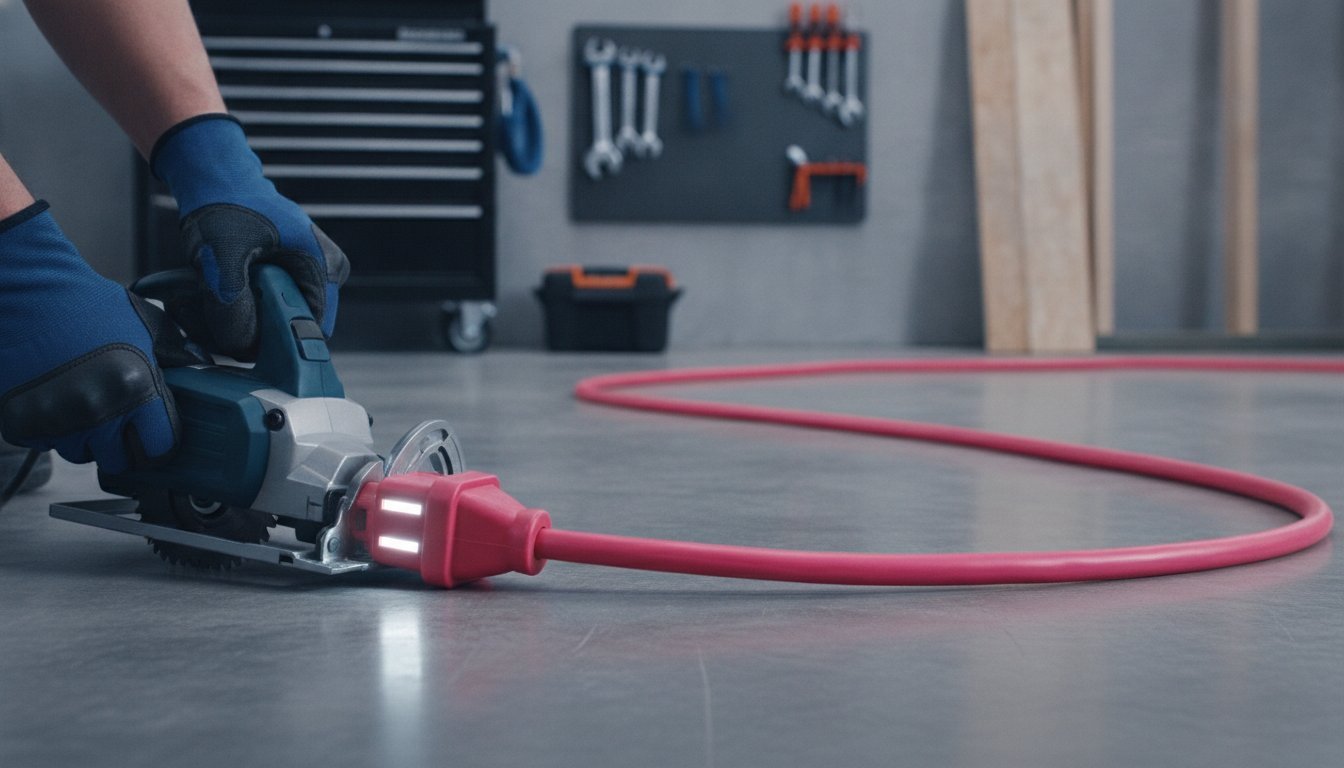
Did you know that reaching for a standard thin extension cord could be the fastest way to kill your $500 table saw? When you’re running power across a jobsite, distance is the enemy of your equipment. A 12 gauge extension cord 100 ft long is often considered the sweet spot for professional work, but using it incorrectly can still lead to heat buildup and permanent motor damage.
You probably already know the frustration of a circular saw that bogs down mid-cut or a drill that runs hot just because it’s too far from the outlet. We understand that your tools are your livelihood, and protecting them from voltage drop is a top priority. In this guide, you’ll learn why the 12 gauge 100 ft cord is the industrial standard for reliability and how to use it to keep your high-amperage tools running at peak performance. We’ll cover everything from OSHA compliance and hard usage ratings to simple tricks for preventing jobsite theft and keeping your gear organized.
Key Takeaways
- Learn why a 12 gauge extension cord 100 ft is the industry standard for high-amperage power tools and how the 12/3 rating protects your equipment.
- Understand the science of voltage drop and how to prevent “choking” your expensive motors when working at a distance.
- Discover when to upgrade to a 10 gauge cord for heavy-duty items like generators and high-surge compressors.
- Master the “over-under” coiling technique to extend the life of your cords and prevent permanent internal wire damage.
- Stop jobsite theft and equipment confusion by using personalized, custom-printed cords that identify your gear instantly.
Understanding the 12 Gauge Extension Cord 100 Ft Standard
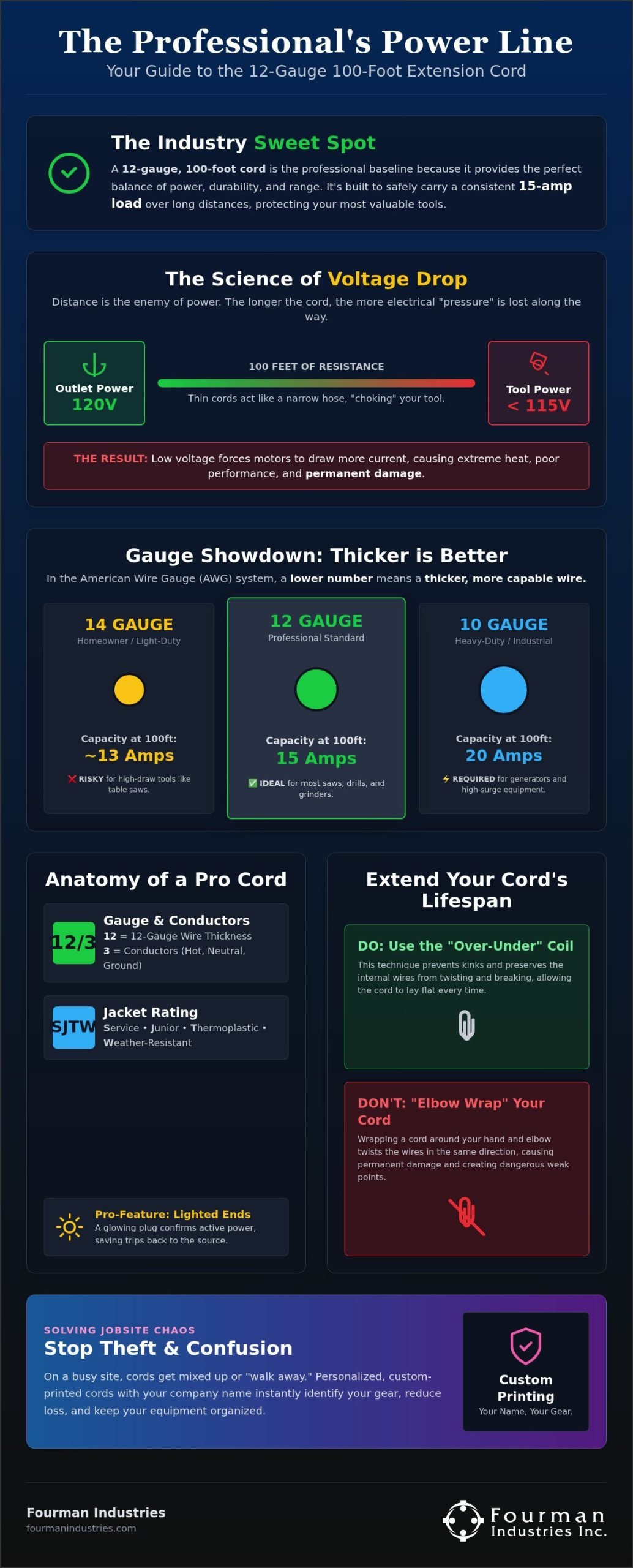
Choosing the right gear for your jobsite starts with understanding the specs. When you see a cord labeled as “12/3,” it tells you exactly what’s under the jacket. The “12” refers to the thickness of the copper wire, while the “3” indicates three separate conductors: the hot, neutral, and ground wires. A 12 gauge extension cord 100 ft is the professional baseline because it provides enough copper to carry a consistent 15-amp load over a long distance without breaking a sweat.
Distance is the biggest enemy of electrical efficiency. At 100 feet, electrical resistance becomes a major factor. Electricity behaves much like water flowing through a pipe; the longer the pipe, the more friction slows down the flow. In electrical terms, this friction causes heat and a drop in voltage. If you use a thin cord at this length, your tools won’t get the “pressure” they need to operate. This forces the motor to work harder, which leads to overheating and a shorter lifespan for your expensive equipment.
What Does 12 Gauge Actually Mean?
Wire thickness is measured by the AWG system. AWG stands for American Wire Gauge, and it is the standard for wire diameter in the US. This system is counterintuitive because the numbers work backward; lower numbers represent thicker wire. A 12-gauge cord is significantly beefier than a standard 14-gauge homeowner cord. That extra copper volume is vital. It creates a wider path for electricity to flow, which reduces resistance and keeps the cord cool during heavy use. For high-draw tools like table saws or large grinders, that extra metal is the difference between a smooth cut and a blown motor.
The Anatomy of a Heavy-Duty 100 Ft Cord
A pro-grade cord needs more than just thick wire; it needs a jacket that can survive the elements. Most industrial cords use an SJTW rating. This acronym stands for Service, Junior, Thermoplastic, and Weather-resistant. It’s a jacket designed to handle the “hard usage” requirements found in Extension Cord Standards across the industry. These cords are built to resist moisture and remain flexible even when the temperature drops. For a complete breakdown of what every letter in this rating means and how it affects your jobsite safety, our SJTW extension cord professional reference guide covers every technical specification you need to know.
Safety features are just as important as the wire itself. A grounded 3-prong plug is mandatory for protecting both the user and the tool from electrical faults. Many professionals also prefer cords with lighted indicator ends. These small lights glow when the cord has active power. It’s a simple troubleshooting tool that saves you from walking all the way back to the generator or outlet just to see if a breaker has tripped. When you’re 100 feet away from your power source, those saved steps add up quickly.
The Science of Voltage Drop Over 100 Feet
Electricity doesn’t travel for free. As power moves through a wire, it encounters resistance, which is essentially electrical friction. The longer the wire, the more resistance the electricity faces. By the time the current travels through a 12 gauge extension cord 100 ft, it has lost some of its “push.” This loss of electrical pressure between the power outlet and your tool is known as voltage drop. It is a critical factor that every professional needs to understand to keep their equipment running safely.
Think of voltage like water pressure in a garden hose. If you have a very long, thin hose, the water barely trickles out the end because of the friction against the walls of the pipe. Electricity works the same way. If you don’t have enough copper to handle the distance, the voltage at the tool end will be significantly lower than the 120 volts coming out of the wall. This leads to a simple, unbreakable rule for any jobsite: the longer the run, the thicker the copper needed to maintain power.
How Voltage Drop Affects Your Power Tools
Your tools are designed to operate within a specific voltage range. When they receive low voltage, they try to compensate by drawing more current to stay at the required power level. This extra current creates massive amounts of heat. High-draw tools like circular saws, table saws, and air compressors are the most vulnerable. They need a massive burst of energy to start up, and if the voltage is too low, they will struggle to reach full speed.
You can often spot voltage drop before the tool fails. Watch for dimming lights on the tool’s casing or a “labored” sound when you pull the trigger. If your saw feels like it’s bogging down during a standard cut, you’re likely starving it of power. Over time, this heat destroys the internal insulation of the motor. Replacing a professional-grade saw because you used a cheap, thin cord is an expensive mistake that’s easily avoided with the right gear. For a reliable connection that stands up to these demands, consider our 12 Gauge SJTW Triple Tap Extension Cords.
Calculating Amperage Capacity at 100 Feet
A 12 gauge extension cord 100 ft is generally rated to handle a 15-amp load safely. This makes it the standard choice for most professional portable tools. However, you should never guess when it comes to power. Always check the “Amp” rating on the data plate of your tool before you plug it in. If your tool requires 15 amps or more, using a 14 or 16 gauge cord at this length is a fire hazard and a guaranteed way to damage your equipment.
If you’re unsure about the requirements for your specific distance and tool, consult a Voltage Drop Chart to see how different gauges perform. While a 12-gauge cord is the “sweet spot” for most tasks, very high-draw equipment might require an even thicker 10-gauge cord to eliminate drop entirely over a 100-foot run. Stick to the right gauge to ensure your tools stay cool and your warranty stays intact.
12 Gauge vs. 10 Gauge: Choosing the Right Heavy-Duty Cord
Choosing between 12 and 10 gauge depends entirely on your load and your location. A 12 gauge extension cord 100 ft is the standard professional choice because it handles most tools without being a burden to carry. However, when you step up to a 10 gauge cord, you’re getting a massive increase in copper volume. This “extreme duty” wire is designed for the highest amperage draws, but it comes at a cost of weight and flexibility. A 100-foot 10-gauge cord is significantly heavier and stiffer than its 12-gauge counterpart. You’ll feel the difference when you’re hauling it up a ladder or across a muddy site.
For general construction, 12-gauge wire is the baseline. It is thick enough to prevent significant voltage drop for most 15-amp tools while remaining manageable. If you move to 10-gauge when you don’t need it, you’re just adding extra weight to your truck and extra strain to your back. Stick to the gauge that matches your tool’s data plate. If the tool pulls 15 amps or less, the 12-gauge option is usually your best bet for a 100-foot run.
When 12 Gauge is the Perfect ‘Sweet Spot’
For daily construction tasks, the 12-gauge cord is the sweet spot. It provides the perfect balance of power delivery and portability. It is the ideal match for tools like professional drills, angle grinders, and smaller jobsite table saws. When you rely on a 12 gauge extension cord 100 ft for your daily workflow, you’re choosing the best mix of performance and ease of use. Because 12-gauge wire is more flexible, it’s easier to route through a jobsite or wrap up at the end of the day. Using a Triple Tap end on these cords is a smart move; it allows you to run a few smaller tools simultaneously without the clutter of extra lines.
When You Should Upgrade to 10 Gauge
There are times when 12 gauge isn’t enough. If you’re powering large space heaters, industrial shop vacuums, or connecting to a generator, you need the maximum capacity of 10-gauge wire. These high-draw items create massive surges that can strain thinner wires. Our 10 Gauge ECONO extension cords are the safer choice for these constant, high-amperage loads. We call them the “Econo” choice because they offer extreme-duty protection at a price point that makes sense for high-surge equipment. Use this checklist for extreme duty needs:
- Running a portable generator for backup power.
- Using tools that pull more than 15 Amps.
- Operating high-surge equipment in extreme cold or heat.
- Powering multiple high-draw tools at the end of a long run.
How to Safely Maintain and Store Your 100 Ft Cord
Managing 100 feet of heavy-duty copper is a workout. If you treat your gear like a garden hose and just toss it in the truck, you’re asking for trouble. A 12 gauge extension cord 100 ft long is an investment in your productivity. To keep it working for years, you need to protect the internal copper strands from unnecessary stress. Proper storage isn’t just about being tidy; it’s about electrical safety and preventing the “memory” that causes permanent tangles.
Environmental factors play a huge role in cord health. Even with a weather-resistant SJTW jacket, moisture can seep into the plug ends if they sit in puddles. Always keep your connections elevated off the ground. Cold weather is another challenge. In freezing temperatures, thermoplastic jackets become stiff and brittle. If you force a frozen cord to bend, you risk cracking the outer shell. Conversely, extreme heat is equally taxing on both gear and workers; while you protect your equipment, staying comfortable with a personal cooling fan like FrostWave can help you maintain peak performance during summer shifts. Try to keep your cords in a climate-controlled area when they aren’t in use to maintain that vital flexibility.
The Over-Under Coiling Technique
Most people use the “elbow-wrap” method, but this is the fastest way to kill a cord. Wrapping a cord around your arm introduces a twist into the wire every single time you make a loop. Over time, those twists build up and damage the copper conductors inside. The over-under method is the professional standard because it neutralizes those twists.
- Step 1: Hold the male end of the cord in your non-dominant hand. With your other hand, create a standard loop and place it in your palm.
- Step 2: For the next loop, reach under the cord, flip your wrist, and pull it toward you. This creates a “reversed” loop that sits against the first one.
- Step 3: Alternate between a standard overhand loop and a reversed underhand loop until the entire length is coiled.
When you use this method, the cord will lay perfectly flat the next time you pull it out. No tangles, no knots, and no internal strain on the wires.
Repair vs. Replace: Safety First
Knowing when to retire a cord is just as important as knowing how to coil it. Perform a quick inspection every time you wrap up for the day. Look for nicks in the jacket, exposed copper, or prongs that feel loose or look burnt. If the plug feels hot to the touch after use, that’s a major red flag for internal damage or a poor connection.
Never use electrical tape as a permanent fix for a cut jacket. Tape doesn’t provide the same moisture protection or abrasion resistance as the original material. While we take pride in helping you understand your gear, Fourman Industries focuses on providing brand-new, reliable hardware rather than repair services. If your cord is showing signs of failure, don’t risk a fire or a shocked employee. It is always safer and cheaper to replace a damaged cord than to pay for a burnt-out tool motor or a jobsite accident.
Ready to upgrade your jobsite setup? Browse our selection of 12 Gauge SJTW Triple Tap Extension Cords to find a reliable power solution built for the long haul.
Solving Jobsite Chaos with Custom Printed Extension Cords
A busy jobsite is a breeding ground for equipment confusion. When multiple crews are working in the same space, every yellow or orange cord looks identical. This leads to the number one headache for contractors: theft and accidental “cord swapping.” You spend good money on a 12 gauge extension cord 100 ft long to protect your tools, only to have it disappear into someone else’s van by the end of the shift. Solving this problem requires more than just a permanent marker that rubs off after a week of dragging through the mud.
Personalized gear management is the most effective way to secure your investment. By moving away from generic commodities and choosing specialized equipment, you eliminate the “it looked like mine” excuse. It’s about pride in your workmanship and your tools. When your gear is clearly marked and easy to spot, your crew spends less time hunting for power and more time getting the job done. This level of organization doesn’t just save money; it projects a level of professionalism that clients notice the moment they walk onto the site. To maintain this standard across your entire facility, you can learn more about StripeGuys Warhouse Line Striping for professional floor marking and industrial safety guidance.
Preventing Theft with Personalized Imprinting
The most powerful deterrent against jobsite theft is permanent identification. Custom imprinting allows you to have your company name or phone number printed directly onto the cord jacket every 12 inches. This makes the cord nearly impossible to steal because it can’t be resold or claimed by another contractor without the theft being obvious. It’s a permanent solution that outlasts any tape or marker. For a deeper look at how this process works, check out our Ultimate Guide to Custom Printed Extension Cords. Beyond security, these branded cords act as a rolling billboard for your business, showing every passerby that you run a high-quality, organized operation.
High-Visibility Colors for Safety and Organization
Safety is another area where standard cords fall short. In low-light conditions or cluttered environments, a standard cord can easily become a trip hazard. High-visibility colors like pink and purple serve a dual purpose. First, they stand out against sawdust, dirt, and concrete, making them much easier to see and avoid. Second, they allow for an instant color-coding system. You can assign pink cords to the framing crew and purple to the electricians, or use specific colors to identify which cords are plugged into high-draw circuits.
At Fourman Industries, we specialize in providing these unique solutions. We offer 12 Gauge SJTW Triple Tap Extension Cords in these distinct colors to help you manage your jobsite chaos. Whether you’re looking for pink extension cords to support a cause or purple extension cords to match your company branding, having a unique color makes your gear unmistakable. It’s a simple, practical way to keep your 12 gauge extension cord 100 ft safe, visible, and exactly where you left it.
Secure Your Power and Your Gear
Your tools are the backbone of your business, and they deserve better than a thin, generic power line. Using a high-quality 12 gauge extension cord 100 ft ensures your motors receive the consistent voltage they need to stay cool and run at peak performance. By mastering the over-under coiling technique and understanding the science of resistance, you have already taken the most important steps toward protecting your equipment from premature failure. These simple habits save you money and keep your workflow moving without interruption.
Now it is time to stop the jobsite chaos and secure your gear for the long haul. We have been a trusted partner for professionals since 1997, providing rugged solutions that thrive in all-weather conditions. With our industry-leading custom printing and durable SJTW jackets, your cords will be as recognizable as they are reliable. Don’t settle for equipment that walks away or chokes your power when you’re 100 feet from the outlet.
Build your custom 12 gauge 100 ft cord today at Fourman Industries.
Take charge of your jobsite security and keep your projects moving forward with confidence and reliable power.
Frequently Asked Questions
Can I plug a space heater into a 100 ft 12 gauge extension cord?
Yes, you can safely plug a standard 1,500-watt space heater into a 12 gauge extension cord 100 ft long. Most residential space heaters draw about 12.5 Amps, which falls within the 15-Amp safety limit for this gauge at this distance. Always make sure the cord is fully uncoiled to prevent heat from being trapped inside the loops.
What is the difference between a 12 gauge and a 14 gauge extension cord?
The primary difference is the thickness of the copper wire and its ability to carry current. A 12-gauge cord is thicker than a 14-gauge cord, meaning it has lower electrical resistance. This allows it to power heavier tools over longer distances without significant voltage drop. For any professional jobsite task, the 12-gauge option is the safer baseline for performance.
Is it safe to daisy-chain two 50 ft cords to reach 100 feet?
No, you should avoid daisy-chaining cords because it creates multiple points of resistance. Every connection between plugs causes a slight drop in voltage and creates a potential spot for overheating or a short circuit. It is always better to use a single, continuous 12 gauge extension cord 100 ft to ensure your tools receive steady, reliable power.
What does the ‘SJTW’ label on my extension cord mean?
The SJTW label is a standard industry code that describes the cord’s build quality. S stands for Service, J for Junior (rated for 300 volts), T for Thermoplastic, and W for Weather-resistant. This rating tells you the cord is designed for hard usage in outdoor environments and can withstand moisture and sunlight without the jacket breaking down. To fully understand how each component of this rating affects your cord’s performance and OSHA compliance, see our detailed guide to SJTW extension cord specifications and safety requirements.
How many amps can a 100 ft 12 gauge extension cord handle safely?
A 100-foot 12-gauge cord is rated to handle up to 15 Amps safely. While 12-gauge wire can handle more current at shorter lengths, the 100-foot distance introduces resistance that limits its capacity. If your equipment requires 16 to 20 Amps, you must step up to a 10-gauge cord to avoid damaging your motors or creating a fire hazard.
Will a 100 ft extension cord reduce the power of my electric lawn mower?
It will only reduce power if the wire gauge is too thin for the mower’s motor. An electric mower needs consistent voltage to keep the blades spinning at full speed. A 12-gauge cord is usually sufficient for most residential mowers at 100 feet, but using a thinner 14 or 16-gauge cord will cause the motor to bog down and run hot.
How do I know if my extension cord is UL certified?
Look for the UL mark stamped directly into the plug or printed on the cord’s outer jacket. Underwriters Laboratories tests these products to ensure they meet strict safety requirements for heat resistance and conductivity. A certified cord will also have the gauge size and temperature rating clearly visible along the length of the wire.
Why is my extension cord getting hot during use?
Your cord is getting hot because the electrical load is too high for the wire thickness or the length of the run. This often happens when a high-draw tool is “starved” for power, forcing the electricity to fight through the resistance of the copper. If the heat is concentrated at the plug, it usually indicates a loose connection or a bent prong that needs to be replaced.




