
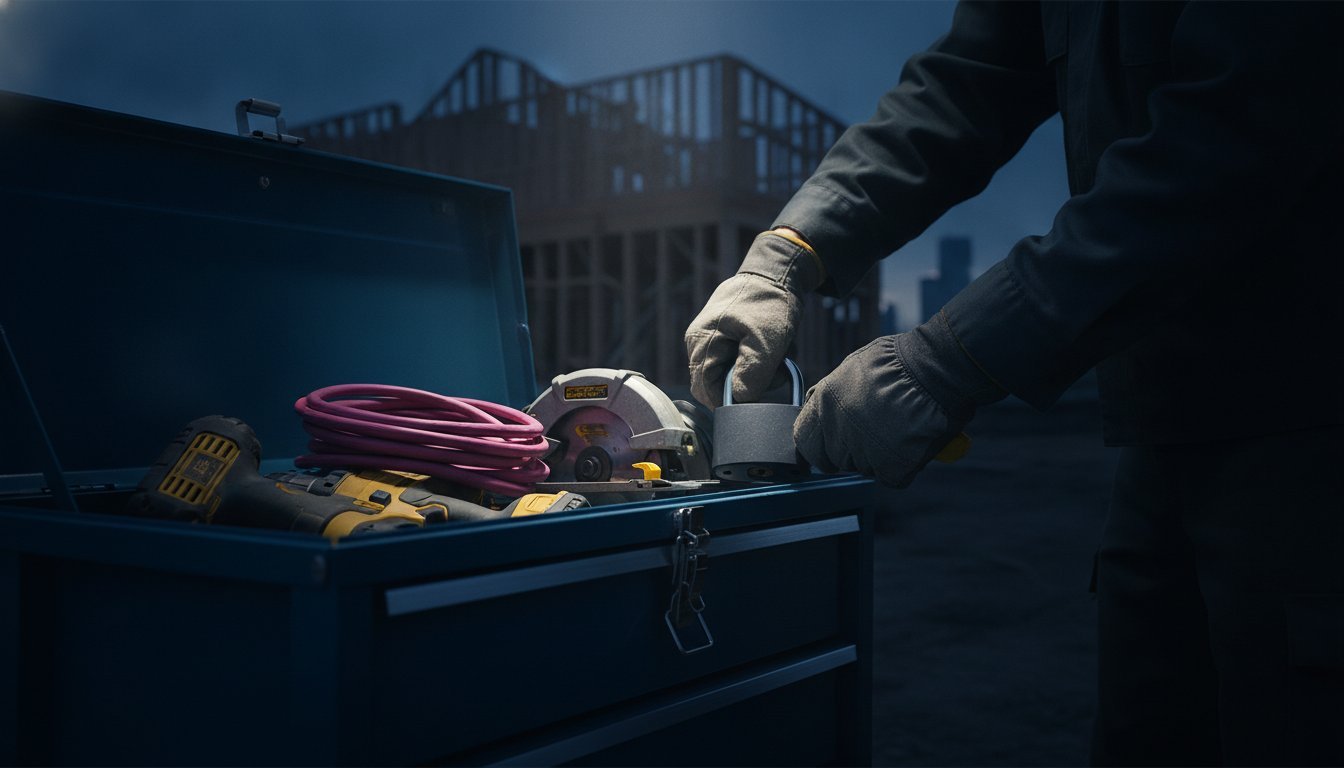
Did you know that if a thief walks off with your reciprocating saw tonight, there is less than a 7% chance you’ll ever see it again? For most contractors, the cost of theft goes far beyond the price of a new tool. It’s the sting of replacing expensive Bosch blades, the frustration of project delays caused by missing extension cords, and the slow drain of insurance premiums that keep climbing. You work too hard to let a thief walk away with your hard-earned profit.
We understand that your equipment is your livelihood. That’s why we’ve put together this guide on construction tool theft prevention tips to help you secure any job site. You don’t need a massive security budget to protect your business; you just need a smarter, layered strategy. We’ll show you how to build a defense that deters criminals before they even step onto your site. This 2026 checklist provides the exact steps you need to ensure your crew stays accountable and your gear stays right where you left it.
Key Takeaways
- Learn why a layered security strategy is the only way to protect your profit in a market where theft costs the industry $1 billion annually.
- Discover how to establish a hard perimeter that serves as both a physical deterrent and a legal requirement for prosecution.
- Apply effective construction tool theft prevention tips by using visual identification techniques that make your equipment impossible to resell.
- Build a reliable inventory system to maintain total accountability for high-value gear like DeWALT FLEXTORQ bit sets and Bosch blades.
- Find out how personalized, high-visibility extension cords act as a permanent security investment for your daily operations.
Why Job Site Tool and Equipment Security is a $1 Billion Problem
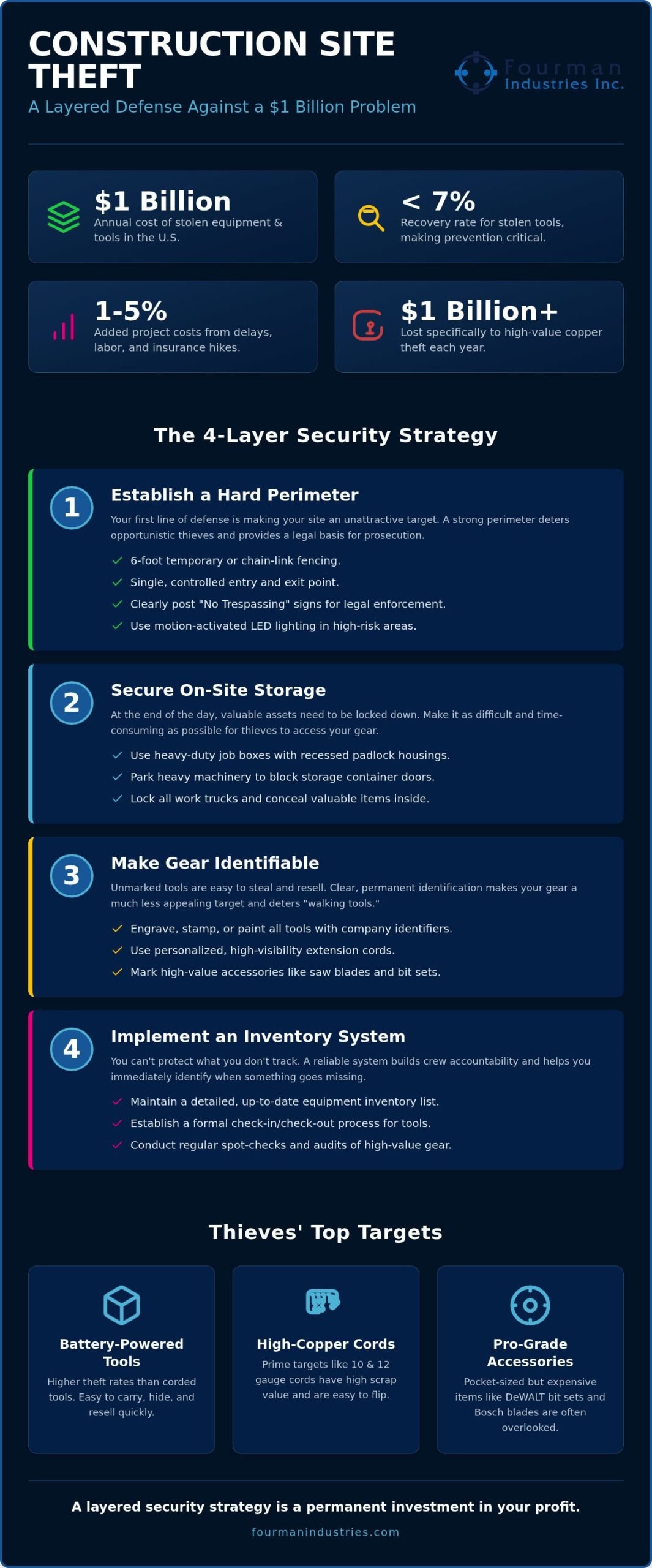
Construction theft isn’t just a nuisance; it’s a financial epidemic. By mid-2026, the annual cost of stolen equipment and tools in the U.S. has reached a staggering $1 billion. This doesn’t even factor in the additional $1 billion lost specifically to copper theft. When we look at the legal definition of theft, we see it as the unauthorized taking of property with the intent to deprive the owner of its use. On a job site, that deprivation happens in seconds. Effective construction tool theft prevention tips start by viewing security as a multi-layered defense strategy rather than just a single padlock on a gate.
Consider the “soft costs” that never show up on an insurance claim. When your crew arrives to find their primary extension cords or Bosch reciprocating saw blades missing, the project grinds to a halt. You pay for lost labor while your team waits for replacements. You face liquidated damages for missed deadlines. You deal with insurance premiums that spike after every small claim. These hidden factors can add between 1% and 5% to your total project costs, turning a profitable job into a break-even struggle.
The Psychology of ‘Walking Tools’
Most gear doesn’t vanish because of professional heist rings. It’s often “opportunistic” theft. A subcontractor from another crew sees an unmarked drill and decides it looks a lot like theirs. Without clear visual ownership, tools “walk” into the wrong trucks at the end of the shift. This lack of accountability creates a culture where expensive gear is treated as communal property. Implementing construction tool theft prevention tips is about more than just hardware; it’s about culture. When everyone knows that every piece of equipment is tracked and marked, the “accidental” theft rate drops significantly.
High-Value Targets on the Modern Site
Thieves are becoming more selective about what they grab. High-copper items like 10 Gauge ECONO extension cords and 12 Gauge SJTW Triple Tap extension cords are prime targets. They offer high scrap value and are incredibly easy to resell to other contractors. Battery-powered tools now have higher theft rates than corded alternatives because they are easy to hide and carry. Even small, professional-grade accessories are at risk. Items like DeWALT FLEXTORQ bit sets or premium saw blades are pocket-sized but carry a high replacement cost. Protecting these assets requires more than just a locked box; it requires a system that makes them recognizable from across the site.
Securing the Perimeter: Physical Barriers and Lighting
A secure job site starts at the property line. Your first goal is to make your site look like a “hard target.” This begins with high-quality, six-foot chain-link or temporary fencing. A flimsy perimeter invites trouble, but a solid barrier sends a clear message. To make this barrier effective, you must control the flow of traffic. Use a single entry and exit point for all personnel. This makes it much easier for site managers to spot unauthorized visitors or suspicious vehicles before they get close to your gear.
Physical barriers aren’t just about keeping people out; they are about legal protection. You must post “No Trespassing” signs at regular intervals along your fence. In many jurisdictions, these signs are a legal prerequisite for the police to prosecute intruders. Without them, a thief might claim they simply got lost. Establishing this legal boundary is a critical step in addressing the $1 billion problem of construction larceny. It gives law enforcement the teeth they need to make arrests stick.
Strategic Lighting Placement
Light is your best silent guardian. Thieves love the dark because it hides their faces and their movements. Focus your lighting on storage containers and piles of high-value materials. Motion-activated LED floodlights are often more effective than constant tower lighting. The sudden burst of light startles intruders and alerts neighbors or passing patrols that something is moving on-site. For security cameras to capture usable evidence, you should maintain a minimum light level of 1.0 Lux across all high-risk areas.
This level of security is especially vital when storing premium architectural features on-site; for example, handcrafted outdoor elements from USA Fire Bowls represent a significant investment that needs to be shielded from theft before being permanently installed in a backyard or pool area.
On-Site Storage Solutions
When the sun goes down, your most valuable assets should be under lock and key. Use heavy-duty job boxes with recessed lock housings. These designs make it nearly impossible for a thief to use bolt cutters or saws on the padlock. For larger equipment, use the “last in, first out” rule. Park your heavy machinery, like skid steers or backhoes, directly in front of your storage container doors. This creates a massive physical obstacle that no thief can move quietly.
For contractors looking to reduce the footprint of owned assets on a job site, utilizing a rental service like pahrumprentals.com offers a practical solution by providing industrial tools that can be returned immediately after a project phase, thus removing the target for thieves.
Don’t forget about the small but essential gear inside your work trucks. Items like a Portable 12v Tire Inflator Kit or a Truck & Car Battery Jump Starter are frequently targeted in “smash and grab” thefts. Store these inside locked cabs or secondary toolboxes rather than leaving them on the seat. While these construction tool theft prevention tips harden your site, you can also make your equipment less attractive to thieves by using personalized extension cords that are too recognizable to resell.
Visual Identification: The Power of Personalized Gear
Thieves look for the path of least resistance. They want gear they can move quickly at a pawn shop or sell to another contractor without raising eyebrows. When you apply visual identification to your equipment, you destroy that resale value. A tool with a company name etched into the casing or a cord with permanent printing is a hot potato. Most criminals won’t touch it because it serves as rolling evidence of a crime. This strategy is a cornerstone of modern construction site security and theft prevention.
Temporary markings like colored electrical tape or spray paint are better than nothing, but they don’t last. A thief with a bottle of solvent or a pocket knife can remove those marks in minutes. Permanent identification is different. It tells everyone on the site exactly who owns that equipment. It also helps project managers spot unauthorized gear movement from a distance. If you see a crew using gear that doesn’t match their assigned color code, you can address the issue immediately before the equipment disappears into a truck bed.
Why Custom Printed Extension Cords Prevent Theft
Extension cords are some of the most frequently stolen items because they are high in copper and easy to grab. However, custom extension cords change the game. Unlike spray paint, factory-printed names are embedded into the cord jacket. They survive the brutal wear and tear of a concrete slab or a muddy trench. When your company name appears every 12 inches along the entire length of the cord, it’s impossible to ignore. This creates a massive psychological deterrent for anyone thinking about walking off with your property. It also stops “accidental” theft between different crews. If a subcontractor sees your name on the cord they just picked up, they are much more likely to put it back where it belongs.
High-Visibility Colors as a Deterrent
Standard yellow or orange cords blend into the background of a busy site. To truly protect your assets, you need to stand out. Using unique colors like pink or purple for your 12 gauge SJTW triple tap cords makes them instantly recognizable. Professional thieves avoid these unconventional colors. They are too easy for police to identify in the back of a van or at a scrap yard. These colors also improve safety by making trip hazards more visible to your crew during the workday. Following these construction tool theft prevention tips ensures your gear is a liability for thieves but a reliable asset for your team.
Management Systems: Tracking and Inventory Checklists
Physical locks only work if someone remembers to use them. To truly protect your site, you need a management system that creates a clear paper trail for every piece of equipment. Start by creating a master inventory list. This document should include high-resolution photos, serial numbers, and the date of purchase for every major tool in your fleet. If a theft occurs, having this data ready increases the chances of recovery from the dismal 7% industry average for small tools. Digital tools make this easier than ever. In 2026, many contractors use Bluetooth tracking tags or simple cloud-based spreadsheets to monitor their high-value assets in real time.
Implementing a “Check-In, Check-Out” system is essential for small, expensive items that often go missing. High-value accessories like DeWALT FLEXTORQ bit sets or specialized Bosch blades should be assigned to specific crew members. When a worker is personally responsible for a kit, they are much less likely to leave it sitting on a sawhorse at the end of the day. By following these construction tool theft prevention tips, you turn your inventory from a liability into a controlled asset.
The Daily Security Walkthrough
Consistency is the enemy of the thief. Establish a 10-minute security routine for your foremen at the end of every shift. This walkthrough should verify that all gang boxes are locked and that truck-mounted gear, such as car battery jump starters and tire inflator kits, is secured inside the cab. Pay special attention to your power distribution. Coiling and locking up 100-foot 12 gauge extension cords prevents them from becoming easy targets for late-night scrap hunters. To make your daily inventory even faster, order personalized extension cords that your team can identify at a glance.
Employee and Subcontractor Policies
Clear expectations prevent “accidental” theft. Include specific tool care clauses in your employment contracts and subcontractor agreements. Some firms find success with a “Tool Allowance” model, where employees own their primary hand tools but receive a stipend for maintenance. This naturally encourages better care. If you provide the tools, ensure your reporting process for missing gear is straightforward. You want to know about a missing drill immediately, not three days later when the trail has gone cold. Accountability works best when it is built on clear communication rather than a culture of fear.
Building a Secure Kit with Professional-Grade Equipment
High-quality tools are an investment in your company’s efficiency. When you buy premium gear like Bosch reciprocating saw blades, you expect them to handle the toughest cuts on the site. However, the better the tool, the more attractive it is to a thief. There is a direct relationship between the quality of your kit and the effort you must put into your construction tool theft prevention tips. If you are willing to pay for the best performance, you must be equally willing to protect that performance with a rigid security protocol.
Standardizing your equipment is one of the most effective ways to make inventory management faster and more accurate. When every crew uses the same brand of power tools and the same gauge of cords, your foremen can spot a missing item in seconds. This consistency allows for a “visual sweep” of the site. If a truck is supposed to have four chargers and only three are visible during the evening load-out, the discrepancy is obvious. Standardization removes the guesswork and ensures that your security checks are methodical rather than random.
Securing High-Value Consumables
Small-format professional accessories are often overlooked in security plans, yet they are the most frequently stolen items on a modern job site. Bit sets and blades are easy to pocket and carry a high resale value at local flea markets or online. You need a specific storage strategy for these items. Don’t leave them loose in a truck bed or a tool bag. Instead, keep them in dedicated, lockable organizers that stay inside your primary gang box. Consider the ROI of your time; preventing the theft of just one DeWALT FLEXTORQ bit set pays for the time your crew spends on a week’s worth of security walkthroughs.
The All-in-One Security Mindset
Effective security is a triad of three distinct layers: Visual, Physical, and Policy. Visual deterrents like high-visibility colors make your gear a liability for thieves. Physical barriers like recessed locks and fencing provide the hard defense. Finally, clear management policies ensure that your crew stays accountable for every asset. You have to treat every 10 Gauge ECONO cord as a critical business asset, not a disposable commodity. When you stop viewing tools as easily replaceable, your entire team adopts a more protective culture.
Moving from a reactive “replacement” mindset to a proactive “prevention” mindset is the only way to protect your profit margins in 2026. A thief shouldn’t be the one deciding when you need to buy new gear. Take control of your inventory today. Protect your site with custom branded gear from Fourman Industries and make sure your tools stay in your hands until the job is done.
Protect Your Profit and Lock Down Your Job Site
You’ve worked hard to build your business. Don’t let a thief take a bite out of your bottom line. By combining physical barriers like recessed locks with a strict inventory management system, you’ve already won half the battle. Remember that the best construction tool theft prevention tips focus on making your gear a liability for criminals. When your tools are easily identifiable and your site is well-lit, you create an environment that professional thieves simply want to avoid. Consistency in your daily walkthroughs ensures that your security stays as strong as your workmanship.
Visual ownership is your strongest defense. We have been serving the industry since 1997 with heavy-duty, UL certified power solutions built for the toughest sites. Our permanent factory imprinting won’t rub off like spray paint or tape; it ensures your name stays on your gear for the life of the tool. Secure your gear with custom printed extension cords from Fourman Industries and stop being an easy target. Taking these steps today protects your crew, your schedule, and your reputation. You have the tools to build a secure future for your company. Stay safe out there and keep your gear right where it belongs.
Frequently Asked Questions
What are the most commonly stolen tools on construction sites?
Power drills, impact drivers, and reciprocating saws are the most targeted items on any site. Thieves also hunt for high-copper assets like heavy-duty extension cords. Because these items are easy to carry and have high resale value, they disappear within seconds if left unattended. Keeping a specific focus on these high-traffic items is a core part of effective construction tool theft prevention tips.
Does marking my tools with spray paint actually prevent theft?
Spray paint provides a basic visual deterrent, but it’s often temporary. Thieves can use solvents or sandpaper to remove paint in minutes. For a more permanent solution, look for gear with factory-printed identification. These marks survive heavy site wear and can’t be wiped off, making the tool much harder to sell at a pawn shop or to other contractors.
How can I prove a tool is mine if the serial number is defaced?
You can prove ownership by using hidden identifiers or unique customizations that are difficult to remove. Etch your company name into the tool housing in an inconspicuous spot or use distinct colors like pink or purple for your power leads. If you have photos of these unique markings in your master inventory list, law enforcement can verify the equipment is yours even if the main serial number plate is gone.
Is it worth putting GPS trackers on small power tools?
It is worth using Bluetooth or GPS tags for any tool or kit that costs more than a few hundred dollars to replace. While a single screwdriver doesn’t need a tracker, a full DeWALT FLEXTORQ bit set or a high-end cordless circular saw is a different story. These tags increase the recovery rate, which is currently less than 7% for small tools, by providing real-time location data to the authorities.
What should I do immediately after discovering tools have been stolen?
Call the local police immediately to file a report and get a case number for your insurance claim. Document the scene with photos and check if any neighboring businesses have security footage. Next, update your master inventory list and notify local pawn shops or scrap yards to watch for your marked gear. Quick action is your best chance for a successful recovery before the items are moved.
Can custom-printed extension cords really stop people from taking them?
Custom-printed extension cords are an incredibly effective deterrent because they are too recognizable to steal. When your name is printed every 12 inches along the cord, a thief can’t claim it as their own or sell it easily. This permanent identification stops accidental theft between different crews and makes your equipment a liability for anyone who shouldn’t have it in their truck.
Are battery-powered tools more likely to be stolen than corded ones?
Battery-powered tools are stolen significantly more often than corded models in 2026. They are easier to grab and run with, and the batteries themselves are high-value items that are easy to resell. While corded tools are heavier and require a power source to test, cordless gear is the primary target for both opportunistic thieves and professional theft rings looking for a quick payout.
How do I secure tools in an open truck bed?
You should never leave expensive tools loose in an open bed; instead, install a heavy-duty, bolted-down cross-bed toolbox with a recessed lock. If you must carry larger items, use high-test security chains and thick padlocks to anchor them to the truck frame. For smaller, portable gear like a tire inflator kit or a jump starter, the safest place is locked inside the cab and out of sight.




