
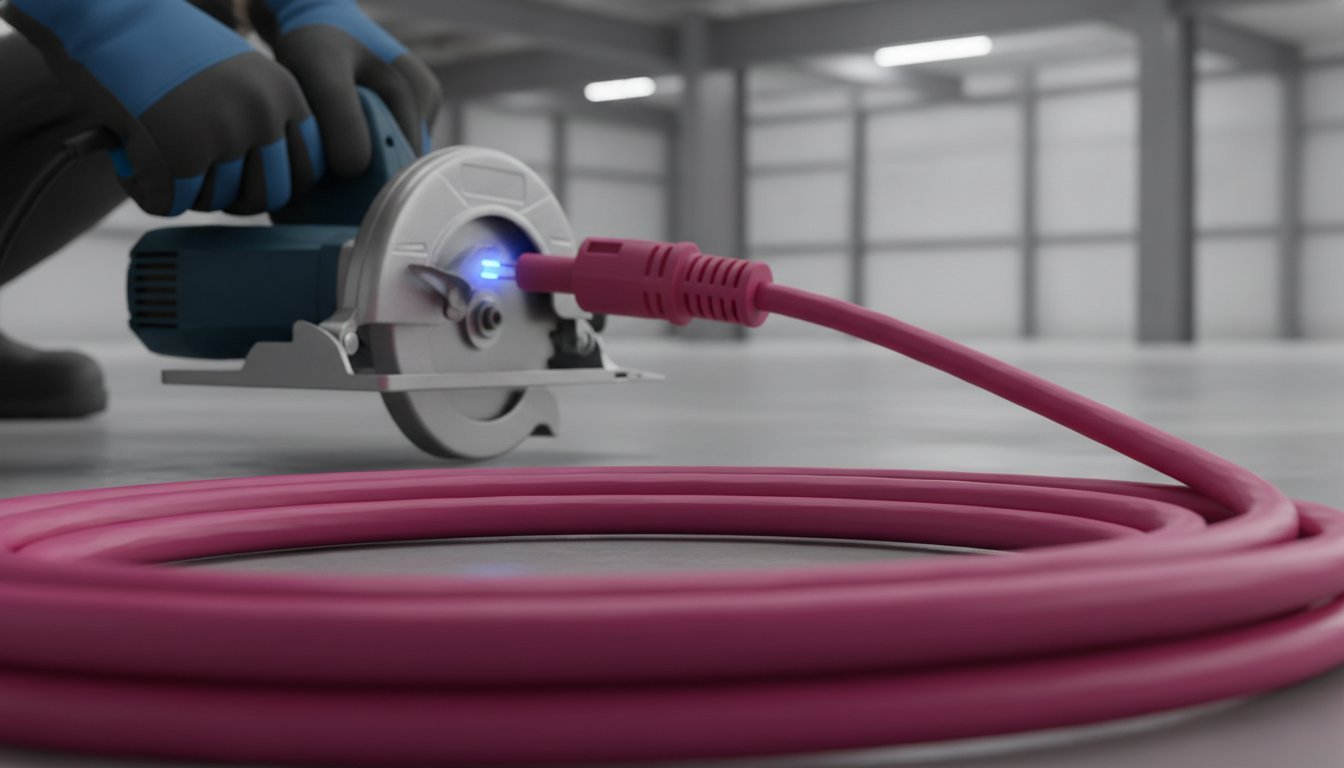
Your equipment is only as reliable as the cable feeding it. Most crews treat their outdoor extension cord like an afterthought until a tool motor burns out or a 100-foot line vanishes from the job site. It’s frustrating to watch your productivity stall because of a cheap, cracked jacket or a voltage drop that starves your saw of the power it needs. You deserve a setup that works as hard as you do without the constant fear of equipment failure or theft.
We’re here to help you master the technical side of professional power so you can keep your project moving. In this guide, you’ll learn how to identify the exact gauge required for your heavy-duty tools and ensure every inch of your gear meets the 2026 NEC and OSHA safety standards. We’ll also show you how custom branding and high-visibility colors like pink or purple can practically eliminate cord theft on busy sites. From understanding SJTW jacket ratings to preventing cold-weather tangles, you’re about to get the straight talk on high-performance power solutions that won’t let you down when the pressure is on.
Key Takeaways
- Learn why the SJTW rating is the gold standard for your outdoor extension cord to ensure it survives harsh weather and rough handling.
- Stop tool motor damage by choosing the right wire gauge to prevent voltage drop over long distances.
- End job site theft with custom-printed jackets and high-visibility colors that make your gear impossible to “borrow.”
- Stay OSHA compliant and safe by using GFCI protection and proper locking mechanisms in damp environments.
- Find out why heavy-duty 12 gauge triple tap cords provide the reliability needed for high-demand industrial tools.
Understanding Outdoor Extension Cord Ratings and SJTW Standards
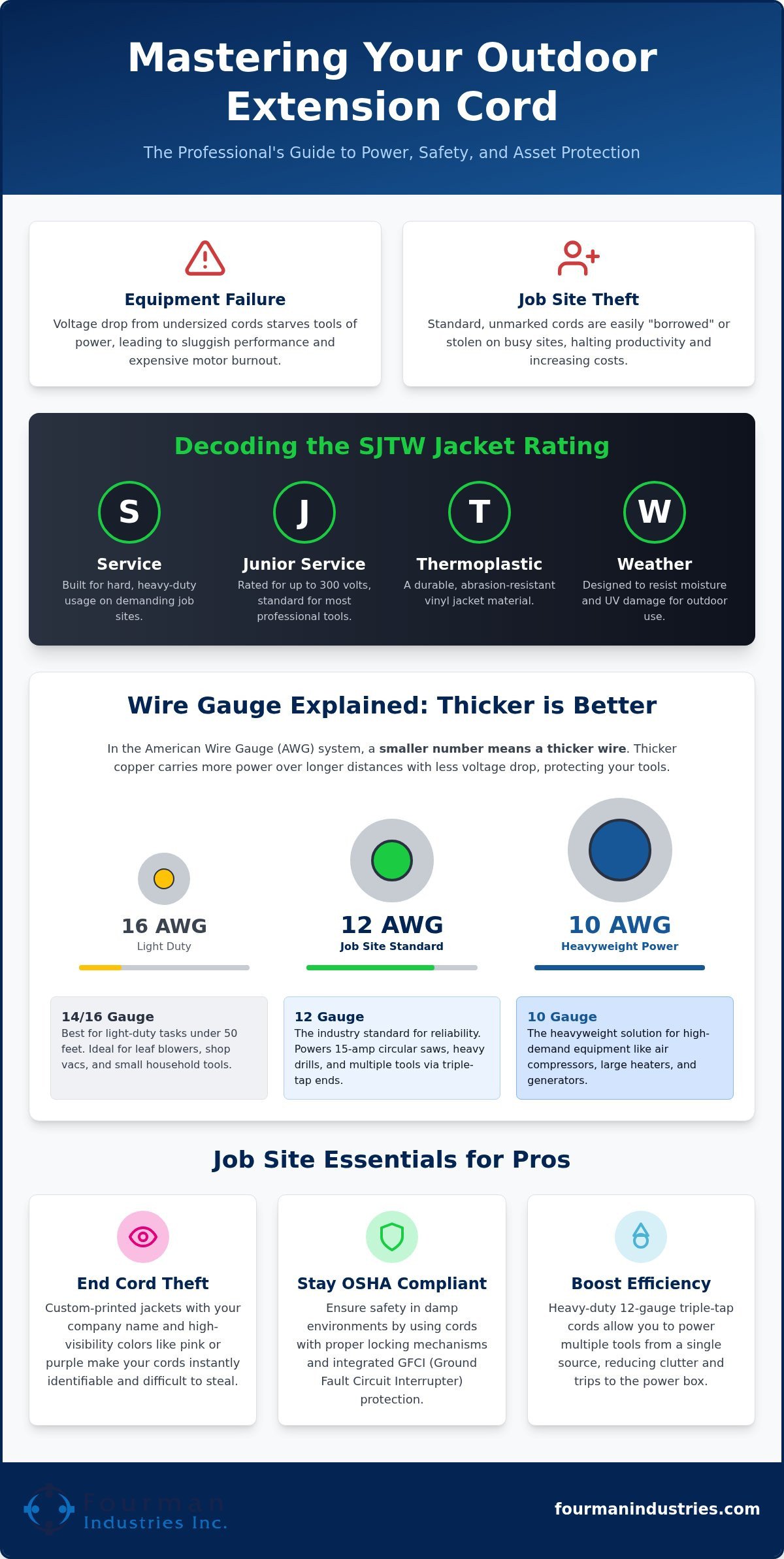
Choosing the right outdoor extension cord isn’t about grabbing the cheapest orange reel at the big box store. It’s about understanding the code stamped right on the jacket. You will see letters like SJTW. That isn’t just alphabet soup; it’s a blueprint for safety. “S” stands for Service, meaning it is built for hard usage. “J” stands for Junior, which indicates a 300-volt rating. “T” tells you it has a Thermoplastic jacket, and “W” confirms it’s Weather-resistant. These extension cord standards ensure your power stays consistent when the clouds open up.
Don’t ever swap an indoor cord for an outdoor one. Indoor jackets are thin and porous. When they sit in damp grass or puddles, moisture seeps in. This creates a massive fire risk or a shock hazard for anyone nearby. Professional-grade power is a different beast entirely. While residential cords might handle a desk lamp, a professional outdoor extension cord is engineered to survive the abuse of a job site. It’s the difference between a tool that lasts a decade and one that burns out in a month. UL certification is your proof that the cord has been tested to meet national safety standards. Look for that mark before you plug in.
The Anatomy of an Outdoor-Rated Jacket
The outer layer of a high-quality cord is its first line of defense. Thermoplastic insulation is designed to reflect UV rays so the jacket doesn’t get brittle and crack under the summer sun. It also keeps moisture away from the copper strands. Just remember that “Weather-resistant” doesn’t mean “Submersible.” Don’t leave your cords at the bottom of a pond. These jackets are also built to handle abrasion. Whether you’re dragging it over rough concrete or jagged gravel, a pro-grade jacket stays intact to protect the internal wiring.
Why Voltage Drop is Your Equipment’s Worst Enemy
If your saw sounds sluggish or your drill is running hot, you likely have a power delivery problem. Long runs of thin wire cause the electricity to struggle. This leads to motor burnout, which is an expensive mistake. You can spot an underpowered tool by listening for unusual noise or feeling excess heat near the motor housing. Voltage drop is the decrease in electrical potential along the path of a current. When the voltage drops too low, your tools have to work twice as hard to do the same job. This extra strain kills equipment fast.
Gauge and Amperage: Choosing Between 10 and 12 Gauge Cords
The American Wire Gauge (AWG) system often feels backwards to those outside the trade. In this world, smaller numbers mean thicker copper. A 12-gauge wire is significantly beefier than a 14-gauge one. This thickness matters because every foot of wire adds resistance. If you’re running a 100-foot outdoor extension cord, you need that extra copper to push power to the end of the line without losing it as heat. Standard 14 or 16 gauge cords you find in retail stores are fine for a leaf blower or a shop vac, but they’ll starve a professional circular saw. Following Extension Cord Safety Tips means matching your cord’s capacity to your tool’s amperage draw to prevent overheating.
Length is the hidden factor in this equation. A 50-foot cord might deliver enough juice, but doubling that distance to 100 feet increases the electrical resistance. This is where voltage drop becomes a real threat to your bottom line. If you don’t increase the thickness of the wire as you increase the length, the tool motor has to work harder. This generates internal heat and leads to premature equipment failure. You aren’t just buying a wire; you’re buying insurance for your expensive gear.
The 12 Gauge Standard for Job Sites
For most daily tasks on a construction site, a 12/3 cord is the industry sweet spot. It comfortably handles the 15-amp draw of circular saws and heavy drills without breaking a sweat. Our 12 Gauge SJTW Triple Tap Extension Cords take efficiency a step further. The triple tap design lets you run a saw, a battery charger, and a work light from one single source. This reduces the number of trips back to the power box and keeps the floor clear of extra cables. These cords are built with a high-quality SJTW jacket that stays flexible even when the temperature drops below freezing. If you need a reliable daily driver that won’t fight you in the cold, consider our professional 12-gauge cords for your next project.
10 Gauge: The Heavyweight Solution for Generators
When you step up to air compressors, large space heaters, or portable generators, 12 gauge is no longer enough. You need the 10 Gauge ECONO series. These heavyweight cords use the thickest copper available in standard portable power to prevent “nuisance tripping.” This happens when your breaker pops because the wire is too thin to handle the massive initial surge of a large motor starting up. Thicker copper stays cooler and ensures your tools get every bit of the 120 volts they require. For industrial crews, investing in 10-gauge wire is a smart long-term play. It protects your machinery from the slow death caused by low voltage and keeps the job moving without constant interruptions.
Asset Protection: Preventing Theft with Custom Printed Cords
Walk onto any job site and you’ll see a tangled mess of yellow and orange cables. It is a sea of anonymity. This is exactly why your outdoor extension cord goes missing. When every cable looks the same, “borrowing” becomes a habit, and your equipment ends up in someone else’s truck. Theft and loss aren’t just annoyances; they are direct hits to your profit margin. Custom Printed Extension Cords solve this by making ownership undeniable. By printing your company name directly on the jacket, you create a permanent mark that can’t be easily rubbed off or ignored.
Branding your gear changes the psychology of the job site. A thief or a disorganized subcontractor is much less likely to walk off with a cord that clearly belongs to someone else. It’s about marking your territory and protecting your investment. Beyond theft, Personalized Extension cords allow you to streamline gear management for large crews. You can stop the morning headache of sorting through piles of tangled wire. Assigning specific colors or printed labels to different teams ensures everyone is responsible for their own kit. For a deeper look at how to keep your cables organized and your crew safe, see our complete guide on job site extension cord management.
Why Pink and Purple Cords are a Professional Power Move
Standing out is a survival strategy. In a sea of standard high-visibility colors, pink extension cords built for heavy-duty job site use and Purple extension cords are impossible to miss. They act as an immediate visual deterrent. No one “accidentally” packs a bright pink cord into their toolbox at the end of the shift. These unique colors also help you organize your site by task or crew. You might use purple for the framing crew and pink for the electricians. This level of organization keeps your site running like a well-oiled machine. The printing on these jackets is designed for the real world. It resists the daily abrasion of being dragged across concrete and gravel, ensuring your name stays visible for the life of the cord.
Branding Your Gear for Better Business
Think of your gear as a walking billboard. When you’re working in a residential neighborhood or a high-traffic commercial site, your cords are often the most visible part of your setup. Having your company name printed on every outdoor extension cord projects an image of professionalism and attention to detail. It tells clients that you’re an established business that invests in quality. Some industry professionals report that branding gear in this way can significantly reduce annual replacement costs by keeping assets on the right truck. This creates a cohesive, professional look for event production or construction teams. It is a simple, cost-effective way to build your brand while keeping your tools where they belong: in your hands.
Safety Protocols and Maintenance for Outdoor Power
Safety isn’t just a checkbox on a form. It’s what keeps your crew working and your project on schedule. When you’re using an outdoor extension cord in damp or unpredictable conditions, GFCI (Ground Fault Circuit Interrupter) protection is your most important ally. A GFCI monitors the flow of electricity and shuts it down instantly if it detects a leak. This prevents fatal shocks before they can happen. Don’t rely on luck. Test your GFCI outlets or inline protectors every morning before you plug in your first tool.
Maintenance starts with a simple visual check. Run your hand down the length of the cable before every shift. If you feel a “hot spot” or spot a nick in the jacket, pull that cord out of service immediately. A hot spot is a sign that the internal copper strands are frayed and struggling to carry the electrical load. This generates intense heat that can melt the insulation from the inside out. It’s a fire waiting to happen. For gear that stands up to this level of professional scrutiny, invest in our heavy-duty 10 gauge and 12 gauge cords built for the toughest environments.
Weatherproofing Your Connections
Keep your plugs dry to avoid short circuits. A dedicated extension cord lock or a weatherproof cover prevents moisture from bridging the connection between two cables. Never use electrical tape to “seal” a connection for a permanent outdoor fix. Tape actually traps moisture against the metal prongs and creates a hidden corrosion point. When it’s time to pack up, use the “over-under” coiling method. This prevents the internal copper from developing “memory” kinks that lead to tangles and eventual breakage.
OSHA Compliance for Professional Job Sites
OSHA regulations are clear about workplace safety for a reason. That third grounding prong is a lifesaver. Never clip it off to force a fit into an old two-slot outlet. Without that ground, a tool’s metal casing could become live during a fault. OSHA requires all extension cords used on construction sites to be of the three-wire type and designed for hard or extra-hard usage. Under the 2026 standards, if the outer jacket is compromised, you should replace the cord rather than attempting a temporary patch. Keeping your site compliant keeps your team safe and your business protected from heavy fines. Our guide on organizing and protecting your job site extension cords covers additional OSHA-aligned best practices to help you stay ahead of inspections.
Fourman Industries: The Source for Professional Outdoor Power
Reliability isn’t something you can fake. Since 1997, Fourman Industries has built a reputation on providing the kind of gear that thrives in the mud, rain, and grit of a real job site. We understand that your outdoor extension cord is the literal lifeline for your business. Whether you are driving a Bosch Reciprocating Saw through heavy timber or using a DeWALT FLEXTORQ Bit Set for precision fastening, you need a power source that delivers every amp without hesitation. We don’t just sell cables; we provide the foundation for your most important projects.
For the independent contractor, every lost tool is a hit to the bottom line. That is why our commitment to customization is more than just a marketing gimmick. It’s a practical solution to a decades-old problem. By combining high-performance copper with your company’s unique branding, we help you reclaim your gear and your professional identity. You shouldn’t have to worry about your equipment walking off while you’re focused on the task at hand. We make it easy to secure your kit and get back to work.
The Fourman Advantage: Quality Meets Customization
Our 12 Gauge SJTW Triple Tap Extension Cords are the flagship of our lineup for a reason. They offer the perfect balance of flexibility and ruggedness for daily professional use. If your equipment demands even more juice, our 10 Gauge ECONO Extension Cords provide the heavyweight power needed for air compressors and large heaters. We take pride in our fast turnaround times. Even with custom printing, we offer national shipping to ensure your personalized setup arrives before your next big contract starts. Ordering is direct and efficient: choose your gauge, select your color, and tell us what to print.
Beyond Cords: Your Roadside and Workshop Partner
We know that the job doesn’t end when the sun goes down or the project moves off-site. Fourman Industries is your partner for every part of the workday. Our inventory includes essential roadside gear like the Truck & Car Battery Jump Starter and the Portable 12v Tire Inflator Kit to keep your fleet moving. For professionals who appreciate custom craftsmanship in their personal ride, Fat Boy Design USA provides specialized motorcycle components built with the same focus on durability. We also stock professional accessories like Bosch Reciprocating Saw Blades to ensure you always have the right edge. Buying from a business with deep industry roots means you get more than a product; you get a partner who knows the trade. Secure your gear today and protect the investment you’ve worked so hard to build.
Power Your Success with Smarter Gear
Your job site shouldn’t be a place where expensive equipment goes to die or disappear. You now have the knowledge to choose the right gauge and understand the SJTW safety standards that keep your crew out of harm’s way. Selecting the perfect outdoor extension cord is about more than just reaching the nearest outlet. It’s about matching the copper to your power needs and protecting your motor-driven tools from the slow death of voltage drop. High-quality 10G and 12G options ensure that your saws and compressors get the full power they require to perform at their peak.
Don’t let your gear become an easy target for theft. Custom branding is a practical, blue-collar solution to keep your assets on your truck where they belong. Since 1997, we’ve focused on delivering rugged, professional-grade power that stands up to the daily grind. Whether you choose a high-visibility pink extension cord or a personalized 12-gauge triple tap, you’re investing in your business’s long-term efficiency. Take the guesswork out of your power setup and keep your projects moving without interruption.
Browse our Heavy-Duty Custom Printed Extension Cords and Protect Your Gear and secure your equipment today. You’ve worked hard to build your business; make sure your gear works just as hard for you.
Frequently Asked Questions
Can I use an outdoor extension cord inside my home?
You can safely use an outdoor extension cord inside your home, but it is usually less convenient than a standard indoor cord. Outdoor jackets are thicker and stiffer, which makes them harder to route around furniture or through doorways. However, if you need to power a high-draw appliance temporarily, the extra durability of an outdoor-rated cable provides a higher safety margin than a thin indoor zip cord.
How do I know if my extension cord is 12 gauge or 14 gauge?
Check the jacket of the cable for embossed or printed text that indicates the gauge. You will typically see a sequence like “12/3” or “14/3” where the first number represents the American Wire Gauge (AWG). If the text is worn off, a 12-gauge cord is noticeably thicker and heavier than a 14-gauge one because it contains more copper to handle higher amperage.
What does the SJTW rating on my extension cord actually mean?
The SJTW rating identifies the specific construction and environmental durability of the cable. “S” stands for Service, “J” means Junior (rated for 300 volts), “T” indicates a Thermoplastic jacket, and “W” confirms it is Weather-resistant. This rating ensures your outdoor extension cord can handle moisture and sunlight without the insulation cracking or breaking down over time.
How long can an outdoor extension cord be before losing power?
Voltage drop typically becomes a significant problem once a cord exceeds 100 feet. To minimize power loss over long distances, you must use a thicker wire gauge, such as 10 or 12 AWG. Using a thin 16-gauge cord for a long run will starve your tools of the voltage they need, which often leads to overheating and permanent motor damage.
Is it safe to run a space heater or air conditioner on an outdoor cord?
It is only safe if the cord’s gauge and amperage rating match or exceed the appliance’s requirements. Most space heaters draw 15 amps, which demands a heavy-duty 12-gauge or 10-gauge cord to prevent the wire from overheating. Never plug high-wattage appliances into standard 14 or 16-gauge retail cords, as this is a leading cause of electrical fires.
How do I prevent my extension cords from being stolen on a job site?
The most effective deterrent is making your gear impossible to mistake for someone else’s. Use custom printing to put your company name directly on the cord jacket and opt for high-visibility colors like pink or purple. These unique colors stand out in a sea of standard yellow and orange, making it very difficult for anyone to “accidentally” walk off with your equipment.
Can I leave an outdoor extension cord plugged in during the winter?
Yes, you can leave it plugged in as long as the cord has a weather-resistant rating like SJTW or SOOW. These materials are engineered to stay flexible and resist cracking even in sub-zero temperatures. Always ensure that the plug connections are kept off the frozen ground and protected from melting snow using a weatherproof cover or cord lock.
What is the difference between a 2-prong and 3-prong outdoor cord?
A 3-prong cord includes a dedicated grounding wire that provides a safe path for electricity during a short circuit. For outdoor projects and power tools, you should never use a 2-prong cord. The third prong is a critical safety feature that prevents the metal housing of your tools from becoming electrified, which protects you from potentially fatal shocks.




